
Munich Airport S1 or S8: Which Line Fits Your Hotel?
Munich Airport has two S-Bahn routes into town. Choose S1 or S8 by your hotel stop, travel hour and ticket zones instead of following the first train you see.
Travel tips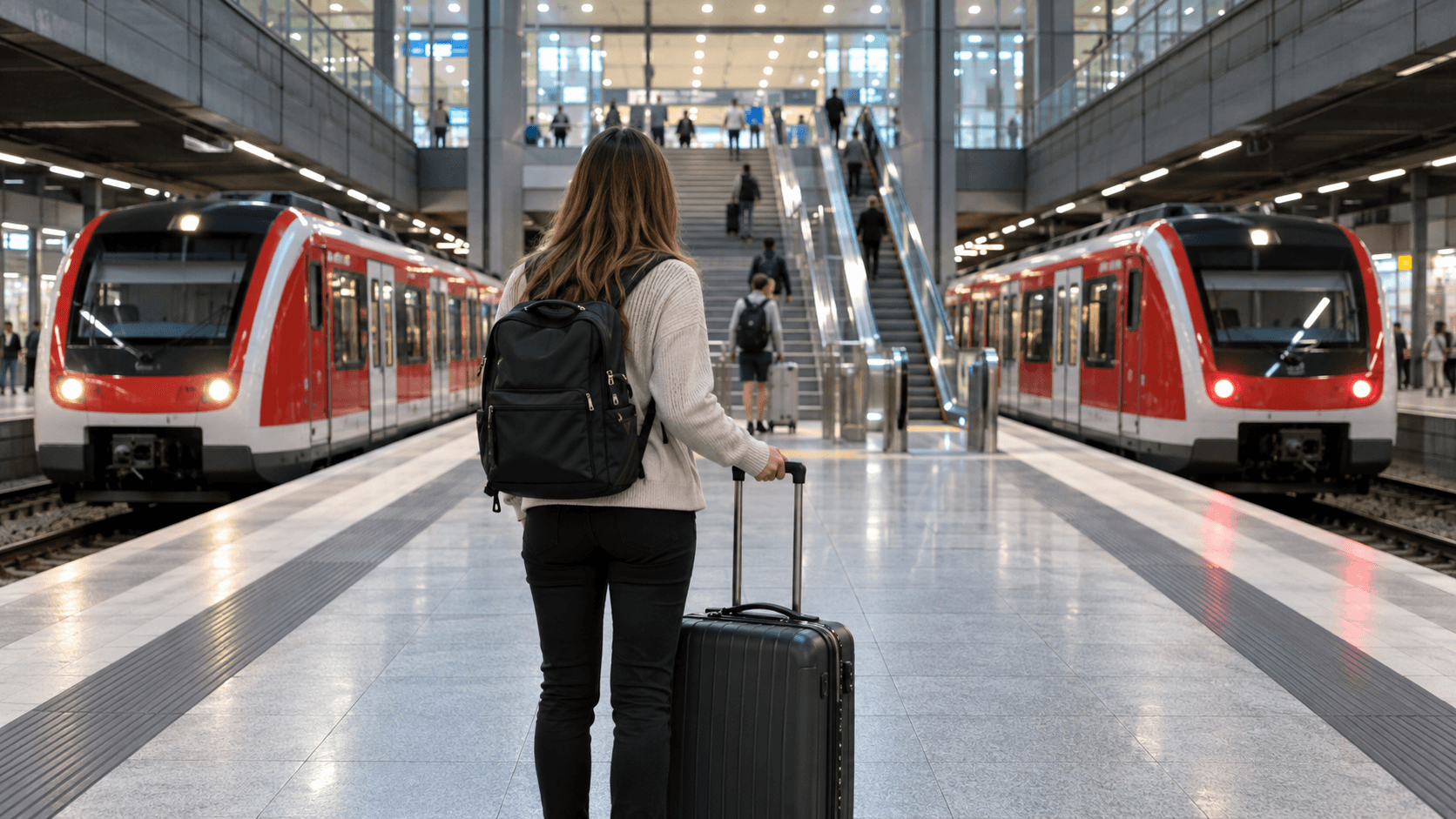
At a glance
- City route
- S1 via the west; S8 via the east
- Central station
- About 40 minutes from the airport
- Airport ticket zones
- M–5 for a trip between the city and airport
Arriving in Munich for an autumn city break, you can face two S-Bahn departures that both advertise a connection to the centre. The useful question is not which train is universally faster. It is which side of the city your hotel or onward train sits on. Munich Airport says S1 goes via the west and S8 via the east, while both connect the airport with the city. Make the decision from your actual destination, departure time and any live disruption notice.
Start with the stop you actually need
If your reservation gives only a hotel name, find its nearest S-Bahn, U-Bahn or tram stop before you reach the airport platform. A station name is more useful than a broad district label. Enter the airport and that stop into the MVV journey planner; check the suggested platform, direction, transfer and final walking leg. A route that reaches Hauptbahnhof quickly can still be the slower door-to-door choice if it sends you back across the city. This is especially true with a suitcase or when a connection requires stairs or a long platform change.
The broad geography is simple. S1 approaches central Munich through the western side, via Moosach. S8 approaches through the eastern side, via Ostbahnhof. The airport puts the journey to the central station at about 40 minutes, so that headline duration does not create a meaningful winner for every address. Some city-centre stops are served by both directions on the shared core. For those, the next suitable departure often matters more than the letter on the train. For a stop on one outer branch, choosing the direct line may avoid a transfer. Verify the current station list in the planner rather than assuming a map you saved months ago still reflects a normal operating day.
When S1 is the practical choice
Choose S1 when your mapped destination lies on its western approach, especially if the planner shows a direct arrival or an easy transfer at a western interchange. This is a hotel-stop decision, not a recommendation to ride S1 for every west-of-centre address: a different connection may still work better when a service is delayed. The airport describes S1 as running via Moosach. It lists a usual 20-minute frequency from roughly 3 a.m. to midnight, with continuous service on weekends and holidays. These are published patterns, not a promise for the moment you land. Check the actual departure board after baggage reclaim.
There is also a subtle airport-to-city versus city-to-airport difference. When you are departing, a train labelled for the airport must be the correct branch and current service, not merely a train on the western line. Check the destination display and the planner's platform information. When you are arriving, both airport S-Bahn lines use the station named Flughafen München, so focus on your city stop and change point. The airport lists Besucherpark separately; that stop serves airport administration and parking areas and is not the terminal station most arriving passengers want.
When S8 fits better
S8 is the first route to test for an eastern hotel stop or an onward connection around Ostbahnhof. The airport identifies it as the eastern route and says it has continuous service, including overnight. Its stated overnight interval is about 40 minutes from roughly 1 a.m. to 4 a.m.; otherwise the line normally runs about every 20 minutes. A late landing therefore requires more attention to the exact departure time than a daytime arrival. Do not count on turning up at the platform and waiting only a few minutes during that overnight window.
For a central hotel, compare the real itinerary shown for both lines. An S8 departure in two minutes can beat a theoretically more convenient S1 departure much later, provided the route reaches your stop or offers a sensible connection. Reverse that logic if S8 would require a backtrack. The airport says the two lines alternate to give roughly a ten-minute combined interval between the airport and the city during regular operation. That combined pattern should not be treated as a guarantee during disruptions or at every time of night.
Find the station and buy a ticket for the full trip
At the airport, follow the S-Bahn signs to the station below the Munich Airport Center. The airport's transport FAQ places the station at MAC level 02 and describes escalator and lift access to the terminal level. Allow walking time from the arrival gate, passport control and baggage reclaim before treating a journey-planner departure as catchable. Terminal 2 users cross the airport-centre area; the path from the train is not the same as stepping straight from the aircraft onto the platform.
A ticket must cover the zones for both the airport and the destination. The MVV 2026 airport timetable specifies M–5 for travel between Munich city and the airport. Its example single day ticket for M–5 costs €17.50 and the group day ticket €32.60. At ECB reference rates on 23 October 2026, those day-ticket examples were approximately US$19.59 and US$36.49 respectively; exchange rates and card charges can change. The day ticket is valid until 6 a.m. the following day for journeys within its zones, including other MVV modes. Those figures are 2026 examples, not an assurance that a day ticket is the best value for a single ride. Use the current fare selector to compare a one-way ticket with a day ticket for your exact group, date and later travel.
Do not assume a city-only ticket covers the airport because both trains carry the familiar S-Bahn symbol. A city hotel may be in zone M while the airport lies farther out. A traveller changing to a regional train should check whether a separately booked rail ticket already covers any part of the trip; ticket validity depends on the product, not on the route's appearance. Keep the purchase confirmation or validated ticket available for inspection throughout the journey.
A worked arrival decision
Imagine arriving in the afternoon with one suitcase and a hotel near Ostbahnhof. First identify the hotel's exact nearest stop; if it really is Ostbahnhof, test S8 because it travels via the eastern side. Next look at today's departures and disruptions. If S8 is running normally and reaches the stop without a change, taking it avoids carrying the bag across a central interchange. If the board shows a disruption on that side, enter the same destination into the live planner again. It may recommend S1 with a central transfer, or a replacement service. The hotel address and live service decide the answer, not a general claim that one line is always quicker.
Now change only the destination: suppose the hotel is near a western S1 stop. The eastern route may still reach central Munich, but it can create a return trip across the network. Compare the arrival time at the hotel, including the walk, rather than the arrival time at Hauptbahnhof. For a late-night landing, also compare whether S1 is operating on that specific weekday and whether the next S8 comes within your comfortable wait. This is the value of doing the destination search rather than memorising a single route recommendation.
What can change on travel day
Construction and disruption notices can override the usual east-versus-west rule. Munich Airport explicitly warns that travel times may change at short notice and points passengers to current operating information. Check again before leaving the terminal and before the return trip to the airport. A saved screenshot is useful as a backup for the address, but it is poor evidence of a live platform or replacement bus. Leave extra time for security and airport walking on departure; the published rail ride is only one component of an airport itinerary.
Mobile data can make those rechecks easier, especially if your home roaming plan is uncertain. Before departure, verify that your phone supports eSIM and compare a suitable Roameo destination plan with your existing roaming terms. Roameo resells data connectivity, so network availability and speed depend on the local network and conditions. An eSIM is a planning aid here, not a guarantee that an app will update in a tunnel or that a disruption cannot happen.
Frequently Asked Questions
Do S1 and S8 cost different amounts from the airport?
The route letter does not by itself set the fare. MVV ticket validity depends on the zones and ticket product. For an airport-to-Munich-city journey, the 2026 MVV guidance says to use a ticket valid for M–5. Check the current fare for your actual destination.
Which S-Bahn should I take to Munich Hauptbahnhof?
Both S1 and S8 connect the airport with the city centre and the airport gives about 40 minutes to the central station. Check the next usable departure and any disruption, then follow the current journey planner.
Is there a train directly under Terminal 2?
The S-Bahn station is at the Munich Airport Center, below its public level. Terminal 2 passengers reach it by walking through the airport-centre connection; follow the signs and allow time for the walk.
Keep reading
Dublin Express or Aircoach: Which Stop Fits Your Stay?
Two airport coach brands reach Dublin, but their routes serve different hotel areas. Compare your nearest stop, terminal pickup and booking terms before buying.
Read more
Prague Airport: Line 59 or Airport Express Bus?
Prague Airport’s line 59 connects with Metro A, while Airport Express goes to the main railway station. Choose by destination, transfer and the ticket each accepts.
Read more
Edinburgh Castle or Holyroodhouse: Which Visit Fits?
Compare Edinburgh Castle and Holyroodhouse for a late-2026 visit: opening days, adult prices, visit length, luggage rules and what each ticket includes.
Read more