
Rwanda Gorilla Trekking 2026: Kwita Izina and Permit Costs
Rwanda names 22 baby gorillas on 4 September at Kwita Izina, as Netflix-driven demand hits the $1,500 permit system. What booking a 2026 trek costs and takes.
Guides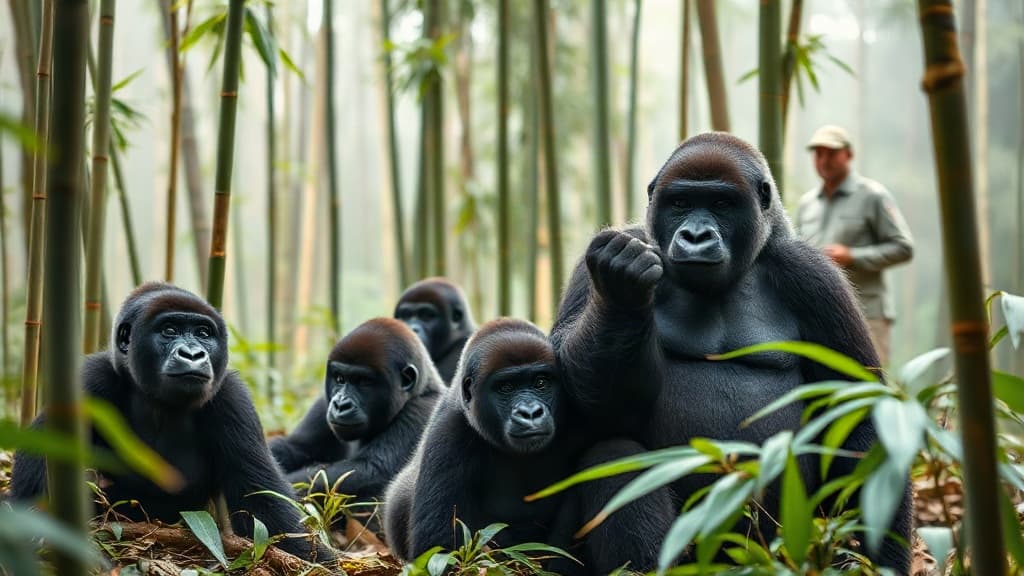
At a glance
- Gorilla permit (foreign)
- $1,500 per person, 8-visitor group cap
- Kwita Izina 2026
- Fri 4 Sept, 21st edition, Kinigi
- Golden monkey permit
- $100 per person
- Low-season discount
- 30% off, Nov-May only, not Jun-Oct
- Visa on arrival
- All nationalities, up to $50, since 2018
- Gateway
- Kigali (KGL), then ~2.5-3hr to Musanze
Volcanoes National Park, Kinigi — Volcanoes National Park, Kinigi · Kigali International Airport · Musanze town
On Friday, 4 September 2026, Rwanda names 22 infant mountain gorillas in a field at the foot of Volcanoes National Park. It is the 21st running of Kwita Izina, the country's annual gorilla-naming ceremony, held this year in Kinigi, Musanze District, under the theme "Conservation is Life: Sustaining the Future." Since the ceremony began in 2005, 438 gorillas have been named this way, and organisers say more than Rwf23 billion (roughly US$16 million) has gone into nearly 1,300 community projects tied to it, according to the event's own site and reporting by the African Tourism Travel Association.
If you are only now looking into a Rwanda gorilla trek, you are not early and you are not late -- you are booking into a system that runs on a fixed daily cap regardless of how much interest spikes. And interest has spiked. David Attenborough's Netflix documentary "A Gorilla Story," which follows a gorilla named Pablo that Attenborough first filmed in 1978, premiered in April 2026 and set off what Euronews called the "Attenborough effect" two months later. Lydia Eva Mpanga, founder of the Rwanda-based operator Nkuringo Safaris, told Euronews that travellers booking multiple treks in one trip have gone from roughly 2-3 in every 10 guests to about 5 in 10 -- longer, more deliberate trips rather than more permits, since "when global interest rises, the permit system does not suddenly stretch to meet it."
What a gorilla trekking permit actually costs
Rwanda's Development Board (RDB) runs its own booking portal, and the price table on it hasn't changed for the core foreign-visitor tier: a permit costs $1,500 per person for foreign non-residents, $500 for foreign residents of Rwanda or other African passport holders, and $200 for Rwandan or East African Community citizens, according to RDB's own booking portal. Each permit is good for one gorilla family, capped at 8 visitors per group, with a strict 15-year minimum age and a one-hour limit once you find the gorillas -- rangers hold visitors to a 7-metre distance from the animals throughout. Bookings are first-come, first-served and issue automatically once the online application and payment clear; cash is not accepted at the park gate.
There is a real discount, but it comes with conditions that rule it out for a September trip. RDB's own low-season discount page lists a 30% cut on the gorilla permit -- down to roughly $1,050 for a foreign visitor -- available only from November through May, and only if you pair the gorilla trek with a minimum three-day, two-night visit to Akagera National Park or Nyungwe National Park. The discount is explicitly unavailable June through October, which covers both this year's Kwita Izina window and Rwanda's long dry season immediately after it. If your dates are flexible and you don't mind trading the naming ceremony for a quieter, cheaper trip, the November-to-May window with an Akagera or Nyungwe add-on is the one lever available to cut the single biggest line item in a Rwanda trip.
A cheaper primate to add to the same trip
Volcanoes National Park also runs golden monkey tracking, a separate permit priced at $100 per person -- corroborated across the park's own operator-facing pages and two independent Rwanda-based trekking outfits after RDB's own portal excerpt didn't surface a standalone line-item for it. The golden monkeys live in the park's bamboo forest on a gentler, flatter walk than the gorilla trek, and a habituated troop sighting is close to guaranteed on a one-hour visit. Most visitors who add it do so on a second park day rather than the same morning as the gorilla trek, since both start early and both run at their own pace once you're in the forest.
When to actually go
Rwanda has two dry-season windows worth planning around: the long dry season from June through September (overlapping this year's Kwita Izina), and a shorter one from December through February. Trails are least muddy and gorilla movement slightly more predictable in both, though trekking happens year-round regardless of season -- Volcanoes National Park never closes for rain the way some East African reserves do. Given the current demand spike, operators quoted in Euronews' reporting and multiple Rwanda-focused trekking sites recommend booking permits 6 to 12 months ahead for June-through-September dates specifically, since the 8-visitors-per-family structure means a single popular week can sell out family by family well before the date itself.
Getting there and getting in
Kigali International Airport (KGL) is the practical gateway for essentially every foreign visitor; Volcanoes National Park sits roughly 2.5 to 3 hours northwest by road, through Musanze town, with the park's Kinigi headquarters -- and this year's Kwita Izina site -- at the end of that drive. Rwanda's own immigration authority confirms the country has issued visas on arrival to citizens of every nationality since 1 January 2018, with a fee ceiling of $50 for a single-entry visa or $70 for multiple entry, according to Rwanda's Directorate General of Immigration and Emigration. Nationals of African Union, Commonwealth or La Francophonie member states get a free 30-day visa on arrival, and East African Community citizens get free entry for up to six months. That makes Rwanda one of the more straightforward East African entries for a worldwide readership -- no advance visa application required for most travellers, regardless of home country, though applying online ahead of arrival is also an option if you'd rather not queue at immigration.
If your trip pairs Rwanda with Uganda, note the price gap: a Uganda gorilla permit runs $800 through the Uganda Wildlife Authority, roughly half Rwanda's $1,500 foreign rate, though both countries track the same Virunga Massif gorilla population and both cap groups at 8 visitors per family.
Staying connected in the park
Buying a local SIM in Rwanda means bringing your passport to the counter -- MTN Rwanda and other carriers copy your passport and take a photo as part of mandatory registration, a process that typically takes about 15 minutes in person, according to independent SIM-buying guides for the country. That's a minor hassle at Kigali airport arrivals, but it's a bigger one once you're in Kinigi or Musanze the morning of a trek, where local shops and registration desks are thinner on the ground than in the capital. A pre-installed travel eSIM sidesteps the passport-and-photo counter altogether, which matters more on trek days than on Kigali city days -- you want data working before you leave the lodge, not queued at a shop while your group's departure time slides. Check your phone supports eSIM before you fly using a device compatibility check, since older or carrier-locked phones sometimes don't.
FAQ
How much does a Rwanda gorilla trekking permit cost in 2026?
$1,500 per person for foreign non-residents, $500 for foreign residents or other African passport holders, and $200 for Rwandan or East African Community citizens, per RDB's own booking portal. A 30% low-season discount applies November through May only, tied to a combined trip with Akagera or Nyungwe National Park.
What is Kwita Izina and can tourists attend?
Kwita Izina is Rwanda's annual gorilla-naming ceremony, held this year on 4 September 2026 in Kinigi at the foot of Volcanoes National Park, where 22 infant gorillas are being named in its 21st edition. The event includes a public ceremony, a conservation exhibition and gorilla trekking experiences run alongside it, according to the event's own organisers.
Do I need a visa to visit Rwanda?
Rwanda has issued visas on arrival to every nationality since 1 January 2018, capped at $50 for single entry or $70 for multiple entry, per the country's immigration authority. Nationals of African Union, Commonwealth or La Francophonie states get a free 30-day visa on arrival, and East African Community citizens get free entry for up to six months.
How far in advance should I book a gorilla permit?
Operators recommend 6 to 12 months ahead for June-through-September dates specifically, since permits are sold per gorilla family at 8 visitors each and popular weeks can sell out family by family well before the date. Bookings run first-come, first-served through RDB's own portal.
Is Rwanda or Uganda cheaper for gorilla trekking?
Uganda's gorilla permit costs $800 through the Uganda Wildlife Authority, about half Rwanda's $1,500 foreign rate. Both countries track gorilla families across the same Virunga Massif ecosystem and cap groups at 8 visitors per family.
Keep reading
Uluru's New 54km Signature Walk: 2026 Booking Guide
Kata Tjuta to Uluru, 54km over 5 days — the first overnight stays ever allowed inside the national park. What the 2026 season costs and who can book it.
Read more
Uzbekistan Is Visa-Free for Americans Now: Samarkand to Khiva
A 3 November 2025 decree made Uzbekistan visa-free for US citizens from 1 January 2026. Here's the registration rule and Silk Road train fares to know first.
Read more
Ha Long Bay 2026: How to Book a Cruise That Passed a Safety Check
A storm capsized a Ha Long Bay tour boat in 2025, killing 39. Here's what changed before you book a 2026 dry-season cruise, and what to check before you pay.
Read more