
Sydney Airport Train or Bus 420: Which Costs Less?
The T8 train adds an airport station access fee. Bus 420 serves Mascot and both terminal areas, but many city hotels need a connection. Compare your full route.
How-to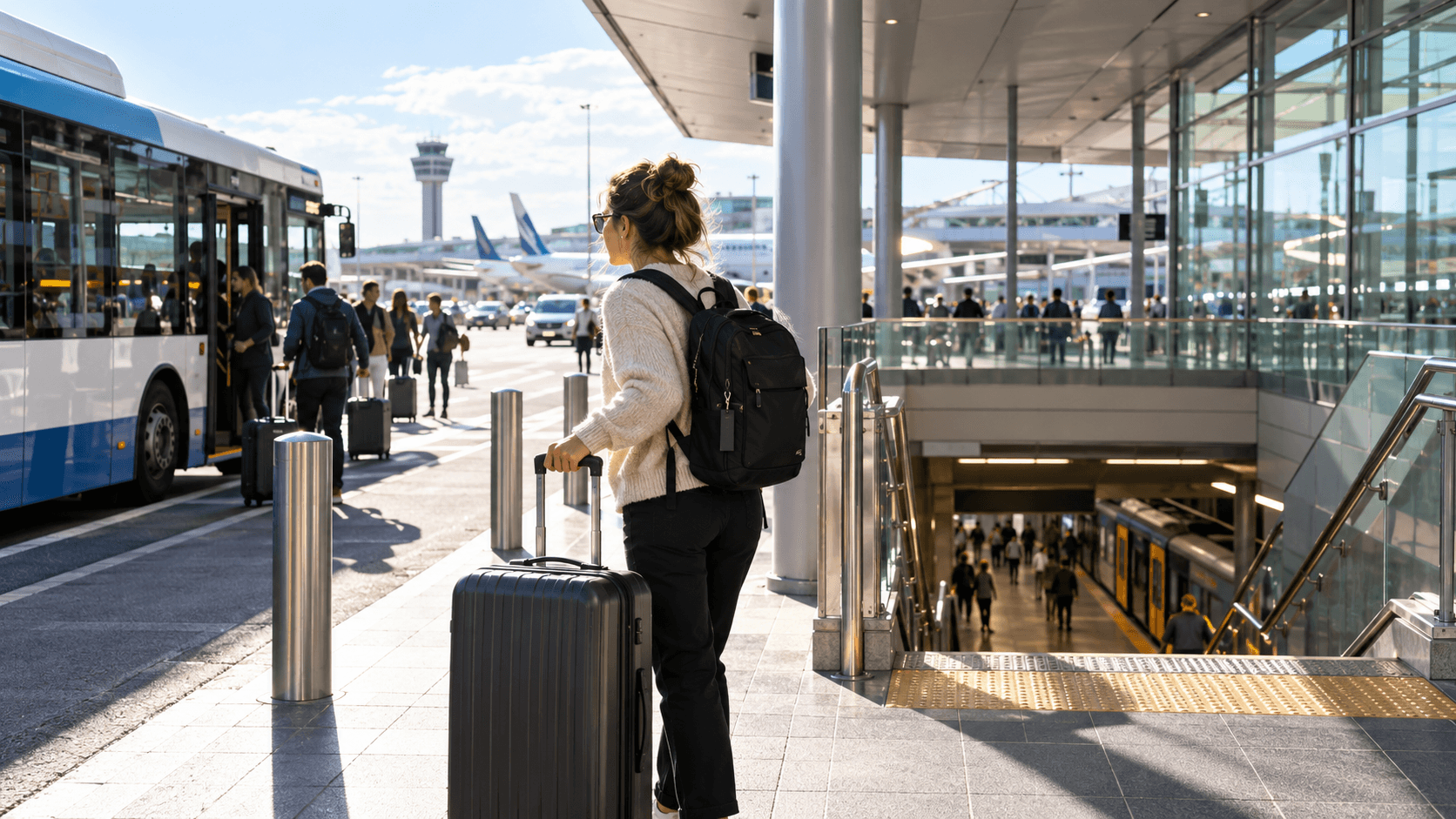
At a glance
- Adult station access
- A$18.61
- Bus 420
- Burwood and Mascot Station
- Train line
- T8 train
Sydney Airport’s rail station access fee changes the usual airport transport calculation. The T8 train is a direct way toward the city, but Transport for NSW charges a station access fee in addition to the ordinary train fare when you use Domestic or International Airport station. Bus 420 serves both airport terminal areas and connects with Mascot, but it is not a direct bus to the central business district. For an October arrival, choose after pricing the entire route to your address, not by comparing a bus fare with a train fare that omits the airport station charge. The official airport transport guide sets out the routes and fee.
The quick decision
Use the T8 train if you want a simple rail trip toward a city station, have luggage, or value fewer transfers. Use bus 420 if Mascot or another stop on its route is useful, or if you are prepared to connect onward and want to avoid paying the airport rail station access fee. The bus saving is not a guaranteed saving on every complete itinerary: add the onward train or bus fare, walking, waiting, and the cost of your time. A late arrival also needs a timetable check. The official guide says the T8 serves the airport between about 5 am and midnight, and airport bus patterns vary by route and hour.
Why the train price surprises travelers
Transport for NSW lists an adult airport station access fee of A$18.61 (about US$13.08) with Opal or contactless payment, in addition to the ordinary train fare. Its guide also lists A$19.00 (about US$13.36) as the adult station access component of an Opal single trip ticket, with the train fare on top. Those are station charges, not complete city fares. The same government page explains that the fee is collected for the privately owned airport stations. If you see a low ordinary T8 train fare in a generic fare table, it does not tell you what you will pay when starting inside the airport station.
The train has a different advantage: there is a station beneath each terminal area. Transport for NSW directs T2 and T3 arrivals toward the lift or escalator near baggage carousel 1 for Domestic Station. For T1 International, it directs arrivals via Exit A and toward the station entrance, with another lift or escalator near check-in desk A. Those details matter after a long flight. You can follow station signs rather than searching outside for a bus stop, and you can confirm the train’s destination before boarding. The airport describes the train to the city as about 13 minutes, but that is a rail segment, not a guarantee for your hotel door.
What bus 420 actually connects
Transport for NSW says route 420 runs between Burwood and Mascot Station via Campsie and Rockdale and serves both the International and Domestic terminal areas. Sydney Airport’s transport page also identifies clearly marked arrivals-level stops for the route. Mascot is the connection many travelers have in mind when they describe a “cheap bus and train” airport route. The bus gets you out of the airport area; a separate rail or bus leg may then be needed for a city-centre hotel. Check the current direction at the stop, because a 420 bus going toward Burwood is not the same as one bound for Mascot Station.
Bus 420 can be especially sensible for an address genuinely on its line. For a CBD hotel, it is a transfer strategy, not a direct city bus. A traveler with a bulky suitcase should compare the walk to the bus stop, time on board, interchange at Mascot, and the final city walk. The ordinary bus fare can look appealing beside the station access fee, but a connection creates more chances for a missed service or a confusing platform. If the cost difference matters, use the Transport for NSW trip planner on your travel date; it calculates the full Opal fare and includes any airport station fee where applicable.
Payment and caps are part of the choice
For buses and trains, Transport for NSW permits an Opal card, eligible contactless bank card or digital wallet, or an Opal single ticket. The authority says the airport station access fee is the same for Opal and contactless payments, while single trip tickets have a higher station component. It also warns of a minimum A$35 (about US$24.61) top-up if you load an Opal card at an airport train station. An overseas visitor who already has an accepted contactless card may find that simpler than buying and loading an Opal card just for arrival, although card fees and foreign-exchange terms belong to the card issuer.
The airport station access fee has its own weekly cap, separate from ordinary Opal travel caps. The official adult weekly station-fee cap is A$37.75 (about US$26.54) for Opal and contactless payments. The approximate dollar conversions use the Reserve Bank of Australia’s 26 October 2026 reference rate of A$1 to US$0.7031; the rate applied by a payment card can differ. That can matter to someone making repeated airport-station trips in the same Monday-to-Sunday week, but it does not turn the first airport train ride into a free one. Transport for NSW also says the ordinary 60-minute Opal transfer does not apply at airport stations: tapping off and on again there within an hour can trigger two journeys and two station access fees. Avoid using the airport station as a casual interchange simply because it looks close on a map.
Worked examples from different arrivals
Imagine a solo traveler landing at T1 and staying near a station served conveniently by the T8 route. The train may justify its larger fare because it reduces navigation and changes. The traveler should still price the full station fee plus train fare, and confirm the actual city stop. Now imagine a pair staying beside Mascot Station with light bags. Bus 420 toward Mascot may reach the useful connection without either traveler entering an airport rail station. The saving is specific to their destination and tolerance for a surface-bus ride; it is not a universal airport travel hack.
A third visitor lands at the domestic terminal and has a hotel in a district that needs another bus after reaching central Sydney. The direct T8 ride is only the first leg, so compare both complete routes. The airport’s terminal location also matters: a bus or train serving the International terminal might not be the right boarding point for a Domestic arrival. If you are transferring between flights rather than entering the city, Transport for NSW says both T8 and 420 can link Domestic and International. That is a different journey with different fare logic; check the airport’s transfer information before selecting a paid public service.
Timing, luggage, and accessible travel
The train operates frequently, but use the live board for your actual landing time. Transport for NSW says bus 420 operates from early morning until around midnight, with the International terminal route described more specifically as roughly 4 am to midnight. These are published service windows, not a guarantee of a particular departure. If a flight lands near the edge of service, factor in immigration, baggage claim and the walk to the stop. A taxi or another late-night route may be the practical fallback, and the official planner is more reliable than a fixed timetable copied into an article.
For accessibility, the station directions identify lifts or escalators, while the bus involves an outdoor stop and boarding. The best mode depends on the precise assistance needed and any disruption on the day. Check the current accessibility status of the stations and stops in the official planner. Similarly, a short train ride is not necessarily low effort if the hotel is far from the destination platform. Map the last walk with luggage in mind and choose a route you can actually complete comfortably.
Make the decision before you leave arrivals
Save your terminal and hotel address before the flight. When you land, ask the trip planner for both a T8 itinerary from your terminal station and a 420 itinerary from the terminal bus stop. Compare the complete payment shown, transfers, arrival time and walk. If you use the train, remember that airport station access is an extra charge. If you use the bus, confirm the direction toward the stop you need. A working travel eSIM can make live directions easier; check your device on Roameo’s compatibility page and compare relevant destination plans before travel. Connectivity does not replace the operator’s fare advice.
Frequently asked questions
Does bus 420 go straight to Sydney CBD?
No. The official route runs through the airport between Burwood and Mascot Station. For a CBD address, plan an onward connection and price the whole trip.
Is A$18.61 the complete adult airport train fare?
No. It is the adult airport station access fee for Opal or contactless payment, added to the ordinary train fare. Check the trip planner for the final amount.
Can I avoid the access fee by using bus 420?
Bus boarding itself does not use an airport rail station. If your later route enters or exits an airport train station, the station-fee rules still matter. Price the actual itinerary.
Keep reading

Zurich Airport Train or Tram 10: Which Stop Fits?
The train reaches Zürich HB quickly, while tram 10 serves Oerlikon and intermediate stops. Choose from your exact hotel address, transfer needs and ZVV ticket zones.
Read more
Madrid Airport Metro or Cercanías: Which Rail Fits?
Choose Madrid-Barajas Metro line 8 or the T4 Cercanías train by arrival terminal, hotel stop, airport supplement, ticket rules and any transfer you need.
Read more
Gatwick Express or Thameslink: Which Fits Your Hotel?
Choose between Gatwick Express and Thameslink by your London hotel stop, ticket route and terminal. Avoid a cross-city transfer after landing or when departing.
Read more