
Tongariro Alpine Crossing 2026: Booking and Shuttle Guide
Tongariro's 2026/27 season starts 23 October, but spring ice can linger. Here is the free booking, shuttle, route and weather plan for spring trips now.
Guides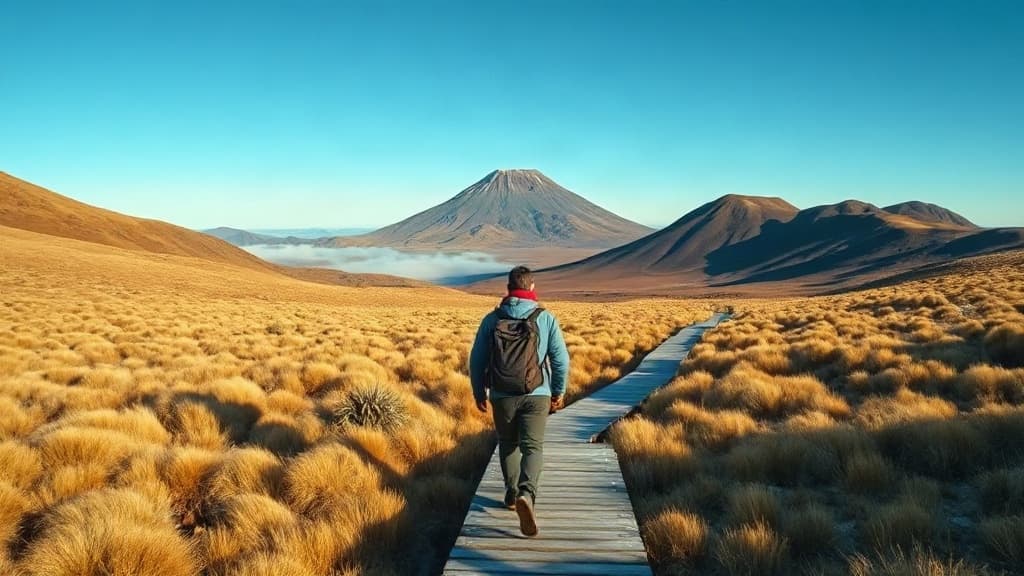
At a glance
- Season turns
- 23 October 2026
- Track booking
- Free, but booking is recommended
- Distance
- 19.4 km one way
- Summer time
- 7–8 hours in summer
- Shuttle budget
- About NZ$40 (about US$22)
- Water
- 2–3 litres per person
Red Crater — Red Crater · Mangatepōpō Road end · Ketetahi Road end · Taupō Airport
On 23 October 2026, Tongariro National Park switches into its 2026/27 Great Walks season. That date is useful for booking huts and transport; it is not a promise that Red Crater has turned into an easy summer path overnight. As of 4 October, New Zealand's Department of Conservation (DOC) still says alpine skills are essential on the Tongariro Alpine Crossing from May through October. If your trip sits near that boundary, make the weather and snow decision first and the sightseeing plan second.
The crossing itself is free. Its booking is free. The expense most independent walkers cannot sensibly avoid is transport between two different road ends. DOC's current guide puts a typical shuttle at about NZ$40; at the Reserve Bank of New Zealand's 2 October reference rate of US$0.55915 per New Zealand dollar, that is About NZ$40 (about US$22). This guide explains what to reserve, where the one-way route actually goes, and when to abandon the plan without wasting the trip.
What 23 October changes — and what it does not
The date belongs most precisely to the adjoining Tongariro Northern Circuit. DOC lists its Great Walks season as 23 October 2026 to 30 April 2027, with bookings already open. The Alpine Crossing is the famous day-walk section through the same volcanic landscape, and DOC describes May to late October as winter season. In other words, a 23 October itinerary sits on an administrative boundary, not a meteorological one.
Before late October, DOC expects snow, ice, avalanche terrain and sub-zero temperatures. Its winter advice calls for navigation ability when snow hides marker poles, avalanche-rescue competence, crampons, an ice axe and a helmet. Shuttle buses generally do not run in winter, while guided winter trips normally include transport. A traveller without those skills should not treat an open track as an invitation to improvise.
Do not use the Great Walks season date as a go/no-go signal. Read the current DOC alert, the NIWA mountain forecast and the New Zealand Avalanche Advisory. If snow or ice remains and you lack alpine training, choose a guide or another walk.
The start area also looks different after two 2025 fires. DOC says walkers can expect blackened ground and regenerating vegetation around the beginning of the crossing. Ngāti Hikairo ki Tongariro placed a 10-year restorative rāhui over the affected area. For a visitor, the practical response is simple: remain on the formed track, do not enter burned ground, clean footwear before arrival so it does not carry weeds, and take all rubbish out.
Book the free track place before the shuttle
Free, but booking is recommended is the shortest accurate description of the track system. DOC recommends a booking for anyone using any part of the Alpine Crossing. A booking is required if you use a shuttle or a guided-walk service. Make the booking through the link on the official DOC crossing page; there is no fee for the track reservation.
That reservation is not an admission ticket with a guaranteed start. It helps DOC understand use of the route and lets transport operators work within the system. DOC estimates that around 100,000 people visit in the October-to-April walking season, but it explicitly warns that the number is approximate because counters record movement rather than unique people. Its latest monitoring also says future booking improvements will show demand levels, making it easier to choose quieter dates.
Reserve a flexible block of two or three possible days in the region rather than building the entire trip around one dawn. Ask the shuttle operator what happens when it cancels for unsafe weather and whether the fare can move to the next morning. The track booking may cost nothing, but accommodation and transport terms belong to their individual operators.
The route: 19.4 kilometres, two road ends
The Mountain Safety Council measures the classic route at 19.4 km one way and advises allowing 7–8 hours in summer. DOC's winter allowance is nine hours. This is a crossing, not a loop: most walkers start at Mangatepōpō Road end and finish at Ketetahi Road end.
| Route point | What the official route says | Planning consequence |
|---|---|---|
| Mangatepōpō | Start at 1,120 m; the first 5.4 km rises gradually through the valley | Use the toilets and check the group before committing to the upper route |
| South Crater approach | A staircase gains about 350 m | This is an early fitness test, not the final climb |
| Red Crater | The high point is 1,886 m | Expect more wind and cold than in the towns below |
| Emerald Lakes descent | Loose volcanic scree creates a slip hazard | Slow down and give the person ahead room |
| Ketetahi | The track finishes at 760 m after a long stepped descent | Knees may be the limiting factor late in the day |
DOC gives the total elevation change as plus or minus 1,196 m. The hard part is not merely reaching Red Crater: the descent continues for hours, first over loose rock and later through many steps. The route is rated for high fitness, travels through exposed terrain and is not recommended by DOC for children under 10.
At the Emerald Lakes and Blue Lake, stay on the track and do not touch or enter the water. These waterways and the surrounding peaks are sacred to Ngāti Hikairo ki Tongariro of Ngāti Tūwharetoa. The request is not a picturesque extra to the hike; it determines how visitors should behave at the places most often photographed.
Why the shuttle is part of the route, not an add-on
During summer, DOC says there is no visitor parking at Mangatepōpō for people completing the full crossing. A private car park operates near the Ketetahi end, but stopping on the shoulder of a state highway is not recommended. DOC's preferred answer is a shuttle, with services arranged from local towns including National Park, Whakapapa, Tūrangi and Taupō.
About NZ$40 (about US$22) is a sensible planning figure from DOC's crossing page, not a universal fare. Your actual price will depend on origin, parking and operator. Confirm the pickup point on a map before paying: “National Park” can mean the village called National Park, while your hike takes place inside Tongariro National Park.
For the least fragile plan, stay in a shuttle-served settlement the night before, pack before bed, and take an early departure. Taupō is 86.5 km from the track according to DOC, whereas National Park village is 13.5 km away. The longer transfer can still make sense in a broader North Island itinerary, but it gives you less room to react to a late forecast change.
Use DOC's 6 am weather decision
In the summer hiking season, DOC can publish a “Not Recommended Today” advisory. Staff assess the forecast at 6 am. The trigger is not one vague bad-weather icon: the official thresholds include an average wind of at least 55 km/h, gusts of at least 70 km/h, wind chill of minus 10°C or colder, or specified combinations of rain, snow and cold.
Treat that advisory as a stop signal even if your shuttle is paid. Volcanic risk also exists while the route is open; DOC points walkers to GeoNet for the current alert level. Fumaroles near the Emerald Lakes can burn, the ground can be unstable, and no booking removes those hazards.
A spare day turns a cancellation from a ruined holiday into a route change. DOC names Taranaki Falls and Tama Lakes as alternatives when conditions on the crossing are poor. They still need a forecast check, but they do not require forcing a high exposed traverse simply because it was the photograph you came for.
Pack for an alpine day, not a social-media viewpoint
Carry 2–3 litres per person; DOC says water found along the track is not suitable for drinking. Bring food, a waterproof jacket and trousers, insulating layers, hat, gloves, sunscreen, sturdy footwear, a head torch and an offline route. Toilets are spaced roughly every one to two hours, although the first after Mangatepōpō is only about 1 km from the start.
A phone is useful for the forecast and transport messages, but it is not the emergency plan. Coverage varies in the park, batteries drain quickly in cold wind, and volcanic terrain can block signal. Leave your route and expected finish time with someone who will act if you do not check in. A personal locator beacon is a more appropriate backup for an incident outside reception.
Drones require a permit on conservation land and are prohibited here without one. More importantly, a drone flight around sacred lakes or a crowded ridge is not compatible with the place DOC and Ngāti Hikairo are asking visitors to protect.
Entry rules and data for an international trip
New Zealand entry permission depends on the passport you carry. If your passport is on the visa-waiver list, Immigration New Zealand says you normally need an NZeTA before travel rather than a visitor visa; Australian citizens and permanent residents travelling on an Australian passport are treated differently. Travellers outside those cases may need a visitor visa. Check your own passport on the official Immigration New Zealand list, and complete the required New Zealand Traveller Declaration rather than applying a rule written for somebody else's nationality.
Set up maps, transport contacts and weather links while you still have reliable Wi-Fi. If your phone supports eSIM, compare current New Zealand eSIM plans before departure and install the plan according to its activation instructions. Mobile data can help with a changed pickup or forecast; it should never be presented as rescue coverage on an alpine route.
A practical two-day Tongariro plan
On day one, arrive in a shuttle town before dark, collect food and water, confirm the pickup location, and check DOC, NIWA, GeoNet and the avalanche forecast. Keep the track booking and operator confirmation available offline. If the advice is unfavourable, move the crossing to day two or replace it with a lower route.
On the walking day, read the 6 am advisory before boarding. At Mangatepōpō, make an honest early assessment: weather, footwear, pace and the least experienced person all matter. The staircase toward South Crater is the last sensible place to recognise that the group is not moving well before the route becomes more exposed.
After Ketetahi, do not schedule a tight onward drive or flight. A 7–8 hours in summer estimate is not a booking slot, and loose scree, photographs, queues and tired knees all add time. Eat, rehydrate and let the shuttle complete the crossing's final logistical leg.
FAQ
Is the Tongariro Alpine Crossing booking compulsory?
DOC recommends a booking for everyone using any part of the track. It is required when you use a shuttle or guided-walk service, and there is no charge for the track booking.
How much does the Tongariro Alpine Crossing cost?
The walk and track booking are free. DOC describes a shuttle fee of about NZ$40, approximately US$22 at the Reserve Bank's 2 October 2026 reference rate. Operator prices, parking and accommodation are separate.
Can I park at the Mangatepōpō start?
Not for a full summer crossing. DOC says there is no visitor parking at Mangatepōpō for people doing the crossing in summer and recommends using a shuttle. A private parking option is available near the Ketetahi finish.
Is late October already safe for a normal summer hike?
Not automatically. DOC classifies May to late October as winter season and says alpine skills and equipment may be needed. Check the live track alert, mountain weather and avalanche advice for your exact date.
Can I swim in the Emerald Lakes?
No. DOC asks visitors not to touch or enter any of the waterways. The lakes and peaks are sacred to Ngāti Hikairo ki Tongariro, and geothermal ground near the lakes can also be unstable.
Keep reading

New Zealand's Visa Rules Change on 24 September 2026
New Zealand stops taking paper visitor-visa applications from 24 September and 1 October 2026 — here's the NZeTA, IVL and cost stack before you book summer.
Read more
Milford Track Sold Out in 30 Minutes. Here's Your Plan B
New Zealand's most famous walk emptied its 2026/27 bunks in half an hour on 13 May. The cancellation window, cheaper alternatives and what a hut costs.
Read more
Albuquerque Balloon Fiesta 2026: Tickets and Best Days
Albuquerque's Balloon Fiesta opens today. Compare the US$20 admission, Park & Ride prices, launch and glow schedule, weather rules and arrival strategy.
Read more