
The Twelve Apostles in 2026: The Last Free Season Left
A $126 million visitor centre is hiring staff now for a late-2026 opening — and with it, the Twelve Apostles will charge an entry fee for the first time.
Destinations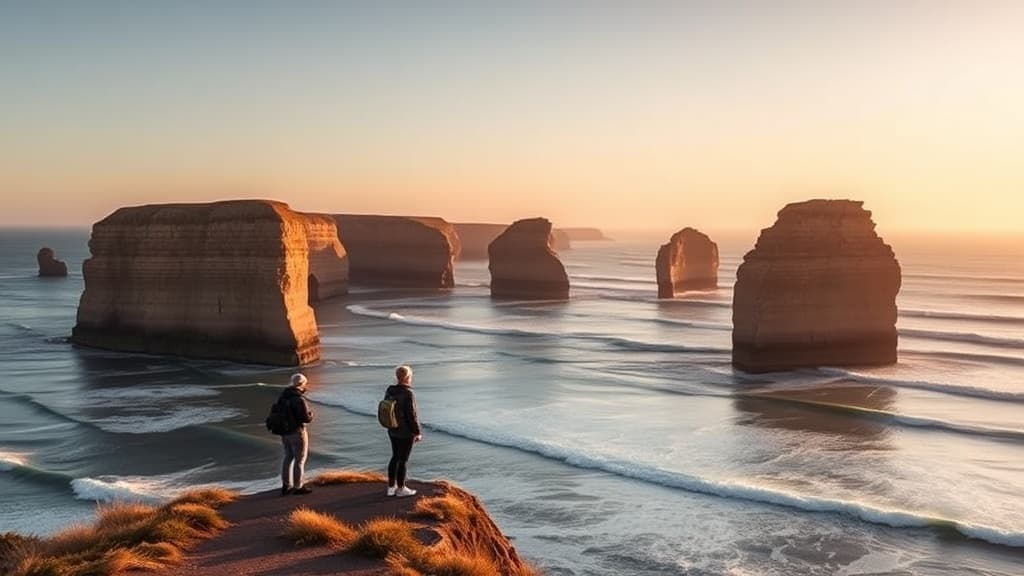
At a glance
- New visitor centre cost
- A$126 million
- Opening
- expected by the end of 2026
- Stacks remaining
- just seven remain
- 2019 visitor numbers
- 2.8 million for the area
- Fee exemptions
- locals and the Eastern Maar community
- Australia ETA
- AUD $20 (about US$14)
The Twelve Apostles — The Twelve Apostles · Loch Ard Gorge · London Arch · Gibson Steps · Melbourne
The Great Ocean Road Coast and Parks Authority is hiring for roughly 40 jobs right now — retail, housekeeping, maintenance, visitor experience — to staff the new A$126 million Twelve Apostles Visitor Centre before it opens later this year. When it does, seeing Australia's most photographed limestone stacks will cost money for the first time in the site's history. If you can still make the trip in 2026, you're catching the last stretch of free entry.
What's actually changing
Victoria's environment minister, Steve Dimopoulos, announced the fee in March 2026: visitors will pay to park and enter the new Twelve Apostles Visitor Experience Centre, the building that now controls access to the main viewing decks over the sea stacks. The government hasn't published a dollar figure yet — the announcement covered the principle, not the price card — so treat any number you see quoted online as unconfirmed until the centre actually opens. What is confirmed: people who live near the site and members of the Eastern Maar Aboriginal community, the site's traditional owners, won't be charged — locals and the Eastern Maar community are exempt, and everyone else will pay once the centre opens. Dimopoulos framed the fee as unremarkable by Australian standards, pointing to existing charges at Uluru, Kakadu and Kosciuszko national parks and at Cradle Mountain in Tasmania — this brings the Apostles into line with sites Australia already treats as premium natural attractions rather than free roadside lookouts. Those comparisons have real numbers behind them: Parks Australia charges AUD $38 (about US$26) for a three-day adult pass to Uluru-Kata Tjuta National Park, and Kakadu National Park charges AUD $40 (about US$27) for an adult pass in the dry season, dropping to AUD $25 (about US$17) during the wet season from July to October. Neither of those figures tells you what the Twelve Apostles fee will actually be — but they're the closest real-world benchmark until Parks Victoria publishes one.
Why the government is doing this now
Two things are converging on the same stretch of coastline. The first is erosion: although the site was named for twelve limestone stacks, Parks Victoria says there were probably only ever nine, and just seven remain standing today after decades of wave action and rockfall. The formations are not being protected from that process — nothing stops the ocean — but the government argues the fee funds monitoring and safer viewing infrastructure while the stacks last. The second is volume: Development Victoria put 2019 visitor numbers at 2.8 million for the area, with 2026 forecast to reach roughly 4 million. Locals have long complained about bus congestion at the lookout car park during peak hours, and a booked, ticketed system is the government's answer to spreading that load out.
The new centre isn't an isolated project. It's stage one of the Shipwreck Coast Master Plan, which already delivered a smaller but telling preview: an A$8 million viewing platform at the Loch Ard Gorge blowhole, named Poombeeyt Koontapool ("Breath of the Whale" in the Keerray Woorroong language), opened in October 2025. It replaced a platform that had been closed for 15 years on safety grounds, and — like the Twelve Apostles centre itself, designed by architecture firm Grimshaw — it was built with direction from the Eastern Maar Aboriginal Corporation, the same community exempted from the coming fee.
The drive, and what's actually free
The fee applies to the visitor centre and its car park, not to the 240km of the Great Ocean Road itself. From Melbourne it's roughly three and a half hours' drive out to Port Campbell, longer if you stop through Torquay, Lorne and Apollo Bay on the way. The cluster of sights around the Twelve Apostles is compact and walkable between stops: Gibson Steps, a steep staircase down to beach level almost under the stacks; Loch Ard Gorge, named for an 1878 shipwreck and now home to the new blowhole platform; and London Arch, a freestanding rock arch that was still connected to the mainland until it collapsed in 1990 (it was called London Bridge until then, and two tourists were famously stranded on the seaward side when it fell). None of these carries a fee today, and nothing announced so far suggests that will change — the charge is specifically tied to the new centre's car park and building, not the coastline.
A reason to go this year specifically
Southern right whales migrate along this exact stretch of coast to calve, with the nearby Logans Beach nursery at Warrnambool drawing the most reliable sightings. Victoria's state biodiversity monitoring project records first sightings typically in May and June and last sightings around September — meaning a visit anytime through August or into September puts you in whale season and ahead of the new centre's fee, in the same trip. It's a narrower window than the Great Ocean Road's broader summer (Nov-Mar) tourist season, but it's the one that currently overlaps with both the free-entry period and an experience the fee-based centre won't add anything to.
Basing yourself along the way
Doing the Twelve Apostles as a single long day trip from Melbourne is possible but rushed given the 3.5-hour drive each way; most visitors split it over two days and base themselves in Port Campbell, the closest town to the stacks, or Apollo Bay, about 100km further back toward Melbourne and a better stop if you also want time on the rainforest side of the Great Otway National Park. Warrnambool, roughly 100km past the Apostles heading west, is the practical base if the whale season is the actual reason for your trip — it's a short drive from the Logans Beach nursery and has more accommodation capacity than Port Campbell during peak months. None of these towns are affected by the new visitor centre fee; it's specific to the Twelve Apostles site itself, not to lodging or fuel along the route.
Getting in, and staying connected on the drive
Most passport holders need an Electronic Travel Authority (ETA, subclass 601) to enter Australia, applied for through the AustralianETA app for AUD $20 (about US$14); some nationalities instead use the free eVisitor (subclass 651). Check which applies to your passport before you fly, since Australia's government no longer accepts ETA applications through a website — the app is mandatory. Once you're on the road, coverage along the more remote stretches between Anglesea and Port Campbell can drop out entirely in patches, which matters if you're relying on maps or booking systems for the new visitor centre. A travel eSIM set up before departure means you're not hunting for a local SIM in a town with one shop; browse Australia eSIM plans or check device compatibility before you go, and see how Australia compares with other stops on a longer trip via plan comparisons.
FAQ
Has the Twelve Apostles entry fee started yet?
No. As of August 2026, the fee has been announced but not priced or started — it takes effect when the new Twelve Apostles Visitor Experience Centre opens, expected by the end of 2026. Until then, visiting the lookout and car park remains free.
Who won't have to pay the new fee?
The Victorian government has said residents living near the site and members of the Eastern Maar Aboriginal community, the area's traditional owners, will be exempt. No other exemption categories have been announced.
Why are there only seven Apostles if it's called the Twelve Apostles?
Parks Victoria says the formation was likely never home to a full twelve stacks — probably closer to nine — and coastal erosion has brought that number down to seven today. The name predates any accurate count and has simply stuck.
Is the rest of the Great Ocean Road affected by the new fee?
No. The announced charge applies specifically to the new Twelve Apostles Visitor Experience Centre and its car park. Nearby free sights — Loch Ard Gorge, London Arch, Gibson Steps — aren't part of the fee as announced.
Keep reading
Sydney New Year's Eve 2026: Free Views and Tickets
Sydney has now published 48 official harbour vantage points for New Year's Eve 2026. Compare free sites, ticket dates, entry windows and transport plans.
Read more
Uluru's New 54km Signature Walk: 2026 Booking Guide
Kata Tjuta to Uluru, 54km over 5 days — the first overnight stays ever allowed inside the national park. What the 2026 season costs and who can book it.
Read more
Dinosaur Valley Katoomba 2026: Dates and Ride Plan
Dinosaur Valley is open in Katoomba through January 2027. Use this practical daily plan for tickets, included rides, transport and a weather-proof route.
Read more