
BER Airport: FEX or S-Bahn for Your Berlin Hotel?
Berlin Brandenburg Airport has FEX, regional and S-Bahn links. Use your hotel stop and the current timetable to choose the route and the required ABC ticket.
Travel tips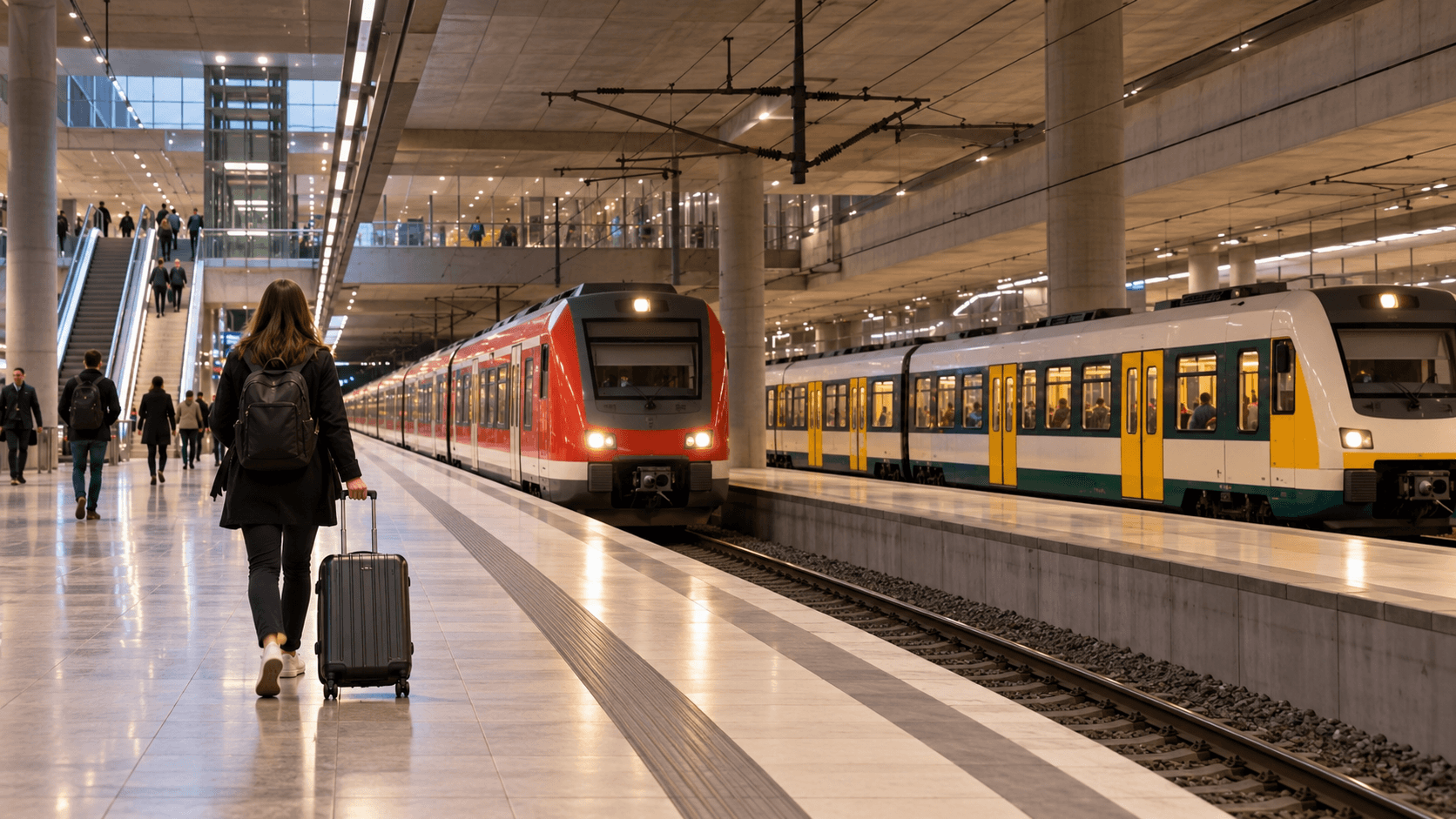
At a glance
- Airport station
- Terminal 1, level U2
- Central station fare
- Berlin ABC single ticket: €5.00
- FEX to Hauptbahnhof
- About 23 minutes on the published route
The way into Berlin from Brandenburg Airport changed with the December 2025 rail timetable, so an old route screenshot can send an autumn 2026 arrival to the wrong connection. The Airport Express FEX now serves Hauptbahnhof via Potsdamer Platz and Südkreuz, while S-Bahn lines serve a different spread of city stops. Both can be useful. The right answer depends on where your hotel actually is, whether a transfer saves or costs time, and the departure shown when you reach the airport station.
Start with the station closest to the hotel
BER's public transport route guide lists FEX from the airport through Südkreuz and Potsdamer Platz to Berlin Hauptbahnhof. For a hotel or onward train at one of those stations, the express is the natural first route to inspect. The airport publishes approximate rail times of 14 minutes to Südkreuz, 19 minutes to Potsdamer Platz and 23 minutes to Hauptbahnhof. These are train times between named stations, not promises of total travel time from the arrivals hall to a hotel room.
The S9 has a different advantage: its listed route includes Ostkreuz, Warschauer Straße, Ostbahnhof, Alexanderplatz, Friedrichstraße, Hauptbahnhof, Zoologischer Garten, Charlottenburg and Spandau. A traveler whose hotel is near Alexanderplatz or the eastern part of that corridor may prefer one through S-Bahn ride to a quicker FEX followed by a transfer. The S85, also listed by the airport, serves the airport via Schöneweide and Ostkreuz toward its northern route. Its usefulness depends on the day and actual stopping pattern, so verify a live journey for the exact address.
The word “express” describes the FEX pattern, not a universal ranking for every Berlin destination. For a hotel beside Potsdamer Platz, FEX avoids an onward transfer. For an apartment beside Alexanderplatz, S9 may deliver a simpler trip. For a place near Ostkreuz, check both S-Bahn service and regional connections listed by the airport. A journey planner can compare the whole door-to-door path; the route map tells you why its suggestion differs from a generic airport article.
Know where to board at BER
The airport states that the rail station, Flughafen BER, is underneath Terminal 1 on level U2. After arriving at Terminal 1, follow rail signs down to that level. For Terminal 2, the airport directs travelers first to the arrivals level E0 and then along the signs to Terminal 2 when travelling outward; arriving Terminal 2 passengers should follow the current connection signs to the Terminal 1 rail station. Treat the terminals and the rail station as parts of one airport campus, but allow actual walking time. A tight itinerary that counts only the train ride overlooks this first leg.
At the station, look at the electronic board for line, destination and intermediate stops. The airport lists FEX and several regional rail services as well as S9 and S85. Do not board the first vehicle showing a Berlin destination without checking whether it stops at your intended station. In particular, a service can be excellent for Hauptbahnhof and irrelevant to a hotel on another rail corridor. If you have heavy luggage, compare whether one direct slower ride is easier than a faster ride with a platform change.
The airport says S9 is scheduled every 20 minutes and S85 every 20 minutes on its published route page. The same page describes the FEX and RE20 pattern with a note about service up to December 2026. These statements are a planning baseline. They do not tell you that a train will be waiting when you exit baggage claim. Recheck live service and engineering notices on the day, especially late at night or on a weekend. A missed or cancelled departure can change which route gets you to the hotel sooner.
One airport fare rule covers the local options
The Berlin-Brandenburg transport association says that travel between central Berlin and BER requires a Berlin ABC single ticket and that the regular VBB fare applies without an airport express surcharge. Its page gives €5.00 from 1 January 2026. That means the decision between FEX and an eligible S-Bahn service is mainly about route and timing for a standard single journey, rather than an assumed special premium for the word “express.” Check the current fare and ticket validity when you buy, since prices and product terms can change.
Berlin's fare zones matter more than the train branding. A Berlin AB ticket is not the same as an ABC ticket for the airport journey. If you already hold a pass, inspect its zone validity before boarding; a city ticket that covers only AB should not be treated as automatic airport coverage. For a party, each traveler needs a valid product according to its terms. A ticket machine or official transport app can show the applicable fare; use the journey from Flughafen BER to the exact destination so the correct zones are selected.
Validate or activate the ticket in the way the chosen product requires before travelling. Do not assume a ticket displayed on a phone is active merely because it was bought, and do not rely on a screenshot of a purchase confirmation as a substitute for the actual valid ticket. The VBB site and the airport point travelers to official journey and ticket information. Check those instructions at purchase, especially if you are using a day product, a pass issued outside Berlin, or an app whose activation starts a validity clock.
How the timetable change affects a real arrival
The VBB airport page explains that the December 2025 opening of the Dresden Railway changed the FEX route and reduced the Hauptbahnhof–airport rail time. That is the concrete reason this comparison needs a date. A traveler using instructions saved before the change may expect an older FEX path. For October 2026, use the airport's current route page and the live planner, not a map in a dated review or a remembered platform from a previous trip.
Consider a worked example. A visitor's hotel is a short walk from Potsdamer Platz. The airport's published FEX pattern serves that station directly, so the visitor first checks the next FEX or relevant regional departure and the short hotel walk. A second visitor is staying beside Alexanderplatz. The S9 serves Alexanderplatz directly, so the second traveler compares a through S9 ride with any FEX-plus-transfer proposal. A third traveler has an onward intercity booking from Hauptbahnhof; the FEX route directly reaches that station, but the traveler still leaves a buffer for collecting bags, reaching U2 and finding the intercity platform.
The three travelers may buy the same zone product for an ordinary central Berlin airport journey yet choose different trains. They should also react differently to a disruption. If FEX is delayed, the Potsdamer Platz traveler might examine another rail option and its transfer. If S9 is disrupted, the Alexanderplatz traveler should examine a route via another interchange. The decision is therefore a conditional comparison, not an instruction to always take the express or always take the suburban train.
Late arrival and disruption checklist
The airport's general route page contains service windows and frequencies, but special works can override a normal pattern. BER's transport notice explicitly warns travelers to use VBB's live timetable for changes, including night-time deviations. The dated notice also describes rail restrictions lasting into December 2026. Check which lines and dates its warning covers, then verify a current journey before leaving the arrivals area and again if the station board differs from the plan.
For an overnight landing, calculate the earliest realistic moment you can reach the platform. Landing time is not rail departure time; passport control, bags, walking and buying a ticket intervene. Search a departure after that realistic platform time. If neither desired service runs soon, the airport guide also lists buses and other regional options, but compare their actual connections and ticket conditions rather than assuming a bus is a direct replacement for a rail line. For a return flight, add the walk from the airport station to your terminal and the airline's own check-in margin.
Keep your hotel address, the chosen station name and an offline copy of the route. If you want data to consult the VBB planner on arrival, look at Roameo destination plans and confirm your phone's eSIM compatibility before travel. Roameo offers access over partner mobile networks; coverage and speeds vary. The airport displays and official ticket machines remain the source of truth if your phone does not connect immediately.
In short, choose FEX first for a destination on its current direct corridor, choose an S-Bahn when its through route better matches your endpoint, and let live departures settle close calls. Buy a ticket with the airport's ABC zone requirement, verify its activation rules, and allow for the walk between the terminal and the train. This is the set of decisions that gets a traveler to the right Berlin stop, rather than merely onto the first train labelled for the city.
Frequently Asked Questions
Is the FEX always faster than the S-Bahn to my hotel?
No. The FEX has short published times to its direct stops, but a hotel near an S9 stop may be easier to reach without changing trains. Compare the complete journey to your address.
Do I need a special FEX surcharge?
VBB says its regular fare applies without an airport express surcharge for central Berlin–BER travel. It specifies the Berlin ABC zone ticket for that journey.
Where is the airport railway station?
BER says Flughafen BER station is under Terminal 1 on level U2. Follow the current airport signs from your arrival terminal and check the live platform display.
Keep reading
Malpensa Express: Cadorna or Centrale for Your Milan Stay?
Malpensa Express has separate Cadorna and Centrale branches. Match the station to your Milan address, then check journey times, fare validity and payment.
Read more
Schiphol to Amsterdam: Train or Bus 397 for Your Hotel?
The Schiphol train suits Amsterdam Centraal, while bus 397 serves Museumplein and Leidseplein. Choose by your hotel stop, ticket rules and arrival time.
Read more
Changi Airport to Singapore: MRT or Taxi After Landing?
Choose the Changi MRT or a metered taxi by arrival time, terminal, luggage and final stop. See the transfer, fare conditions and late-night fallback before you land.
Read more