
Changi Airport to Singapore: MRT or Taxi After Landing?
Choose the Changi MRT or a metered taxi by arrival time, terminal, luggage and final stop. See the transfer, fare conditions and late-night fallback before you land.
Travel tips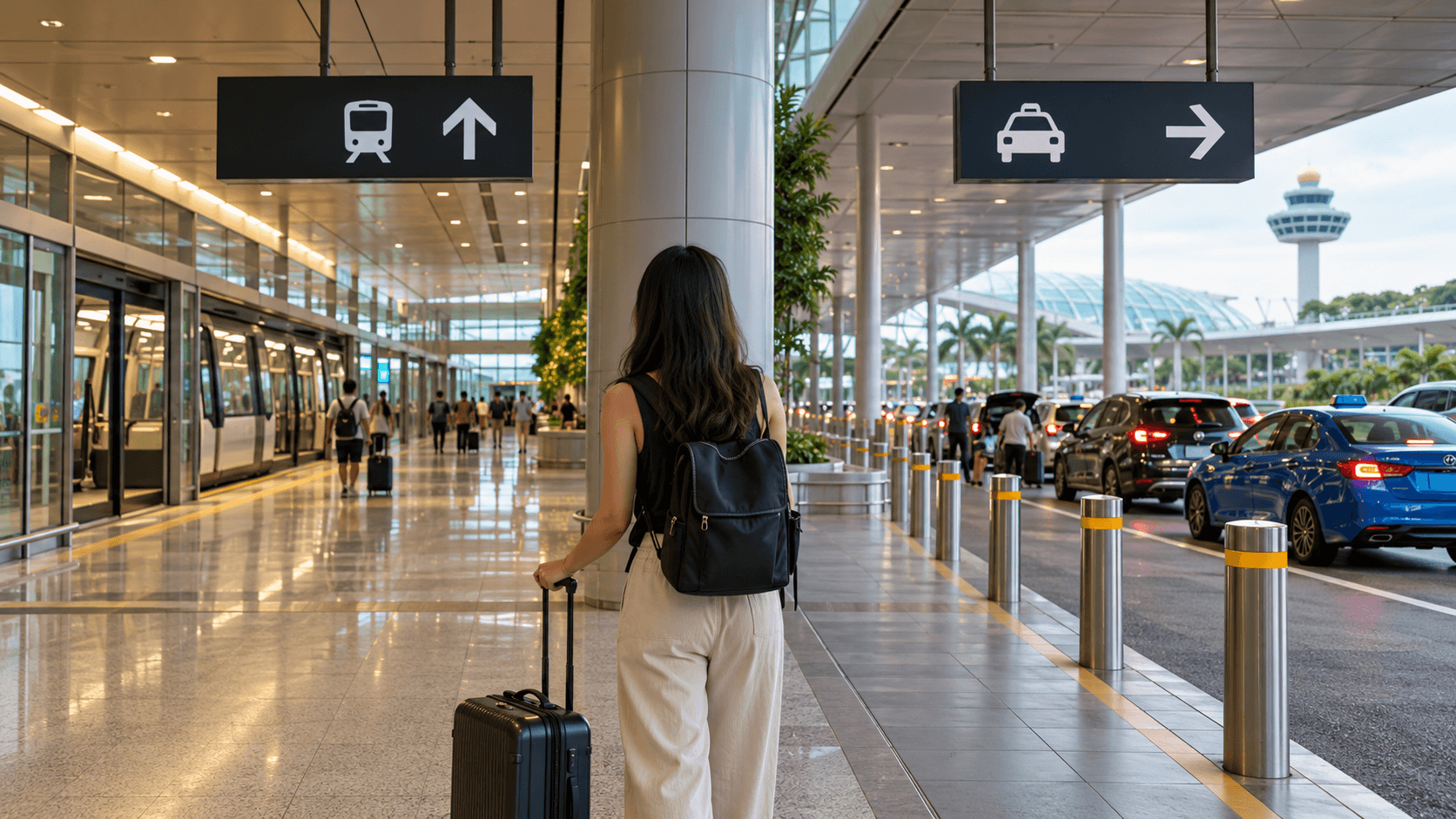
At a glance
- MRT route
- Change at Tanah Merah or Expo
- Taxi to city
- About 30 minutes; S$25–S$45 before applicable extras
- Late arrival
- Most MRT and bus services do not run all night
Landing at Changi with a hotel address is the moment to choose a route, not just a vehicle. The airport’s current transport guide sends city-bound rail passengers through Tanah Merah or Expo, while its taxi estimate is about 30 minutes and S$25–S$45 before the applicable extras. For a solo traveler with a compact bag and a hotel near a station, the MRT is usually the practical first choice. For a group, bulky luggage, a distant last walk or an arrival after rail service, a taxi may buy a much easier final leg. Decide from your actual hotel entrance and landing time rather than a generic “airport to city” headline.
First identify the stop you really need
Changi Airport MRT station is CG2. The airport directs passengers traveling toward the city to ride to Tanah Merah EW4 and transfer to the East West Line toward Tuas Link, or to ride to Expo CG1/DT35 and transfer to the Downtown Line toward Bukit Panjang. Those are route branches, not interchangeable promises of a train to every hotel. Put your hotel's nearest station into a route planner before buying or boarding. A hotel near an East West Line stop can make Tanah Merah the tidy change; a Downtown Line destination can make Expo more logical. A map pin at the hotel name alone can conceal a long walk from the station exit.
The rail decision has two parts: airport to the connecting station, then connecting station to the hotel area. Count changes after Tanah Merah or Expo as well. Someone staying near a station that requires another connection may still prefer rail in daylight, but a taxi becomes more appealing when arrival fatigue, stairs, rain, or luggage make the final walk costly. Compare door-to-door effort, not only the onboard segment. Save the address in English and any local format supplied by your hotel so that the same destination can be checked in a transit planner or shown to a taxi driver.
What the MRT journey asks of you
Follow the public-area MRT signs once you have entered Singapore and collected your bags. Changi's station guide says the station connects directly with Terminals 2 and 3. Terminal 1 passengers can move through the public inter-terminal links; Terminal 4 passengers need to account for an additional landside connection to the MRT. Changi’s terminal transfer guide lists a complimentary public shuttle between T4 and T2/MRT. It says the shuttle runs direct in the daytime and on a loop overnight. That transfer makes an MRT itinerary from T4 longer and less simple than one beginning beside T2 or T3, even when the train fare itself is the same.
The airport publishes first and last train information, but the relevant cutoff is the train that still connects to your onward line, not merely the last train that departs CG2. On the source page checked for this article, the first airport train to Tanah Merah is listed at 5:31 a.m. Monday to Saturday and 5:59 a.m. on Sundays and public holidays; the last connection toward Tuas Link is listed at 11:18 p.m. Those are published planning points, not a guarantee after a delayed flight. Recheck the operator journey planner for your date, especially around engineering works or a late landing. The airport itself warns that most public bus and MRT services do not operate through the night.
Pay for the train without confusing the card fee
Changi lists contactless Mastercard, Visa and NETS bank cards, mobile wallets, stored-value cards and the Singapore Tourist Pass among public transport payment methods. The Land Transport Authority’s SimplyGo guidance says a contactless bank card can pay adult fares without advance registration and that a card issued outside Singapore incurs an administrative fee. That fee matters when comparing a foreign card with a local stored-value card, especially over several riding days. The airport also points to its station service centre and ticket office for stored-value card purchase. Check current fare and fee information at the payment source before deciding that one card method is cheapest.
Use the same physical card or the same phone wallet for entry and exit so the transit system can match the journey. Do not assume that a phone wallet and the plastic card behind it are identical payment tokens for tapping purposes. Keep the chosen card accessible before you reach the gates rather than stopping with luggage in the fare line. If you expect several city rides, compare payment methods across the whole stay. The airport transfer itself is only one ride, so a tourist pass purchase should be justified by later trips rather than by the arrival alone.
What the taxi estimate includes, and what it does not
Changi lists taxi stands in the arrivals areas of all four terminals. Its published trip to the city is about 30 minutes and S$25–S$45, with a metered fare. It separately lists an airport surcharge of S$8 for trips beginning between 5:00 p.m. and 11:59 p.m. and S$6 at other times. The airport also notes midnight and peak-hour surcharges. Therefore the S$25–S$45 estimate is a starting range, not a fixed quote to your particular hotel or a ceiling on the final meter. Traffic, destination, time and surcharges matter. Ask the driver to use the meter and confirm your destination before leaving the stand.
The right taxi comparison is often per vehicle against rail costs for every traveler, plus the cost of an extra city connection. A party of three with full-size bags may find that the time and effort saved outweigh the total fare difference. A solo traveler arriving in the morning for a hotel steps from a direct rail line may not. This is a decision framework, not a claim that one mode has a universal price advantage. If an app quotes a private-hire fare, read that live offer separately; it is not the airport’s metered taxi estimate.
A worked arrival decision
Imagine two travelers clearing immigration at T3 in the early evening. Their hotel is a short, level walk from an East West Line station, and each has one rolling bag. The MRT requires a straightforward transfer at Tanah Merah and avoids a taxi bill that may include the evening airport surcharge. They should check the live route for the final stop, choose a payment method, and walk to CG2. Now change only the facts that matter: the flight lands after the useful connection toward their hotel, the hotel sits far from a station, and they have heavy bags. In that version, the taxi stand at their arrival terminal is the more reliable door-to-door plan. The decision changes because the complete journey changed.
For a T4 arrival, add the shuttle leg to the rail calculation before comparing times. For a passenger whose onward trip is to Pasir Ris, the airport describes a different transfer at Tanah Merah toward Pasir Ris rather than the citybound route. This is why “take the city train” is inadequate advice without an endpoint. If you are visiting Singapore briefly, download the hotel address and route screenshot while you still have airport Wi-Fi. A travel eSIM can help with live maps and delay checks; compare coverage and plan terms at Roameo destinations before relying on one for the arrival.
When to check again
On your travel day, check the train planner after your flight's actual arrival time is known. The published first and last train table should be treated as an operating guide, because immigration, baggage delivery and walking to CG2 consume time. Check the T4 public shuttle if that is your terminal; do not borrow timing from an airside transfer itinerary. If the rail plan becomes tight, a metered taxi from the official arrivals stand is the simple fallback. Keep enough flexibility to choose after landing, particularly when a missed rail connection would force an unplanned second transfer.
Frequently Asked Questions
Is there a direct MRT train from Changi to every city hotel?
No. The airport tells citybound passengers to change at Tanah Merah for the East West Line or at Expo for the Downtown Line. Your hotel may require another train, a bus, or a walk. Check the exact stop before deciding.
Can I take the MRT from Terminal 4 without a terminal transfer?
The airport MRT station is directly linked to T2 and T3. From T4, plan a public-area shuttle connection to T2/MRT and allow time for that extra step. Changi publishes the current shuttle arrangements on its transfer page.
Is the airport taxi fare a fixed S$25–S$45?
No. Changi describes that as an approximate city-trip cost and says taxis are metered. Airport, peak-hour and midnight surcharges can apply, so the final fare depends on the actual ride.
Keep reading

Geneva Airport to the City: Train or Bus, and Is It Free?
The airport-to-city train and bus share Geneva zone 10, but the old free arrival ticket ended. Choose by final stop, hotel card eligibility and arrival time.
Read more
Brussels Airport: Train or Bus 12 to Your City Stop?
Choose the train or bus 12 from Brussels Airport by your city endpoint. Compare Central station, the European Quarter, ticket rules and the moved bus station.
Read more
BER Airport: FEX or S-Bahn for Your Berlin Hotel?
Berlin Brandenburg Airport has FEX, regional and S-Bahn links. Use your hotel stop and the current timetable to choose the route and the required ABC ticket.
Read more