
Bhutan in Autumn 2026: What the $100 Nightly Fee Buys
Bhutan charges US$100 a night before you book a hotel, added 5% GST in January, and holds the halved rate only until 31 August 2027. The real numbers.
Guides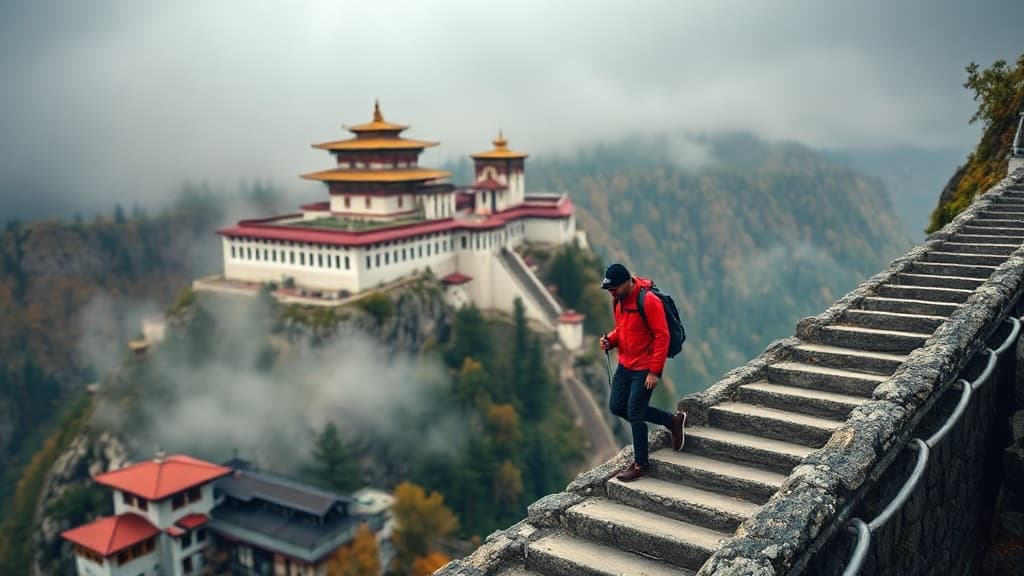
At a glance
- SDF
- US$100 per adult per night
- Discount reassessed after
- 31 August 2027
- Visa
- US$40, reviewed in five working days
- GST
- 5%, in force since 1 January 2026
- Thimphu Tshechu
- 21-23 September 2026
Thimphu — Thimphu · Paro Taktsang · Paro International Airport
On 1 January 2026 Bhutan switched on a 5% Goods and Services Tax, replacing the older sales tax and excise regime. It lands on your hotel bill, your guide, your transport and your meals — but not on the fee that dominates the cost of a Bhutan trip. That one is still US$100 per adult per night, and it is a discounted number: the Department of Tourism halved the standing US$200 Sustainable Development Fee with effect from 1 September 2023, and the discount is written to run for four years, until 31 August 2027. If you are looking at the autumn 2026 festival season — Thimphu Tshechu falls on 21-23 September this year — you are booking inside that window, not after it.
The fee that decides your budget
Bhutan does not price a trip the way other countries do. Since the 2022 tourism reforms there is no minimum daily package rate; you book your own hotel, guide and transport, and the state charges a separate nightly levy on top. The Sustainable Development Fee is that levy, and it is paid up front when the visa or permit is issued, not on arrival.
| Traveller | SDF per night |
|---|---|
| Adult paying in US dollars | US$100 |
| Child aged 6-12 | 50% of the adult rate |
| Child aged 5 and under | Fully waived |
| Indian, Bangladeshi and Maldivian nationals | Regional rate in ngultrum; no visa required |
Multiply before you go further. A seven-night trip is US$700 in SDF for one adult, US$1,400 for a couple, before a single hotel night is booked. That is the number that makes Bhutan expensive, and it is also the number that keeps the trails and dzong courtyards uncrowded — the Department of Tourism collected just over US$43 million in SDF in 2025, up from US$29 million in 2024, according to national broadcaster BBS.
Two exemptions are worth knowing. Visitors staying up to 24 hours in the border towns are waived under a standing operating procedure the Department published in April 2024. And the government has said only that it will reassess the incentive after 31 August 2027 and may discontinue it — no successor rate has been announced, so anyone telling you the fee returns to US$200 on 1 September 2027 is guessing.
The visa: US$40, five working days, no operator required
Bhutan's official tourism site puts the visa application fee at US$40 per person, non-refundable, and says an application is reviewed within five working days. You need a digital copy of a passport valid for at least six months beyond your departure, a recent digital passport photo, your arrival and departure dates, and payment details. Applications go through the Department of Immigration portal at immi.gov.bt.
The point most travellers get wrong: you do not need a licensed tour operator to obtain the visa. You can apply yourself, or a tour operator or hotel can apply on your behalf. Nationals of India, Bangladesh and the Maldives do not need a visa at all — Indian travellers use a permit instead, with the SDF paid at the point of permit application.
Two older rules that are no longer in force, and which stale blog posts still repeat: mandatory travel insurance for tourists was lifted in April 2024, and the restriction on visiting monument sites on designated auspicious days was lifted in June 2023.
Tiger's Nest and the six other places that charge
Bhutan's monument entry fees are set by a single Department of Tourism notification, revised with effect from 15 March 2023, which cut the number of fee-charging sites to seven. Everything else on the standard circuit is free to enter.
| Monument | Entry fee |
|---|---|
| Taktsang (Tiger's Nest), Paro | Nu 1,000 |
| Kyichu Lhakhang, Paro | Nu 500 |
| Changangkha Lhakhang, Thimphu | Nu 500 |
| Memorial Chorten, Thimphu | Nu 500 |
| Tashichho Dzong, Thimphu | Nu 500 |
| Punakha Dzong | Nu 500 |
| Chhimi Lhakhang | Nu 500 |
Children aged 6-18 pay half; children five and under are free. The notification explicitly names the sites that charge nothing — Jakar Dzong, Simtokha Dzong, Buddha Dordenma, Dobji Dzong, Trongsa Dzong, Jambay Lhakhang, Kurjey Lhakhang, Rinchending Lhakhang and Ringpung Dzong — and instructs Royal Bhutan Police officials to accept e-ticket copies from the online booking system at services.tourism.gov.bt.
Book Taktsang ahead and start early. BBS reported in May 2026 that the site drew over 108,000 visitors in 2025, up from over 70,000 in 2024, and had already taken more than 38,000 in the first four months of 2026. Riding-horse services on the climb require pre-booking under a separate 2023 Department notification.
Autumn 2026: the dates worth building a trip around
The Association of Bhutanese Tour Operators publishes a tentative festival calendar each year. Tentative is the operative word — the dates follow the lunar calendar and can shift — but these are the ones operators are selling against for autumn 2026:
- Thimphu Tshechu, Tashi Chhodzong, Thimphu — 21-23 September
- Gangtey Tshechu, Wangduephodrang — 24-26 September
- Jhomolhari Mountain Festival, Dangochong — 14-15 October
- Jambay Lhakhang Drup, Bumthang — 26-29 October
- Black-Necked Crane Festival, Gangtey Gonpa, Phobjikha — 11 November
If you have read that Punakha Tshechu is an autumn event, that is wrong: the 2026 edition ran 27 February to 1 March and is long past. Paro Tshechu was 29 March to 2 April.
Autumn is also the walking season. The Trans Bhutan Trail — 403 km from Haa in the west to Trashigang in the east, a 28-day through-hike or any number of day sections — names February to May and September to November as its mild, dry windows.
Flights, cash and the 5% you did not budget for
Two airlines serve Paro: Drukair and Bhutan Airlines. Drukair's published network reaches Bangkok, Delhi, Kolkata, Kathmandu, Singapore, Dubai, Dhaka, Guwahati, Bagdogra and Gaya. Two 2026 changes matter for an autumn booking: Paro-Guwahati-Bangkok resumed twice weekly from 2 April 2026, and the Singapore service stepped up to three times a week, running Tuesday, Thursday and Sunday from 16 May. Bhutan Airlines lists one-way starting fares from Kolkata at US$154.47, Kathmandu at US$202.51, Delhi at US$222.51 and Bangkok at US$358.52.
Paro is a visual-approach airport at 2,235 m, ringed by peaks and restricted to daylight operations in good weather. Build a spare day into any itinerary that connects onward to a long-haul flight.
On the ground, carry cash. The ngultrum is pegged one-to-one with the Indian rupee. Cards work in larger hotels and shops in Thimphu, Paro and Punakha, though operators report surcharges of roughly 3-5%, and Bhutan's domestic QR wallets are tied to local bank accounts and are not available to visitors. The country is heavily digitised for residents and largely cash for tourists. As for the new GST: it is a flat 5% and it replaced a prior 10% sales tax on accommodation and food, so operators put the net effect on a trip at a couple of percentage points rather than the full five. The SDF itself is not a taxable supply.
Staying connected without a passport queue
Bhutan has two mobile operators: Bhutan Telecom, which trades as B-Mobile, and TashiCell. TashiCell publishes tourist SIM packages on its own site — Nu 300 for 2,048 MB with 100 minutes over 14 days, Nu 500 for 3,072 MB with 200 minutes over a month, and short unlimited-data packs at Nu 1,100 for seven days and Nu 1,900 for 14 days. Both operators run counters at Paro airport, and a local SIM requires your passport for registration at the kiosk.
That registration step is the reason a lot of travellers arrive on a travel eSIM instead: it activates on landing over the same local networks, with no counter queue and no paperwork, which matters when you clear a small terminal at 09:00 with a guide waiting. Check your handset first on the eSIM compatibility checker, then look at what is available for the region on Roameo's destination plans — Roameo has local plans in 71 countries and rides on carrier networks it does not operate, so treat coverage in a Himalayan valley the way you would treat any mountain signal.
Expect LTE to be usable in Thimphu, Paro and Punakha and thinner as you climb. Bhutan Telecom is phasing out 3G and migrating users to 4G and 5G, Kuensel reported in March 2025, but no current coverage figure for 5G has been published and it is not something to plan an itinerary around. On a multi-day camping trek — Jomolhari, Snowman, the upper Druk Path — assume you are offline and tell someone your route.
Frequently Asked Questions
How much is Bhutan's Sustainable Development Fee in 2026?
US$100 per adult per night for tourists paying in US dollars. Children aged 6 to 12 pay half and children five and under are exempt. This is a 50% discount on the standing US$200 rate, in effect since 1 September 2023 and scheduled to run until 31 August 2027. Indian, Bangladeshi and Maldivian nationals pay a lower regional rate in ngultrum.
Do I need a tour operator to visit Bhutan?
Not to get the visa. Bhutan's official tourism site says you can apply online yourself, or have a tour operator or hotel apply for you. The visa fee is US$40 and applications are reviewed within five working days. The minimum daily package rate that used to force you through an operator was abolished in the 2022 tourism reforms.
What does it cost to visit Tiger's Nest?
Nu 1,000 for adults under the Department of Tourism's monument fee notification, with children aged 6 to 18 at half price and under-fives free. Six other sites charge Nu 500 — Kyichu, Changangkha, the Memorial Chorten, Tashichho Dzong, Punakha Dzong and Chhimi Lhakhang. Tickets can be booked through the official online monument booking system.
Can I get an eSIM in Bhutan?
Local operators TashiCell and Bhutan Telecom sell physical tourist SIMs at Paro airport and in town, and those require passport registration at the counter. Travel eSIMs bought before departure are the no-paperwork alternative and connect over the same local networks. Check your device supports eSIM before you buy either.
When is the best time to visit Bhutan in 2026?
Late September to November is the dry, clear trekking and festival window. Thimphu Tshechu is tentatively 21-23 September, Jambay Lhakhang Drup 26-29 October, and the Black-Necked Crane Festival at Phobjikha on 11 November. Festival dates follow the lunar calendar, so confirm with an operator before booking non-refundable flights.
Keep reading
Kilimanjaro's Long Dry Season Is Open: What It Costs in 2026
Late June through October is Kilimanjaro's long dry-season climbing window, and it's underway now. Here's what TANAPA's own park fees actually add up to.
Read more
Petra Is Quieter Than It's Been in Years: What a Visit Costs Now
Petra's visitor numbers collapsed by 70% this spring after regional conflict cut Middle East travel. Entrance fees haven't moved — here's the real cost of going now.
Read more
Thailand Just Cut Visa-Free Stays From 60 Days to 30
Thailand's cabinet approved a 30-day cap for 59 nationalities on July 14, 2026, ending its 60-day scheme — here's exactly who's affected and when it bites.
Read more