
Everest Base Camp Autumn 2026: Permits, Flights and Signal
From 25 September every Lukla flight leaves from Ramechhap, not Kathmandu. What the autumn 2026 Everest Base Camp season costs, and how to stay online.
Destinations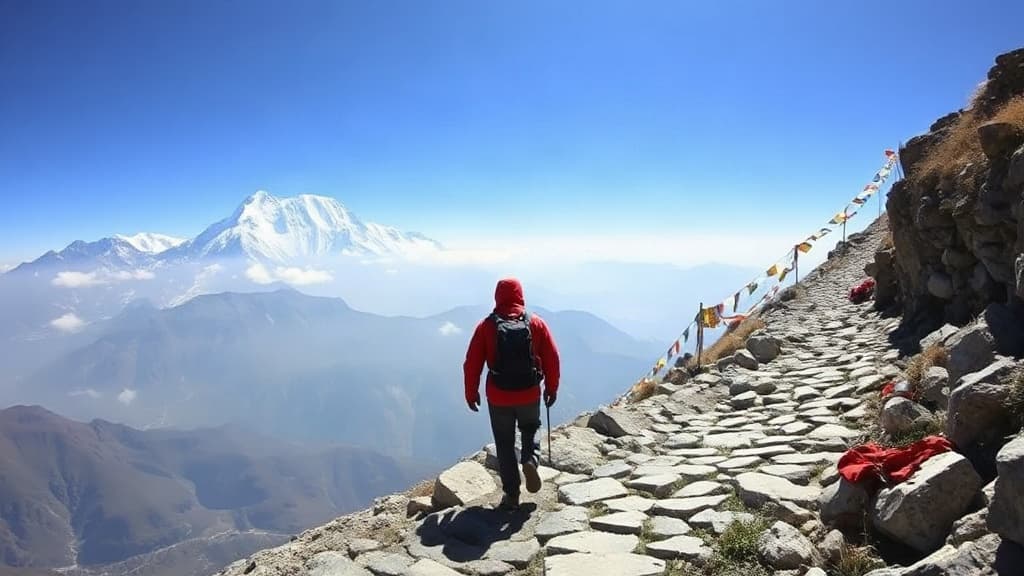
At a glance
- No Lukla flights
- 25 September - 30 November 2026
- Sagarmatha NP permit
- NPR 3,000 plus 13% VAT (~US$23-28)
- Guided package
- Roughly US$1,250-1,800 per person
- Teahouse rooms
- US$7-15 low, US$15-25 higher up
- Food
- Budget US$25-50 a day
Everest Base Camp — Everest Base Camp · Namche Bazaar · Lukla Airport
From 25 September to 30 November 2026, you cannot fly to Lukla from Kathmandu. The Civil Aviation Authority of Nepal shifts every Everest-bound flight to Manthali Airport in Ramechhap for the autumn peak, roughly 132 km east of the capital, and it applies to all airlines on the route. If you are booking an Everest Base Camp trek for October or November, that single rule reshapes your first day: a 1:30am departure from Kathmandu, four to five hours on the BP Highway, check-in at Manthali from about 6:00am, then a 15-to-20-minute hop into Lukla. Trekkers who budget a lazy morning flight out of Kathmandu discover this at the worst possible moment.
What the permits actually cost in 2026
Two permits get you to Base Camp, and neither is a TIMS card. The Trekkers' Information Management System card was retired in the Khumbu and replaced by a local municipality permit; e-TIMS still applies on other routes such as Langtang and Manaslu, but not here.
| Permit | Fee (foreign trekker) | Where it is issued |
|---|---|---|
| Sagarmatha National Park entry | NPR 3,000 plus 13% VAT (about US$23-28) | Nepal Tourism Board office in Kathmandu, or the park gate at Monjo |
| Khumbu Pasang Lhamu Rural Municipality | NPR 3,000 (about US$23), raised from NPR 2,000 | On the trail, usually Lukla or Monjo |
That is roughly NPR 6,000, or about US$45, for the pair. One caution worth taking seriously: trekking operators publish conflicting figures for the Khumbu municipality permit, with some quoting substantially more for independent trekkers. The permit is issued locally and the rate has moved once already. Ask your agency to confirm the current figure in writing before you pay, and carry enough Nepali rupees in cash to cover it — the counters at Monjo and Lukla are not card-friendly.
The guide rule is not optional any more
Unguided solo trekking is banned across Nepal's national parks and conservation areas, and foreign trekkers must walk with a licensed guide from an agency registered with the Trekking Agencies' Association of Nepal. The Khumbu had informal flexibility on this for several seasons; for 2026 that flexibility is effectively gone, and solo walkers are turned back at the Monjo checkpoint and told to join a guided group or return to Lukla.
Read the rule precisely, because it is narrower than the internet suggests. A licensed guide has to walk with you. It does not mean you must join a group departure, share a teahouse with strangers, or book a packaged tour. Two friends hiring one guide between them satisfies the rule.
Money: what an autumn 2026 trek runs to
Reported 2026 ranges land between about US$950 and US$5,000 per person, which is wide enough to be useless without a breakdown. The realistic middle is a standard guided package from a Nepal-based agency at roughly US$1,250 to US$1,800, covering the domestic flights, permits, teahouse beds, most meals, a licensed guide and a porter.
- Lukla flights: about US$215-240 one way from Kathmandu for foreign nationals, or US$175-190 from Ramechhap plus roughly US$30 for shared ground transport — so a peak-season total of around US$205-220 per leg.
- Teahouse rooms: roughly US$7-15 a night in the lower villages such as Phakding and Namche Bazaar, rising to about US$15-25 higher up in Dingboche, Lobuche and Gorak Shep.
- Food: budget US$25-50 a day. It climbs with altitude because everything is carried or flown in.
- Hot shower: US$2-6, charged per use, and not available everywhere above Dingboche.
Weather, and why October fills first
October is the month everyone wants. Post-monsoon skies are clear, trails are dry, and daytime temperatures between 3,000 m and 5,000 m sit around 8-18°C — warm enough to walk in a base layer, cold enough overnight that the morning views are sharp. That combination is why lodges on the popular stretch fill early and why guides, flights and beds are worth locking down months rather than weeks ahead.
November trades a few degrees for thinner crowds, and by late November the nights at Gorak Shep are genuinely cold. If your dates are flexible, the second half of November is the quieter half of the autumn window.
Staying online between Lukla and Base Camp
Nepal has three mobile networks worth knowing: Nepal Telecom (NTC), Ncell and Smart Cell. Ncell tends to be the stronger performer for 4G in Kathmandu, Pokhara and Chitwan; NTC has the deeper reach into remote and high-altitude districts. Along the Everest trail you can generally expect a signal at Lukla, Namche Bazaar and much of the main route, with dead stretches behind ridgelines where there is simply no line of sight to a tower. Nobody can promise you bars at 5,000 m, and any provider that does is selling you something other than information.
Buying a local SIM in Kathmandu means KYC registration under Nepal Telecommunications Authority rules: your passport, a copy of your visa page and a passport photograph, handed over at a shop, with activation typically inside 10-15 minutes. That is fine if you have a spare hour on arrival day. If you are landing late and driving to Ramechhap at 1:30am, it is an hour you do not have.
A travel eSIM installed before you fly is the alternative, and it is why we exist: you land connected, which matters most in the first two hours, when you need a rideshare, a hotel confirmation or a message home. Check your handset first on our eSIM compatibility checker, then look at what is available for Nepal and the wider region on the Roameo destinations page. Roameo has local plans in 71 countries and reaches around 145 once regional plans are counted in — coverage and speed on any of them depend on the underlying local network and, in the Khumbu, on terrain that blocks signal regardless of who sold you the data.
Teahouse Wi-Fi is a separate purchase
Above Namche, mobile data thins out and the lodges sell internet as a product. Two systems dominate. Everest Link prepaid cards run about US$20 for 10 GB and US$30 for 20 GB, each valid 30 days. AirLink sells time rather than data: around NPR 1,200 (about US$8) for 24 hours and NPR 1,500 (about US$11) for 48 hours.
Two practical notes. Buy in Namche Bazaar rather than higher up — the same cards get more expensive with altitude. And factor in charging: above the lower villages, teahouses meter power at roughly US$2-5 per hour, so a 20,000 mAh power bank pays for itself in about four days and removes the nightly queue for the one working socket.
Entry: visa on arrival, and what it costs
Most nationalities can take a tourist visa on arrival at Tribhuvan International Airport in Kathmandu and at designated land borders. Fees run US$30 for 15 days, US$50 for 30 days and US$125 for 90 days. Extensions cost US$45 for a minimum 15 days, then US$3 per additional day, up to a total of 150 days in one calendar year.
Check your own passport's eligibility with a Nepali mission before you book — a small number of nationalities must arrange a visa in advance rather than on arrival, and the list is not something to guess at. A standard EBC itinerary fits comfortably inside a 30-day visa; the 15-day option is tight once you allow for a weather delay at Lukla, which in autumn is a question of when rather than whether.
Frequently Asked Questions
Do I have to fly from Ramechhap for an autumn 2026 Everest trek?
Yes, if you are flying between 25 September and 30 November 2026. The Civil Aviation Authority of Nepal moves all Lukla flights to Manthali Airport in Ramechhap for the autumn peak, and it applies to every airline on the route. Plan for a roughly four-to-five-hour overnight drive from Kathmandu and a check-in from about 6:00am.
How much are Everest Base Camp permits in 2026?
Two permits, about NPR 6,000 (roughly US$45) combined: the Sagarmatha National Park entry permit at NPR 3,000 plus 13% VAT, and the Khumbu Pasang Lhamu Rural Municipality permit at NPR 3,000, up from NPR 2,000. Operators publish conflicting figures for the municipality permit, so confirm the current rate with your agency and carry rupees in cash.
Can I still trek to Everest Base Camp alone?
No. Unguided solo trekking is banned in Nepal's national parks and conservation areas, and foreign trekkers need a licensed guide from an agency registered with the Trekking Agencies' Association of Nepal. Solo walkers are stopped at the Monjo checkpoint. Hiring a guide is not the same as joining a group tour — two people can share one guide.
Will my phone work on the trek?
Partly. Expect usable signal in Lukla, Namche Bazaar and much of the main trail, with gaps behind ridgelines where no tower is in line of sight. Above Namche most trekkers switch to teahouse Wi-Fi cards from Everest Link or AirLink. A travel eSIM bought before departure covers Kathmandu and the lower trail without the passport-and-photo registration a local SIM requires.
Keep reading
Everest Base Camp Trek 2026: What the Permits Now Actually Cost
Spring 2026 set a record for Everest climbing permits. Here's what an EBC trekker (not a summit climber) actually pays, and the guide rule that changed in 2023.
Read more
Sagrada Familia in 2026: Tickets, Towers and Barcelona Costs
The cross went up in February and Pope Leo XIV blessed the tower in June. What visiting Barcelona's finished spire costs this autumn, and what still is not open.
Read more
Giza and the Grand Egyptian Museum: Go Before 1 November
The foreign ticket at the Grand Egyptian Museum rises to US$35 on 1 November 2026. What Giza costs now, why the sites went card-only, and how to get online.
Read more