
Everest Base Camp Trek 2026: What the Permits Now Actually Cost
Spring 2026 set a record for Everest climbing permits. Here's what an EBC trekker (not a summit climber) actually pays, and the guide rule that changed in 2023.
Guides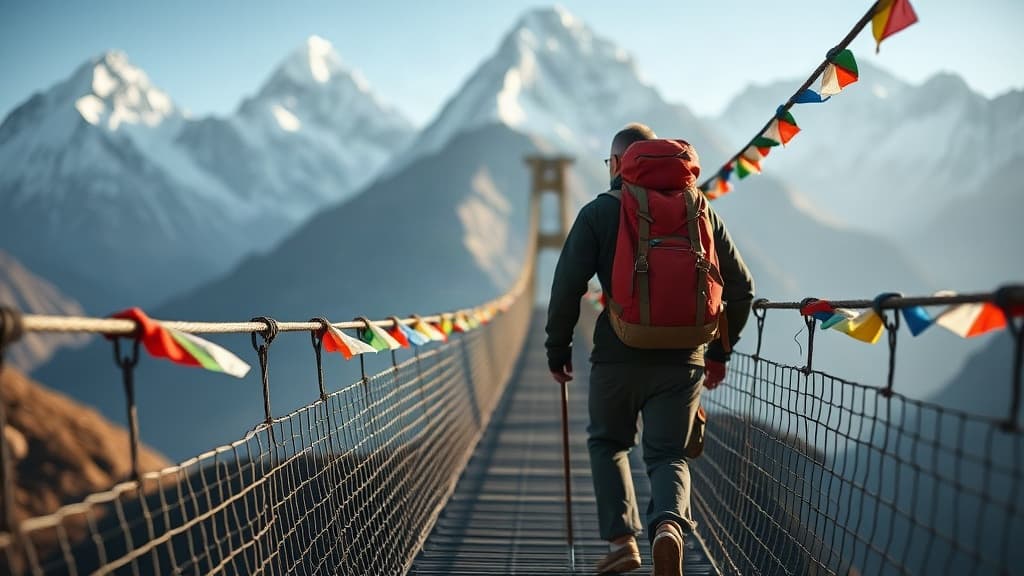
At a glance
- Trekking permits
- NPR 6,000 (~US$45) total, two permits
- Guide requirement
- Mandatory since 1 Apr 2023
- Spring 2026 climbing permits
- 492, a new record
- Peak-season Lukla flights
- Depart Ramechhap, not Kathmandu
- Best trekking months
- Mar-May and Sep-Nov
- Summit royalty (spring)
- US$15,000 per climber
Everest Base Camp — Everest Base Camp · Tribhuvan International Airport, Kathmandu · Lukla (Tenzing-Hillary Airport) · Namche Bazaar
Nepal's Department of Tourism issued 492 Everest climbing permits for spring 2026 — a new record, up from 468 in 2025 and past the previous high of 478 in 2023 — generating roughly Rs1.07 billion (about US$7.7 million) in royalty revenue, the Kathmandu Post reported on 8 May 2026. That number is climbers going for the summit — Everest Base Camp (EBC) itself, the walk-in viewpoint the vast majority of visitors actually do, is a separate and far more affordable trip that doesn't touch the climbing royalty at all. The same record season is a useful excuse to lay out, with real 2026 numbers, what an EBC trek actually costs and what changed in the rules to get there.
The permits an EBC trekker actually needs
Trekkers headed only to Base Camp don't pay the climbing royalty — that fee applies to summit permits above Base Camp. What every foreign trekker does need is two area permits, both required to enter the Khumbu on foot: the Sagarmatha National Park entry permit (NPR 3,000, about US$23) and the Khumbu Pasang Lhamu Rural Municipality permit (also NPR 3,000, raised from NPR 2,000 in the prior season) — NPR 6,000 total, roughly US$45. Both are checked at Monjo, the park entrance a short walk past Lukla, and both can be bought there or in advance in Kathmandu. The old TIMS trekking card was discontinued for the Khumbu route back in 2018 and isn't required here; don't pay for one if a booking site tries to add it.
The rule that ended solo trekking
Since 1 April 2023, every foreign trekker entering a Nepali national park or conservation area — Everest/Sagarmatha included — must be accompanied by a licensed guide or porter-guide booked through a government-registered trekking agency, the Kathmandu Post reported when the rule took effect, citing a string of accidents and missing-trekker incidents as the stated reason. It effectively ended unguided solo trekking on Everest, Annapurna and Langtang alike, and by the 2026 season it's fully and consistently enforced rather than the patchily applied rule it was in its first year — budget the guide fee into your trip cost, not as an optional extra.
Getting to Lukla means checking which airport you're flying from
Almost every EBC trek starts with a short, weather-dependent flight to Lukla's Tenzing-Hillary Airport. During the two peak trekking windows — 1 April to 15 May and 1 October to 15 November 2026 — Lukla flights don't depart Kathmandu's Tribhuvan International Airport at all; they're diverted to Ramechhap's Manthali Airport, roughly 132km and a 4-6 hour road transfer from Kathmandu, because Manthali's lower elevation and cleaner morning visibility window let airlines run more Lukla rotations with fewer weather delays. That means an EBC trip in the two best trekking seasons starts with a pre-dawn bus or jeep to Ramechhap the night before or morning of your flight — build that transfer into your itinerary rather than assuming a same-day Kathmandu departure.
Lukla's runway is short, uphill and weather-sensitive at both ends of the route. Build at least one buffer day into your Kathmandu stay before an international connecting flight home — multi-day fog delays aren't the norm, but they aren't rare either, and a missed Lukla departure cascades into a missed onward flight if the schedule has no slack.
When to actually go
The two trekking windows — March to May (pre-monsoon, also Everest climbing season, which is exactly why 2026's record permit count matters to trekkers too: expect a busier Base Camp and fuller teahouses along the route in April and May) and September to November (post-monsoon, clearer mountain views, generally the calmer of the two) — are when trails, teahouses and flights are running at full capacity and most reliable. Winter (December-February) is possible but cold and quieter; the June-August monsoon brings low cloud that grounds Lukla flights for days at a stretch and is the season to avoid booking around. Nepal's mountaineering community is watching the same spring crowding the record permit count implies: mountaineering expert Ang Tshiring Sherpa told the Kathmandu Post that managing around 200 climbers a day on the summit push is realistic if the weather holds, while a Department of Tourism spokesperson described the season's climber numbers as manageable despite route-preparation delays. Base Camp itself sees far more daily traffic than that from trekkers alone during the same weeks, so a spring booking should expect a busier, more social trail rather than a solitary one — autumn is the better call if a quieter Khumbu matters more than clear-sky reliability.
The altitude is the real itinerary constraint
Base Camp itself sits at 5,364m, but most guided itineraries route trekkers up to Kala Patthar first — a viewpoint above Gorak Shep that tops out around 5,545m (its true rocky summit reaches 5,644m) and gives the clearest look at Everest's south face on the whole route, better than the view from Base Camp proper, which sits below a ridge that blocks the summit itself. Getting there takes 10-14 days round-trip from Lukla precisely because of altitude, not distance: Namche Bazaar at 3,440m is the standard first acclimatization stop, with a second rest day usually built in around Dingboche or Pheriche before pushing past 4,500m. A licensed guide — mandatory since 2023 — is also the person watching for altitude sickness symptoms on the days that matter most, which is as much the point of the rule as the safety incidents that prompted it.
Nepal's SIM rules are the honest reason to sort connectivity before you land
A Nepali prepaid SIM is straightforward to buy but not quick: both major carriers require an in-person visit with your original passport, a passport photo, and — per Ncell's own tourist-SIM page — a biometric thumbprint taken at the counter, on top of a photocopy the vendor makes on the spot. That's a manageable queue at Tribhuvan International Airport on arrival, but it's a queue you don't need at all above Lukla, where signal is patchy and every hour spent on paperwork is an hour not spent adjusting to altitude. An eSIM installed and activated before you fly sidesteps the passport-and-biometrics counter entirely — check device compatibility on Roameo's eSIM compatibility page and browse Nepal eSIM plans before you go, so data is one less thing to sort out once you're on the trail.
FAQ
Do EBC trekkers pay the $15,000 Everest climbing fee?
No. The US$15,000 South Col royalty that took effect on 1 September 2025 applies only to summit-attempt climbing permits above Base Camp. Trekkers who go only as far as Everest Base Camp pay the NPR 6,000 (~US$45) Sagarmatha National Park and Khumbu Pasang Lhamu Rural Municipality permits instead.
Can I still trek to Everest Base Camp without a guide?
No. Since 1 April 2023, every foreign trekker entering Sagarmatha National Park must be accompanied by a licensed guide or porter-guide booked through a registered trekking agency; the rule is fully enforced as of the 2026 season.
Why do Lukla flights leave from a different airport in peak season?
From 1 April-15 May and 1 October-15 November 2026, Lukla flights operate out of Ramechhap's Manthali Airport rather than Kathmandu's Tribhuvan International Airport, because Manthali's lower elevation gives a longer, more reliable morning flying window and lets airlines run more rotations with fewer weather delays.
Is there mobile signal on the EBC trail?
Coverage exists at most overnight stops via local towers and paid Wi-Fi (Everest Link) in teahouses, but it's patchy above Namche Bazaar and a Nepali SIM requires an in-person passport-and-biometric registration, which is easier to sort out before you fly than to queue for after landing.
Keep reading
Everest Base Camp Autumn 2026: Permits, Flights and Signal
From 25 September every Lukla flight leaves from Ramechhap, not Kathmandu. What the autumn 2026 Everest Base Camp season costs, and how to stay online.
Read more
Dubai Late-2026 Guide: Museum of the Future Closes for a Revamp
Dubai's Museum of the Future shuts mid-September 2026 for a year-long revamp. Here is what closes, what opens instead, and the entry rules that just changed.
Read more
Normandy's D-Day Beaches Just Became a UNESCO World Heritage Site
UNESCO inscribed Omaha, Utah, Gold, Juno, Sword and Pointe du Hoc on 26 July 2026. Here's what's free, what costs money, and the visitor change coming before 2027.
Read more