
Geirangerfjord in 2026: Norway's New Zero-Emission Fjord Rule
Since 1 Jan 2026, ships under 10,000 GT entering Geirangerfjord must run zero-emission. What that changes for a 2026 visit, and what it costs to see the fjord.
Destinations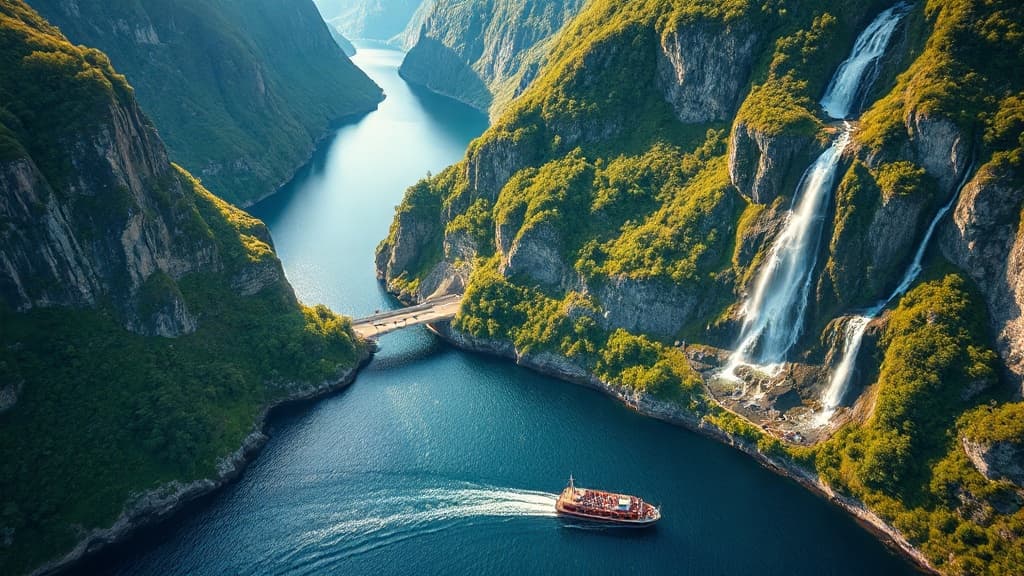
At a glance
- Zero-emission rule
- In force since 1 Jan 2026 for ships under 10,000 GT
- Threshold expands
- To ships 10,000 GT and above from 1 Jan 2032
- Sightseeing cruise
- From 610 NOK (~US$58) adult, Geiranger Fjordservice
- Nearest airport
- Alesund (AES), about 3 hours by road to Geiranger
- UNESCO status
- Geirangerfjord and Naeroyfjord, inscribed together in 2005
- Geiranger-Hellesylt ferry
- Car ferry, about 1 hour, runs year-round
Geiranger — Geiranger · Alesund Airport, Vigra · Hellesylt · Flam
Since 1 January 2026, every passenger ship under 10,000 gross tonnes has had to run on a genuinely zero-emission energy source — no direct CO2 or methane — the moment it enters Geirangerfjord or Naeroyfjord, Norway's two UNESCO World Heritage fjords. The rule is real and it is already changing what the boats on the water sound and smell like this season, even though the headline "cruise ship ban" most travellers heard about has been delayed.
What actually changed on 1 January 2026
Norway's amended Environmental Safety Regulations put a phased, tonnage-based zero-emission requirement into force for passenger ships operating inside the two protected fjords. Ships under 10,000 GT — which covers the local sightseeing boats, the car ferries, and most small-ship expedition vessels — must now run on energy sources producing no direct CO2 or CH4 emissions, verified by Lloyd's Register class notes and corroborated by the Norwegian Coastal Administration (Kystverket). Where shore power is available in fjord ports, ships must connect to it rather than idle on generators. The requirement doesn't reach the big oceangoing cruise ships yet: vessels of 10,000 GT and above — the ones that carry most of the passengers you'll actually see disembarking at Geiranger's pier — get until 1 January 2032 before the same rule applies to them. An earlier, more ambitious plan to ban conventional cruise ships from the fjords outright by 2026 was pushed back to 2032 after industry pressure over limited zero-emission ship availability and port charging infrastructure, a delay environmental groups have criticised.
For a 2026 visitor, the practical effect is on the smaller boats you're most likely to book yourself: Geiranger's own sightseeing cruises now run on hybrid-electric power, marketed specifically as a "silent" 2-hour option alongside the classic 75-minute tour, both departing from the Geiranger waterfront and both priced from 610 NOK (about US$58) for an adult, with children at 50% of that fare, per Geiranger Fjordservice, the operator running the cruise under the VISIT Geiranger brand.
Getting to Geirangerfjord
Alesund Airport (AES) on the island of Vigra is the nearest airport with regular domestic connections, and from there it's roughly 3 hours by road to Geiranger — a drive that includes a car ferry crossing partway. If you'd rather not drive, Alesund also has bus connections into the fjord region, and travellers coming from further afield can route via Oslo or Trondheim by train to Andalsnes, then bus onward. The classic way to see the fjord itself without booking a dedicated cruise is the Geiranger-Hellesylt car ferry, a roughly one-hour crossing that runs year-round and doubles as a scenic ride past the fjord's cascading waterfalls — it's operated within the same zero-emission tonnage bracket as the sightseeing boats, so as of this year it's also running on the same clean-energy footing.
Geirangerfjord and Naeroyfjord aren't the same trip
The zero-emission rule covers both of Norway's UNESCO-inscribed fjords — Geirangerfjord in the north and Naeroyfjord, near Flam, further south — and they were listed together by UNESCO in 2005, but they're not close to each other and most visitors pick one rather than both in a single trip. Flam is the better-known name internationally because of the Flam Railway, a separate scenic train that connects down to the fjord from the mountain station at Myrdal, with one-way adult fares running from about 430 NOK (roughly EUR37) in low season up to 510 NOK (about EUR45) in high season, based on fares checked against the operator's own booking system in April 2026. If your itinerary is built around Bergen, Naeroyfjord and Flam sit naturally on that route, reached by train down from Myrdal rather than by the road-and-ferry combination Geiranger needs. If you're flying into Alesund or Trondheim instead, Geiranger is the more direct target and Flam isn't worth the detour on a short trip. Either way, the same 2026 zero-emission requirement now applies to the small ships and ferries on both fjords, so the "quieter boat" upside holds whichever one you pick.
Why the rule exists
Geirangerfjord and Naeroyfjord were inscribed as a joint UNESCO World Heritage site in 2005 for their dramatic, near-vertical scenery — steep glacially carved walls, waterfalls dropping straight into the water, and abandoned mountain farms still visible on the cliffsides. Cruise traffic through the fjords has climbed for years, and Norwegian authorities have stated the explicit aim of the regulation is protecting that landscape from the exhaust and underwater noise a conventional diesel-powered fleet generates in a narrow, enclosed waterway. Norway isn't waiting on the big ships to catch up before doing something: smaller operators, who serve the volume of everyday visitors, are the ones bound by the rule starting this year.
Planning around it
None of this changes entry requirements or costs much for an independent traveller — there's no new visitor fee tied to the emissions rule itself. What it does mean is that if part of the appeal of Geiranger for you is a quiet boat ride under a waterfall rather than a diesel engine's throb bouncing off the cliff walls, 2026 is meaningfully quieter than 2025 was, at least on the smaller vessels most independent travellers actually book. If you're specifically trying to time a visit around one of the large international cruise ships, be aware those still run on conventional fuel until 2032 and remain the dominant source of the fjord's summer crowding — Geiranger's high season (June-August) is still the point at which cruise-day crowds are heaviest at the pier and on the short walking trails nearest the village.
Norway is inside the Schengen area, so most Western travellers need no visa for a short stay, though the point still holds for connectivity: mobile coverage along the fjord walls and in the ferry crossings can be patchy compared with Norway's cities, so it's worth having a Norway eSIM loaded before you leave cell coverage in Alesund or Bergen, rather than hunting for a local SIM once you're already in the fjord. Compare plan sizes against your trip length on our plan comparison page before you fly.
FAQ
Does the zero-emission rule mean cruise ships are banned from Geirangerfjord in 2026?
No. Only passenger ships under 10,000 gross tonnes — local ferries, sightseeing boats, and most small expedition ships — are required to run zero-emission from 1 January 2026. Large oceangoing cruise ships (10,000 GT and above) remain on conventional fuel until the same requirement extends to them on 1 January 2032.
How do I get from Geiranger to Naeroyfjord or Flam?
They're separate fjords in different parts of Fjord Norway with no direct fast link between them. Geiranger is reached via Alesund; Flam and Naeroyfjord are typically reached via Bergen and the Flam Railway. Plan them as separate legs of a longer Norway trip rather than a single day's travel.
What does the Geiranger sightseeing cruise cost in 2026?
Geiranger Fjordservice's official sightseeing cruise starts from 610 NOK (about US$58) for an adult, with children priced at 50% of the adult fare, for either the 75-minute classic tour or the 2-hour hybrid-electric option.
Is Geiranger easy to reach without a rental car?
Yes, though it takes some planning. Alesund Airport has regular domestic flights and onward bus connections to Geiranger, and the Geiranger-Hellesylt car ferry can substitute for a chunk of the road route while doubling as a scenic cruise.
Keep reading

Lofoten, Norway: Beat the New Tourist Tax Before January 2027
Norway's first visitor tax takes effect 1 July 2026. Vågan, gateway to Lofoten, plans to start charging it 1 January 2027 — what changes and when to go.
Read more
Cappadocia in 2026: Balloon Prices, BalonFest and Booking
Cappadocia's balloon festival just wrapped and 2026 flight numbers are record-setting. What a flight costs, why so many get grounded, and when to book.
Read more
El Nido, Palawan in 2026: World's No.1 Beach, New e-Visa Rule
Entalula Beach just topped the World's 50 Best Beaches list, and US/Caribbean travelers can now e-Visa online. What El Nido costs and how to get there in 2026.
Read more