
Hallasan Autumn 2026: Reservations and Trail Times
Book Hallasan's November foliage window, choose Seongpanak or Gwaneumsa, and follow the stricter October cutoffs for a safe Baengnokdam hike on Jeju Island.
Guides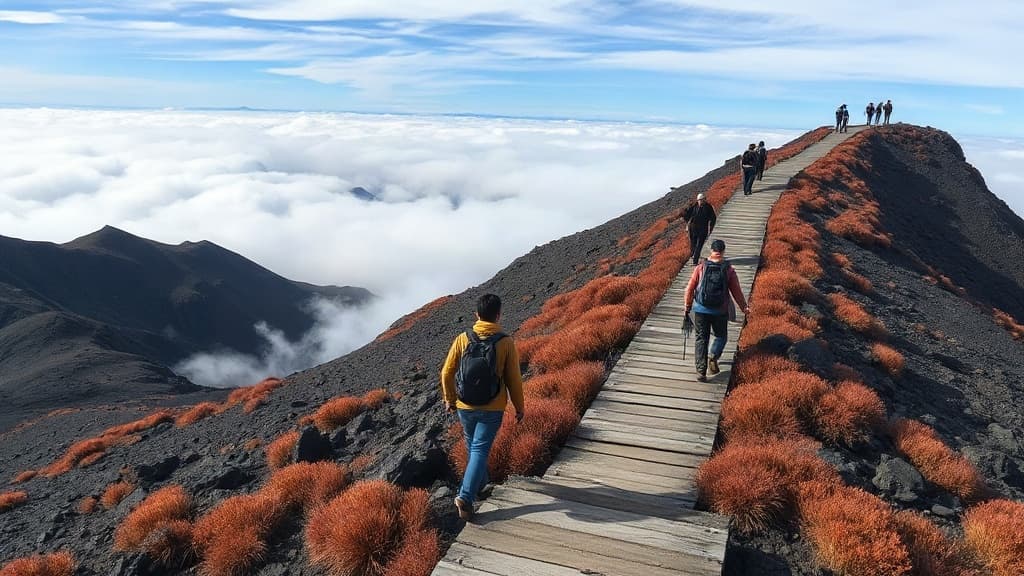
At a glance
- November booking
- 09:00 KST on the first October business day
- Peak foliage
- Late October to early November
- Seongpanak
- 9.6 km one way; about 4.5 hours up
- Gwaneumsa
- 8.7 km one way; about 5 hours up
- October cutoff
- 11:30 at entrance and upper checkpoint
- Summit descent
- Leave Baengnokdam by 13:30
Baengnokdam summit — Baengnokdam summit · Seongpanak trailhead · Gwaneumsa trailhead · Jeju International Airport
Hallasan's November summit reservations are due to open at 09:00 KST on the first October business day, just as the Gwaneumsa summit section reaches the scheduled end of its summer maintenance closure. That matters on 28 September 2026 because Jeju's tourism authority puts the mountain's peak foliage in late October to early November. A traveller waiting for the leaves to turn before booking may find that the useful summit slots have already moved.
The practical move is to choose a route now, make the free trail reservation as soon as the November window opens, and recheck the live operating notice before leaving Jeju City. Hallasan's own pages also classify October as winter for access control, which brings an earlier cutoff than many autumn summaries suggest.
Book the summit route before arranging the rest of the day
Only two routes reach Baengnokdam, Hallasan's summit crater: Seongpanak and Gwaneumsa. The reservation does not cover every metre of those trails. It controls the upper Seongpanak section from Jindallaebat to Baengnokdam and the upper Gwaneumsa section from Samgakbong to Baengnokdam. Jeju's official Hallasan visitor page says the normal daily allocation is 1,000 people on Seongpanak and 500 on Gwaneumsa.
The park's reservation notice opens the next month's dates at 09:00 KST on the first business day of the preceding month. It gives the example that a holiday or weekend can shift the opening to the next business day. Under that published rule, November 2026 inventory is expected at 09:00 KST on the first October business day; check the reservation-system banner in case the operator announces a local change.
One booking can contain up to four hikers. Each named visitor receives an individual QR code and must present matching identification, including a passport for an international visitor. The park tightened its identity check in a June 2026 notice: a QR code whose personal details do not match the ID can be rejected, and traded codes can bring a one-year restriction. Enter every name and birth date carefully rather than booking four generic places and trying to decide the group later.
If you cannot hike, cancel before the end of your reserved entry window. The park's booking guide says one uncancelled no-show can block reservations for three months; a second can block them for one year.
Seongpanak or Gwaneumsa: the useful differences
Seongpanak is the longer but more gradual summit approach. The park lists it as 9.6 km one way; about 4.5 hours up, with a nine-hour return estimate. Its length and gentler profile make it the more obvious first choice for hikers who value a steady ascent over dramatic terrain. It is not a short day: the official estimate assumes a full out-and-back before food stops, summit queues or slow movement on wet boards.
Gwaneumsa is shorter and steeper. Its official route page gives 8.7 km one way; about 5 hours up, with a ten-hour return estimate. The trail passes the Samgakbong shelter and tackles a larger elevation change over less horizontal distance. A common plan is to ascend Seongpanak and descend Gwaneumsa, but transport then has to connect two different trailheads. Both routes require a summit reservation when their upper sections are operating.
| Route | Official one-way length | Official ascent estimate | Best fit |
|---|---|---|---|
| Seongpanak | 9.6 km | About 4.5 hours | A longer, steadier summit day |
| Gwaneumsa | 8.7 km | About 5 hours | A steeper route through deeper mountain terrain |
The upper Gwaneumsa section from Samgakbong to Baengnokdam was closed from 1 August through 30 September 2026 for rockfall-prevention work. The same official visitor page says Seongpanak was the only summit route during that period. The date range points to a 1 October return, but a scheduled end is not the same as a day-of opening. Use the live Hallasan reservation and trail-status page before committing to a cross-mountain itinerary.
October's cutoff is earlier than the word “autumn” suggests
Hallasan's route operator divides the year into a summer season from April through September and a winter season from October through March. On both Seongpanak and Gwaneumsa, entry begins at 05:00. In October, the winter control applies: the 11:30 cutoff is at the entrance and upper checkpoint, and hikers must leave Baengnokdam by 13:30.
A current Visit Jeju autumn feature summarizes the October cutoff as 12:30, while the park operator's route pages classify October as winter and print 11:30. Plan to the stricter operator time, not the more generous summary. Arriving at 11:25 is still a poor plan: the official ascent estimates are measured in hours, daylight is shortening, and weather can trigger a partial or full closure even when a reservation exists.
The same tourism feature identifies late October through early November as the normal foliage peak. That describes a seasonal window, not a promise for one date or elevation. Hallasan's colour changes in bands, and conditions near the summit can be far colder and windier than Jeju's coast. Treat the leaves as a bonus attached to a safely timed mountain day.
You can hike Hallasan without a summit reservation
If the summit inventory is gone, do not buy a QR code from another person. The park lists Eorimok, Yeongsil, Donnaeko, Eoseungsaengak and Seokguram as routes that do not need a trail reservation. Eorimok and Yeongsil reach the Witse Oreum area rather than Baengnokdam, so they solve a different problem: an autumn mountain walk without the summit checkpoint.
Visit Jeju specifically recommends Yeongsil to Witseoreum for cliffs and autumn colour, Eorimok to Witseoreum for foliage and silver grass, and the shorter Eoseungsaengak option for a lighter outing. These are not consolation prizes disguised as the summit. They are sensible alternatives when the forecast, available time or reservation calendar makes Baengnokdam a bad fit.
Do not assume that “no reservation” means “no control.” Weather restrictions still apply across the national park. Check the live status in the morning and turn around at any staffed cutoff.
Getting to the trailhead without losing the slot
Jeju International Airport is the island gateway on the map, but neither summit trail begins beside the airport or in central Jeju City. Build the trailhead transfer into the previous evening's plan. The park warns that Seongpanak's small car park fills very early and explicitly recommends buses 181 or 281. A taxi or arranged transfer can reduce uncertainty for Gwaneumsa, especially if you intend to finish at a different trailhead from the one where you started.
Save the Korean trailhead name, the booking confirmation and your return transport details offline. Seongpanak and Gwaneumsa are not interchangeable at the gate: the reservation is tied to a route and time window. If you plan a Seongpanak-up, Gwaneumsa-down traverse, tell the driver the correct morning entrance and have a separate plan for the afternoon endpoint.
The official notice also says there are no shops on Hallasan. Carry enough water and food from town. Disposable lunch containers are prohibited under the park's current guidance, and Visit Jeju says there are no bins on the mountain, so pack food in reusable containers and carry every wrapper back down.
Entry rules and phone preparation for Jeju
South Korea's entry permission depends on the passport you hold. The official K-ETA notice extends the temporary exemption for the countries and regions already covered by it through 31 December 2026. That does not make every passport visa-free. Check whether your passport needs a visa, a K-ETA or neither before arranging the flight, and do not infer your rule from another traveller's nationality.
For the mountain, download each hiker's QR code, a screenshot of the reservation, the trail-status page and an offline map. A working data connection is useful for bus changes and the live closure notice, but it should not be the only place your entry code exists. If your unlocked phone supports eSIM, compare South Korea eSIM plans before departure and confirm compatibility; network conditions on a mountain route can change with terrain and weather.
A booking sequence that works
- Choose Seongpanak, Gwaneumsa or a non-summit route before the November window opens.
- For a summit hike, reserve at the official site from 09:00 KST on the first October business day and enter the details of every hiker exactly as shown on ID.
- Book accommodation and transport around the confirmed route, not the other way around.
- During the week before the hike, inspect the forecast and the park's operating notices.
- On the morning, check live trail status, carry the QR code and passport offline, and arrive well before the 11:30 control.
FAQ
When do November 2026 Hallasan reservations open?
The published rule opens the next month's dates at 09:00 KST on the first business day of the preceding month. That points to the first October business day for November 2026. Check the official reservation banner in case a holiday or operational notice changes the release.
Do I need a reservation for every Hallasan trail?
No. A reservation controls the upper summit sections of Seongpanak and Gwaneumsa. Eorimok, Yeongsil, Donnaeko, Eoseungsaengak and Seokguram can be used without a trail reservation, although weather closures and park instructions still apply.
Will Gwaneumsa be open in October 2026?
The scheduled rockfall-prevention closure of the upper Gwaneumsa section runs through 30 September 2026. Check the live trail-status page before travel because maintenance, wind or other weather can extend or replace a planned closure.
Which Hallasan route is shorter?
Gwaneumsa is shorter at 8.7 km one way, but the park estimates about five hours to the summit. Seongpanak is 9.6 km one way with an official ascent estimate of about four and a half hours, reflecting its steadier profile.
What is the October summit cutoff?
The route operator classifies October as winter. Its current pages set an 11:30 cutoff at the entrance and upper checkpoint, and require hikers to leave Baengnokdam by 13:30. Start much earlier than the cutoff for a full summit day.
Do foreign visitors need a passport at the Hallasan gate?
Every reserved hiker must show an individual QR code and matching ID. For an international visitor, the park's English notice specifically includes a passport as acceptable identification.
Keep reading
Busan K-Tour Pass 2026: Price, Benefits and Pitfalls
Busan's new K-Tour Pass costs KRW 15,000. See what its rail discount, free attraction, transit card and missing fine print mean for your trip in 2026.
Read more
Seoraksan Heullimgol Valley 2026: Free Access Ends September 30
Heullimgol Valley's free entry ends Sept 30, 2026, then a 5,000-hiker cap begins as Seoraksan's foliage peak forecast lands Oct 16-25. Here's how to book it.
Read more
Korea e-Arrival Card: The K-ETA Visa Exception
A valid K-ETA usually exempts you from Korea's e-Arrival card, but not when you enter with a visa. Match the form to your entry status.
Read more