
Kansai Airport to Namba: Rapi:t or Airport Express?
Both Nankai trains reach Namba from Kansai Airport. Compare the real journey, seat reservation, ticket layers and Terminal 2 transfer before choosing.
Travel tips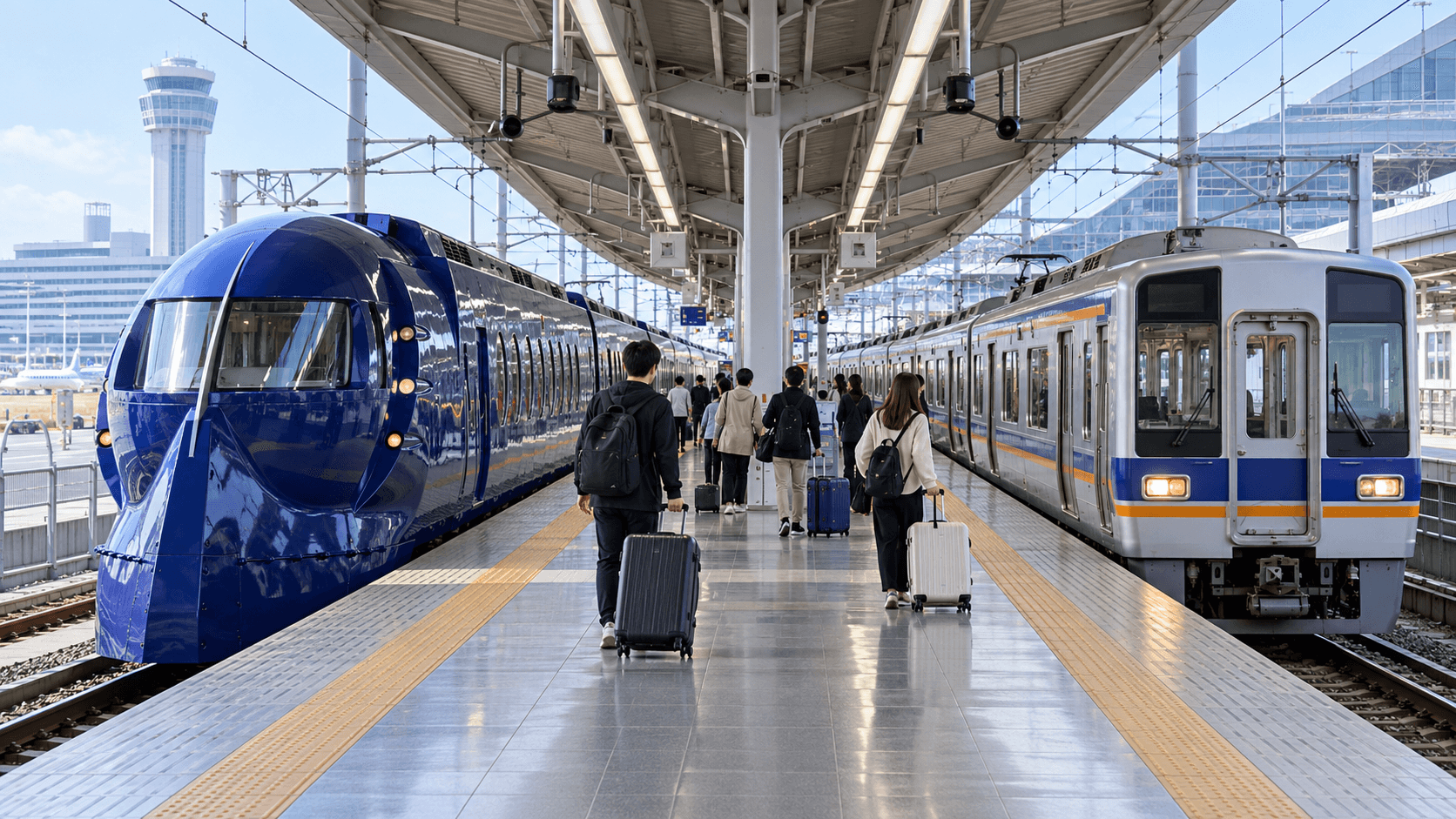
At a glance
- Rapi:t
- Fastest 34 minutes
- Airport Express
- About 45 minutes
- Rapi:t ticket
- Base fare plus express ticket
Planning an Osaka arrival for the autumn travel period? Kansai International Airport has two Nankai trains that people often conflate because both go to Namba: the limited express Rapi:t and the Airport Express. Nankai's train guide describes Rapi:t as taking as little as 34 minutes and the Airport Express as taking about 45 minutes. The practical choice is not simply “fast train or slow train.” It is whether a reserved limited-express seat, its additional ticket and its next departure fit your actual arrival better than a standard train that needs only the normal fare.
Which train should you take?
Take Rapi:t when you value a reserved seat and a clear train choice after a long flight, especially if its departure is convenient. Nankai says an additional limited-express ticket is required on top of a normal train ticket. That extra layer matters at the gate and when comparing prices. Take the Airport Express when you are content with a regular train and want the simpler normal-ticket requirement. Nankai's published approximate travel times make the on-train difference modest enough that a badly timed Rapi:t can lose its advantage while you wait. Compare the next actual departure and arrival in Nankai's live timetable, not just the fastest advertised journey.
Both services are Nankai trains to Nankai Namba. This is useful if your accommodation or onward route is around Namba, but the name “Osaka” alone is too broad for choosing an airport train. A hotel near another Osaka station may need another train or a transfer after Namba. Work backward from your hotel's nearest station and exits before purchasing. The train that looks cheapest or fastest to Namba is not necessarily the easiest end-to-end route with a suitcase. The decision here is specifically between Nankai's two direct Namba services, not between every airport route in Kansai.
Why the advertised minutes are not the whole journey
Nankai's timetable page says the Rapi:t minimum is 34 minutes and Airport Express is about 45 minutes. Its airport access guide gives approximate figures around 38 and 44 minutes for the route. These are train travel estimates from the station, not a promise about the moment you clear immigration, collect luggage or reach your hotel. The small variation across official pages is another reason to use the particular departure you might board. Once a flight lands, the wait to the next train can matter more than the difference in running time.
Think of the trip in parts: arrive at your terminal, reach Kansai-Airport Station, buy or activate the right product, wait for your departure, ride to Nankai Namba, then walk or transfer to the hotel. This simple decomposition prevents a misleading comparison. A traveler whose Rapi:t leaves just after they reach the platform may arrive earlier and seated. A traveler who has just missed it may do better on the next Airport Express. Neither conclusion can be known from a general timetable headline alone; check the day and time in the operator's schedule after the flight.
Understand the two ticket layers
Nankai explicitly says the Airport Express needs only a normal train ticket. Rapi:t needs a normal ticket plus a limited-express ticket. Its Rapi:t page describes regular and Super Seat products, assigned seats and several ways to buy the supplement. An online digital offer may bundle the normal fare and limited-express component, so do not automatically buy a second base ticket when the product description says it already includes one. Conversely, do not assume a regular fare card or ticket alone entitles you to sit on Rapi:t. Check the ticket's route, direction, train and seat before going through the gate.
The Rapi:t Digital Ticket instructions say you cannot use that product until you designate a date, train and seat after purchase. This detail is particularly important for an inbound flight: buying a flexible-looking digital product in advance does not mean you can step onto whichever Rapi:t is waiting. Complete the seat selection when you know your realistic departure. The operator also lists station counters and machines for limited-express tickets. If you are unsure what a discounted product contains, compare its terms against the base fare and supplement rather than adding two incompatible products in a hurry.
Do not let a promotional fare dictate the decision by itself. Discounts and campaigns can change. The reliable structural difference is the extra limited-express entitlement for Rapi:t and the normal-fare requirement for Airport Express. The latter is easier for a traveler who wants to keep the choice open until they see the board. The former has value when a known reserved seat is worth the additional cost to you. Check current prices in the operator's checkout before paying; this article does not treat one dated promotional price as a permanent fare.
Terminal 2 adds a step before either train
Kansai Airport's rail access page places Kansai-Airport Station beside Terminal 1 and the Aeroplaza building, both connected on their second floors. The railway station is not directly inside Terminal 2. The airport provides a free shuttle between Terminal 2 and the Terminal 1/Aeroplaza area, with an indicated ride of 7–9 minutes. That is only the shuttle travel time; walking, waiting and reaching the railway gate take additional time. If your airline uses Terminal 2, allow for the shuttle before assessing a departure on a timetable. The same logic applies in reverse when you are catching a flight from Terminal 2.
This is a common place to overpromise an airport transfer. “KIX to Namba in 34 minutes” starts at the railway platform, not at an arriving aircraft door or a Terminal 2 bus stop. If you are being met in Namba, give the person your likely train after clearing arrivals rather than a clock time calculated directly from scheduled landing. If you hold a reserved train ticket and your flight is delayed, inspect the ticket's change conditions before choosing a replacement. Do not infer a free change from the existence of later Rapi:t services.
A worked arrival decision
Suppose your flight arrives at Terminal 1, you have one rolling suitcase and a hotel close to Nankai Namba. After exiting customs, check Nankai's live departure list. If a Rapi:t with available seats departs soon enough for you to reach the station calmly, its reserved seat and shorter ride may be worthwhile. Buy the correct combined ticket or normal fare plus supplement through the official channel, then verify the train and seat. If the next Rapi:t requires a long wait and the Airport Express is about to leave, the ordinary train may get you to Namba earlier overall. The 34-versus-45-minute headline cannot settle that case; the actual departures do.
Now assume the same flight arrives at Terminal 2 and you are travelling with a child or a large amount of luggage. First add the airport shuttle and a reasonable station margin. Do not reserve a train so tightly that a queue at the bus or a slow walk makes it unworkable. A reserved Rapi:t seat may be appealing after you have reached the station, but the advance commitment has less value when your arrival timing is uncertain. If your group prefers simplicity, take the next suitable Airport Express with a normal fare. If a train's crowding or your mobility needs change the choice, ask Nankai staff about the next service rather than assuming every carriage will feel the same.
What to check at Namba and before the return flight
At Nankai Namba, read the onward walking or transfer route to your precise destination. The airport train's arrival at Namba is the end of this rail leg, not the end of every Osaka itinerary. On the return, use Nankai's Namba-to-airport timetable for your travel day rather than copying the inbound schedule. A Rapi:t reservation and an Airport Express departure need different ticket decisions in both directions. You should also verify the terminal on your flight booking. If it says Terminal 2, budget the free inter-terminal shuttle from Aeroplaza after the train; the airport's to-airport rail page describes that connection.
Keep the railway ticket and airline details accessible even if your phone loses a signal. If you rely on mobile reservation and navigation, choose a plan that fits the destination and check your handset at Roameo's compatibility page; compare the current Japan travel data options before buying. A data plan does not guarantee a specific network speed inside a station, so save essential travel documents offline. This small step is most useful when you have to change trains after a delay, and it does not alter the operator's ticket rules.
The simple choice
Choose the Airport Express for a direct Namba ride on a normal ticket when the next departure works. Choose Rapi:t for an available reserved seat when its actual departure, extra ticket and total cost make sense to you. Include Terminal 2's shuttle in your planning if relevant. Then verify the exact train and platform with Nankai on the day. That is a better decision than buying the product with the smallest advertised train time before you know when you will be standing at Kansai-Airport Station.
Frequently Asked Questions
Can I ride Rapi:t with only a normal Nankai fare?
No. Nankai says Rapi:t requires an additional limited-express ticket. Check whether a digital product already bundles that supplement with the normal fare.
Does the Airport Express go directly to Nankai Namba?
Yes. Nankai lists Kansai-Airport to Namba as its Airport Express route, with an approximate train journey of 45 minutes. Check the day's departure board.
Is Kansai-Airport Station inside Terminal 2?
No. The station connects to Terminal 1 and Aeroplaza. Terminal 2 passengers use the airport's free shuttle to reach the station area.
Keep reading

Van Gogh Museum or Rijksmuseum: Which One Visit Fits?
Have one Amsterdam museum slot? Compare the collections, timed-entry rules, late openings and pass conditions before choosing Van Gogh Museum or Rijksmuseum.
Read more
Shibuya Sky Daytime or Sunset: Which Slot Should You Buy?
Shibuya Sky charges by entry period, not by the moment you take a photo. Choose a daylight or sunset slot with the booking window and rooftop-weather rules in mind.
Read more
Schiphol to Amsterdam: Train or Bus 397 for Your Hotel?
The Schiphol train suits Amsterdam Centraal, while bus 397 serves Museumplein and Leidseplein. Choose by your hotel stop, ticket rules and arrival time.
Read more