
Kenya's New eTA Insurance Rule for Safari Travelers in 2026
Kenya confirmed a $50,000 insurance minimum tied to the eTA in August 2026 — what it covers, whether your home policy qualifies, and the rest of the entry checklist.
Destinations
At a glance
- Standard eTA fee
- $30 per traveler
- eTA processing time
- 3 business days (72 hours)
- eTA validity to enter
- 90 days from issuance
- New insurance minimum
- $50,000 combined coverage
- Medevac minimum
- $25,000 for emergency transport
- Rule source
- Gazette Notice No. 11492, 30 Jul 2026
Maasai Mara National Reserve — Maasai Mara National Reserve · Jomo Kenyatta International Airport, Nairobi · Amboseli National Park · Diani Beach
On 7 August 2026, Kenya's Ministry of Health confirmed a detail that had been sitting quietly inside a July gazette notice: travelers applying for the country's Electronic Travel Authorization (eTA) will need to show proof of travel insurance meeting specific minimum coverage thresholds, uploaded as part of the eTA application itself. If you're planning a Maasai Mara safari, a Diani Beach stretch, or any other Kenya trip for the rest of 2026, this is the one entry-rule change worth reading past the headline.
What the rule actually requires
The requirement traces back to Kenya's Social Health Insurance Act of 2023 and its 2024 implementing regulations, with the specific minimum coverage levels set out in Gazette Notice No. 11492, dated 30 July 2026. The Ministry of Health's 7 August clarification statement spelled out the combined minimum a visitor's policy must meet: $50,000 in total coverage, split across five categories — $20,000 for medical expenses, $25,000 for emergency medical evacuation, $5,000 for repatriation of remains, $1,000 for mental health care, and $300 for prescription medication.
The good news for anyone who already travels with a standard international policy: Kenya is not forcing visitors to buy a new policy from a Kenyan insurer the way Zanzibar does. A policy bought at home qualifies as long as it meets or exceeds those five thresholds. The clarification statement did not specify exactly when the insurance-upload field goes live inside the eTA application form, so the practical move is to buy a compliant policy before you apply rather than assume there's a grace period — a $50,000 international travel-medical policy is inexpensive relative to the cost of being turned away, and insurance is also sold at the point of entry from licensed local insurers if you arrive without prior coverage.
Check your existing travel insurance's declarations page against all five numbers above before you apply for the eTA — a policy that covers $30,000 medical but only $10,000 medevac would not meet the threshold even though the headline coverage number looks large enough.
The rest of the eTA, unchanged
Outside the new insurance line, Kenya's eTA process is the same one that's been in place since January 2024. A standard application costs $30 per traveler, including infants and children, and is generally processed within three business days (72 hours), though the official portal warns verification can take longer during peak season. You'll need a passport valid for at least six months with a blank page, a passport- style photo, your travel itinerary, and an accommodation booking. Citizens of the East African Community — Burundi, DR Congo, Rwanda, South Sudan, Tanzania and Uganda — are exempt.
The approved eTA is valid for travel within 90 days of issuance — that's the window to actually arrive in Kenya, not your permitted length of stay, which immigration sets at the port of entry. Apply well ahead of a booked safari departure so the 90-day clock and any processing delay don't collide with your travel dates.
Building the trip: Nairobi in, the circuit out
Most safari itineraries fly into Jomo Kenyatta International Airport in Nairobi, then connect by light aircraft or road to the reserves. The Maasai Mara draws the wildebeest migration crowds and the highest lodge prices; Amboseli, roughly a four-hour drive southeast of Nairobi, trades some of that density for reliable views of Kilimanjaro across the border in Tanzania and tends to book up faster for July–October game-viewing months. If you're tacking on a coastal stretch afterward, Diani Beach near Mombasa is the standard add-on and runs on a completely different climate calendar — check both before locking dates.
Connectivity across that circuit is inconsistent enough that it's worth sorting before departure rather than at Nairobi arrivals. Some safari camps in the Mara and Amboseli sit outside reliable 4G coverage entirely, so treat a data plan as coverage for towns and gateway cities, not a guarantee inside the bush. Check your phone's eSIM compatibility on Roameo's device compatibility page before you fly, and compare Kenya eSIM data plans against your expected days in Nairobi, the coast, and connectivity stops along the safari route — buying before departure means you can load your eTA confirmation and insurance documents onto your phone before you're standing at immigration without a signal.
A typical week-long circuit — two or three nights in the Mara, a couple more in Amboseli or on the coast, plus arrival and departure days in Nairobi — covers enough moving parts (lodge Wi-Fi that drops when the generator cycles, upload-heavy photo backups, mapping the drive between parks) that it's worth sizing a data plan generously rather than topping up mid-trip from a camp with no signal at all. Confirm your device supports eSIM before you travel; most phones sold in the last four years do, but a handful of carrier-locked or older Android models don't, and that's not something worth discovering at Jomo Kenyatta arrivals.
Timing a Mara trip around the rule
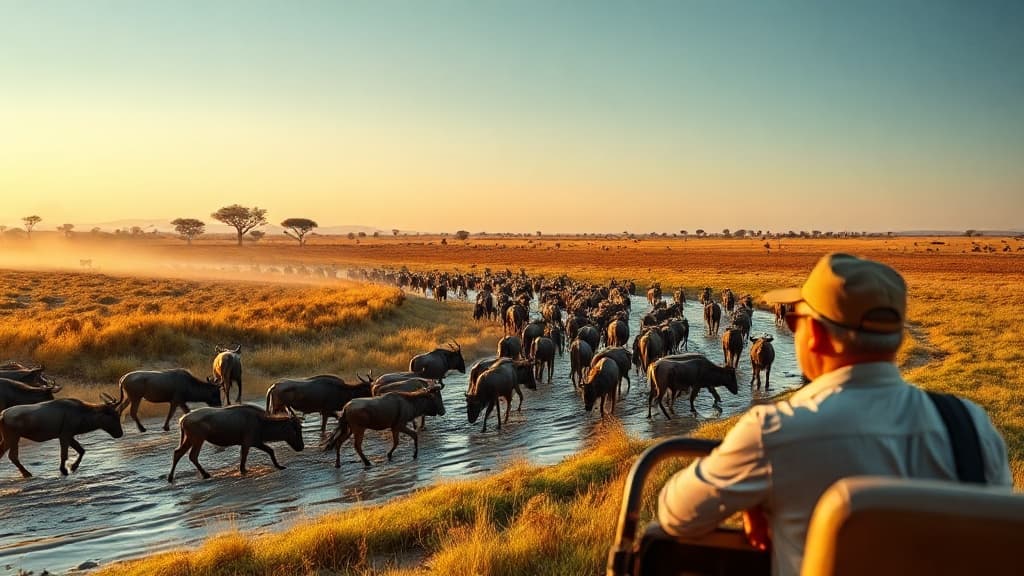
The Maasai Mara's Mara River crossings — the moment roughly 1.5 million wildebeest and their associated zebra and gazelle herds ford the river in a single push — happen primarily between July and September, though the herds move on rainfall rather than a calendar and can shift by weeks in either direction. The migration itself spends about nine months in Tanzania and only three in Kenya, so the Mara window is short relative to the demand it draws — camps in the reserve book out months ahead for peak crossing weeks.
That booking lead time works in your favor here: if you're reserving a Mara safari for next year's crossing season now, you have months to sort a compliant insurance policy before you ever touch the eTA form, rather than scrambling the week before departure once the upload requirement actually activates. Buy the policy, keep the declarations page or a summary letter showing all five coverage figures, and have it ready as a PDF on your phone alongside your eTA approval and accommodation confirmations.
Frequently Asked Questions
Do I need travel insurance to get a Kenya eTA right now?
The Ministry of Health's 7 August 2026 clarification confirmed the $50,000 minimum coverage requirement exists under Gazette Notice No. 11492, but did not give an exact date for when proof of insurance becomes a mandatory upload field in the eTA application. Buy a compliant policy before you apply rather than assume it isn't enforced yet.
Can I use my home country's travel insurance for Kenya's eTA?
Yes. Kenya accepts a policy purchased anywhere as long as it meets the combined $50,000 minimum split across medical expenses, medical evacuation, repatriation, mental health care, and prescription medication. You do not have to buy a separate policy from a Kenyan insurer.
How much does the Kenya eTA cost and how long does it take?
A standard eTA costs $30 per traveler and is generally processed within three business days (72 hours), according to the official eTA portal, though verification can take longer during busy periods.
How long is a Kenya eTA valid once approved?
The approved eTA must be used to enter Kenya within 90 days of issuance. Your actual permitted length of stay is set by immigration officers at the port of entry, not by the eTA itself.
Keep reading
Masai Mara 2026: The Migration Crossing Window Just Opened
Forecasters put the 2026 Mara River crossings between 10 August and 20 September. Here's what a peak-season park permit costs and how the 12-hour rule works.
Read more
Maldives 2026: Green Tax, 17% T-GST and the New OTA Tax Bill
A bill filed 15 August 2026 would tax foreign booking platforms 17%. Every fee a Maldives trip carries, plus the visa and IMUGA rules that get you there.
Read more
Macau Grand Prix 2026: The 73rd Race, 19-22 November
The 73rd Macau Grand Prix races the Guia Circuit on 19-22 November 2026. What recent tickets have cost, who needs a visa, and how to reach Macau from Hong Kong.
Read more