
Masai Mara 2026: The Migration Crossing Window Just Opened
Forecasters put the 2026 Mara River crossings between 10 August and 20 September. Here's what a peak-season park permit costs and how the 12-hour rule works.
Destinations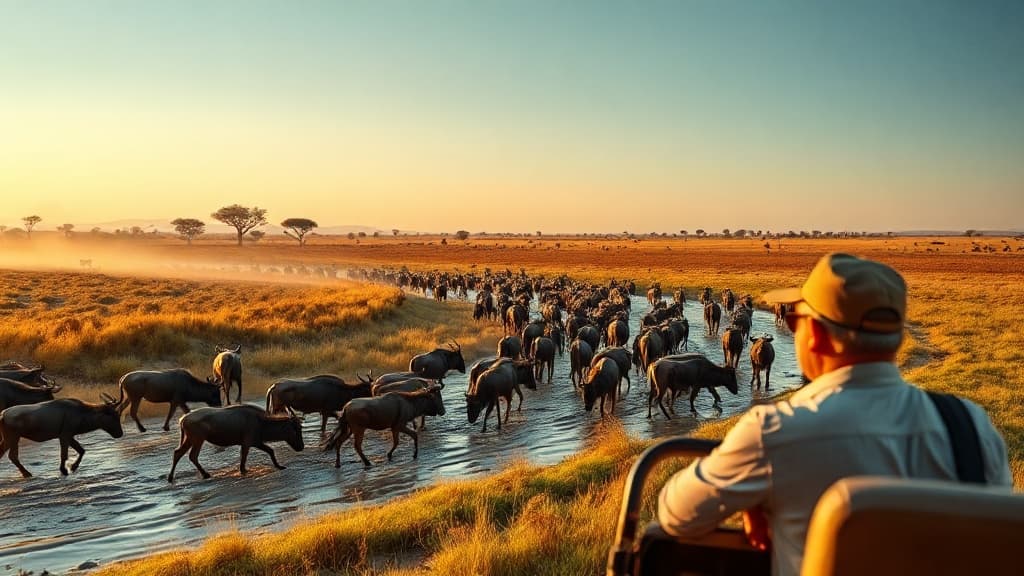
At a glance
- Crossing window
- 10 August - 20 September 2026
- Entry, Jul-Dec 2026
- US$200 per adult per day
- Entry, Jan-Jun 2026
- US$100 per adult per day
- Children 9-17
- US$50 per day; under-8s free
- Kenya eTA
- US$30 standard, US$20 transit
Masai Mara National Reserve — Masai Mara National Reserve · Nairobi
Forecasters tracking Kenya's Masai Mara put the 2026 Mara River crossing window between 10 August and 20 September, with mega-herds already settling into the reserve from the third week of July. One specialist operator narrows that further, to 22 August-7 September, while still advising travelers to hold three to five flex days either side. None of it is a fixed calendar — rainfall and river levels trigger a crossing, not a date on a brochure — but if you are weighing a Mara trip for this year's Great Migration, the window that matters most is open right now.
Why the timing is never guaranteed, and why that's the point
The wildebeest herds that make up the Great Migration follow grass and rain, not a schedule. Through August and into October, over a million wildebeest and hundreds of thousands of zebra funnel out of Tanzania's northern Serengeti and into Kenya's Masai Mara Triangle, crossing the crocodile-infested Mara River — sometimes several times in a single week, sometimes not at all for days. Operators who run migration safaris every year still describe the forecast as exactly that: a forecast. Booking at least four nights inside the window, rather than one or two, is the standard advice for actually seeing a crossing rather than just missing one by a day.
What a peak-season park permit costs
Kenya's Masai Mara National Reserve runs a split-season fee structure for 2026, and the split lands right on top of migration season. From 1 January to 30 June 2026, a non-resident adult paid US$100 per day. From 1 July to 31 December 2026 — covering the entire migration and crossing season — that rate doubles to US$200 per adult per day, under a Narok County restructuring of what used to be a flatter pricing model. Children aged 9-17 pay US$50 per day throughout the year; under-8s enter free.
| Traveler | Jan-Jun 2026 | Jul-Dec 2026 (migration season) |
|---|---|---|
| Non-resident adult | US$100/day | US$200/day |
| Non-resident child (9-17) | US$50/day | US$50/day |
| Under 8 | Free | Free |
That fee covers the reserve itself — Narok County's Sekenani, Talek, Musiara and Oloolaimutia gates. Many migration camps sit instead inside one of the private conservancies bordering the reserve — Mara North, Olare Motorogi, Naboisho, Ol Kinyei among them — which charge their own separate access fees on top of accommodation, typically US$80-100 per person per night depending on the conservancy, per current operator-published rates. A conservancy stay usually means fewer vehicles per sighting and permitted night drives, both banned inside the main reserve, but it is a genuinely separate cost from the reserve permit above, not an alternative to it if your itinerary also enters the reserve itself.
The 12-hour rule that catches people out
A Masai Mara entry ticket is valid for 12 hours, from 6am to 6pm, for visitors staying outside the reserve. The rule that trips up first-timers is on the way out, not the way in: guests departing by road on their last day must exit the reserve by 10am, and guests flying out must reach the airstrip by the same time. Miss that window and the reserve charges for an additional full day, regardless of how few hours you actually spend inside it. A short transit ticket, valid for two hours, exists specifically to let outside-based guests cross the reserve to reach an airstrip without paying for a full day they are not using for game viewing.
Most migration visitors fly in on a small charter from Nairobi's Wilson Airport to one of the Mara's dirt airstrips — Keekorok, Musiara, Ol Kiombo and others are scattered around the reserve and its bordering conservancies, with camps generally arranging the transfer from whichever strip is closest to your booking. It's a shorter, easier trip than the alternative overland drive from Nairobi, which is the main reason flying is the default for anyone whose itinerary is built around a tight crossing window rather than a longer overland safari circuit.
Getting into Kenya
Kenya no longer issues a traditional tourist visa; entry for most visitors runs through the Electronic Travel Authorization (eTA) system instead. The standard single-entry eTA costs US$30 through the official portal at etakenya.go.ke, a transit eTA for connecting flights costs US$20, and a one-year multiple-entry option costs US$300 — worth considering only if your itinerary crosses in and out of Kenya more than once, for example combining the Mara with a side trip to Rwanda or Uganda. Apply well before departure rather than at the airport; the eTA is an entry requirement, not a formality issued on arrival.
Staying connected on safari
Mara camps and lodges typically run their own Wi-Fi off a satellite or long-range cellular link, which is serviceable for messaging and photo backups but not something to plan a video call around. Safaricom's network reaches the gateway towns — Narok, and the airstrips serving the reserve — with signal thinning out the deeper into the reserve and surrounding conservancies you go. Setting up a Kenya eSIM before you fly means you land already connected rather than hunting for a local SIM counter at Wilson Airport or Narok; check your handset's eSIM support on the compatibility checker and compare Kenya plans on Roameo's destination pages. As a reseller operating over Safaricom's and other local carriers' existing infrastructure, Roameo can't promise signal inside the bush itself — treat data in the deep conservancies the way you'd treat it in any remote wilderness, as a bonus rather than a given.
Booking the trip around the window, not the other way round
With the crossing window running into late September and camps inside it filling on short notice once a crossing is confirmed, the practical sequence is: pick a base camp inside or bordering the Mara Triangle (the crossing points cluster there), book at least four nights rather than a flying overnight visit, and budget the US$200/day reserve fee plus any conservancy fee into the trip total before comparing camp rates. The fee doubling from January's US$100 is the one line that most catches travelers working from an older budget spreadsheet or a friend's trip report from earlier in the year.
Frequently Asked Questions
When are the Mara River crossings expected in 2026?
Forecasters place the window between 10 August and 20 September 2026, with one specialist operator narrowing it to 22 August-7 September. Crossings depend on rainfall and river levels rather than a fixed date, so operators recommend booking at least four nights with flex days either side.
How much does it cost to enter the Masai Mara during migration season?
From 1 July to 31 December 2026, the Masai Mara National Reserve entry fee is US$200 per non-resident adult per day, up from US$100 in the first half of the year. Children aged 9-17 pay US$50 per day; under-8s enter free. Private conservancies bordering the reserve charge separate access fees, typically US$80-100 per person per night.
What is the Masai Mara's 12-hour rule?
Entry tickets run from 6am to 6pm. Guests staying outside the reserve who are departing by road on their final day must exit by 10am, and those flying out must reach the airstrip by 10am — missing that deadline triggers a charge for an additional full day.
Do I need a visa for Kenya?
Kenya has replaced its traditional tourist visa with an Electronic Travel Authorization (eTA). The standard single-entry eTA costs US$30 through the official portal, a transit eTA costs US$20, and a one-year multiple-entry eTA costs US$300. Apply online before you travel.
Keep reading
Kenya's New eTA Insurance Rule for Safari Travelers in 2026
Kenya confirmed a $50,000 insurance minimum tied to the eTA in August 2026 — what it covers, whether your home policy qualifies, and the rest of the entry checklist.
Read more
Santorini and Mykonos Now Charge Cruise Visitors EUR20 to Dock
Every cruise passenger stepping off in Santorini or Mykonos this summer pays a landing fee — what it costs by season, and how ferry and flight arrivals skip it.
Read more
Torres del Paine's 2026/27 Season: Book Before It Fills
Reservations for Patagonia's W Trek opened months ago and December-February is filling fast. What park entry costs, and how the two-operator booking split works.
Read more