
Kinkaku-ji or Ginkaku-ji: Which Kyoto Temple Fits?
Choose Kyoto’s Golden Pavilion for its pond view or Ginkaku-ji for a garden walk. Compare hours, admission, access and mobility before planning one stop.
Travel tips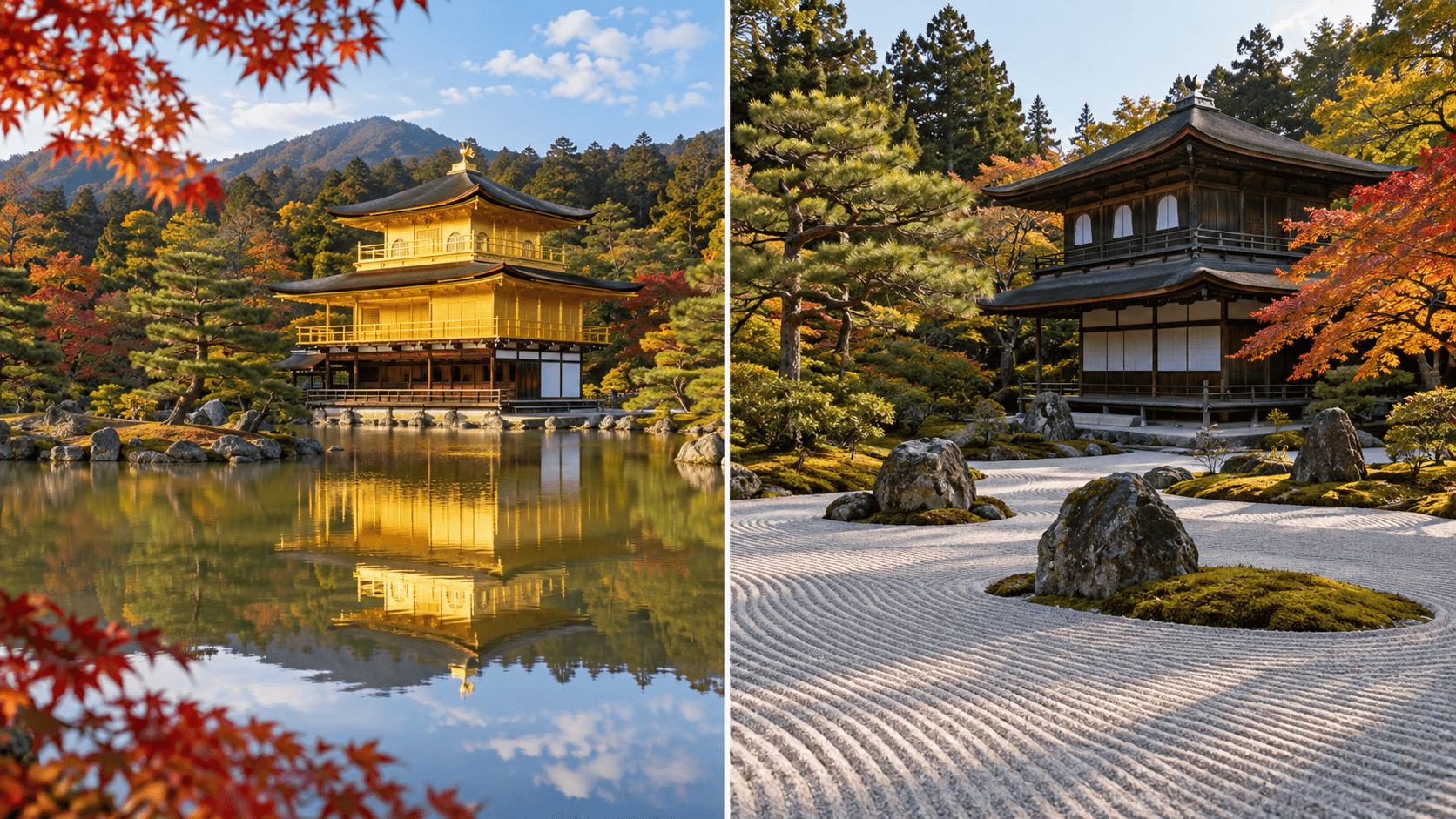
At a glance
- Kinkaku-ji admission
- General admission ¥500
- Ginkaku-ji admission
- General admission ¥1,000
- October opening
- Ginkaku-ji 8:30 a.m.; Kinkaku-ji 9 a.m.
Two Kyoto temple names seem to offer a simple gold-versus-silver choice, but the visits differ more than their colors. Kinkaku-ji, officially Rokuon-ji, centers a gold-leaf pavilion and pond. Ginkaku-ji, officially Jisho-ji, is a garden walk shaped by the culture of Kyoto's eastern hills; its pavilion is not a silver version of Kinkaku-ji. If your autumn 2026 Kyoto itinerary has space for only one, decide whether you want the iconic pond view or a slower walk through a designed landscape. The Kinkaku-ji and Ginkaku-ji operator pages also show different opening times and admission charges, so this is a practical planning decision.
Choose Kinkaku-ji for the pavilion and pond
The gold at Kinkaku-ji is a material feature, not just a nickname. The temple's visitor guide describes gold leaf on the pavilion's upper stories and the Kyoko-chi pond as the center of its garden. The famous view is across water toward the building and its reflection. If the image you most want to see in Kyoto is that composition, choose this temple. There are other structures and garden details along the route, but the pavilion is the clear focus of most first visits.
That expectation should also keep you from planning an interior tour. A standard visit is a walk through the grounds, with the pavilion seen from outside. The operator's accessibility FAQ says the route up to the Gold Pavilion is wheelchair accessible, while steps beyond it mean visitors who cannot use them must return to the entrance. This matters if your party includes someone with limited mobility: you can still reach the principal view, but you should not promise everyone the complete garden circuit. The site also says it has accessible toilets and may have wheelchairs available to borrow; ask on arrival rather than assuming one will be free.
Kinkaku-ji lists ordinary opening hours of 9 a.m. to 5 p.m. throughout the year, subject to changes for special exhibitions. General admission is ¥500 and admission for primary and middle school students is ¥300. These are the operator's posted figures checked for this guide, not a package tour price. If a reseller offers something different, identify exactly what additional service it includes. A standard temple visit need not be dressed up as a separate “skip-the-line” product without evidence from the operator.
Choose Ginkaku-ji for the garden experience
Ginkaku-ji is not covered in silver leaf. The temple's own history explains that the name “Silver Pavilion” arose in the Edo period as a contrast with the Golden Pavilion. It describes the site as the former Higashiyama palace of Ashikaga Yoshimasa, later a Zen temple. That history helps explain the different feel: the garden, paths, sand forms and hillside setting deserve attention as a whole. A visitor looking only for a silver facade is likely to miss what the site is designed to show.
Its grounds guide identifies the Ginshadan, a bank of shaped white sand, and the Kogetsudai, a truncated cone of sand. The guide is careful about the often-repeated stories that these were made to reflect or hold moonlight: it says there is little evidence those explanations date back to the Muromachi period. It is more accurate to admire the forms and the garden than to present folklore as a documented design instruction. The temple also sits by the Philosopher's Path, so it can anchor a walk in the eastern part of Kyoto if that already fits your day.
Ginkaku-ji's posted regular hours change with the season: 8:30 a.m. to 5 p.m. from March through November and 9 a.m. to 4:30 p.m. from December through February. The operator lists general admission at ¥1,000 and primary or middle school admission at ¥500; special exhibitions can change the price or hours. Its FAQ estimates about 30 minutes for a visit, but that is the temple's rough duration, not a requirement to rush through every garden view. In October, an early start here is possible before Kinkaku-ji opens.
The access question can settle the choice
Kinkaku-ji is in Kita-ku on Kyoto's northern side. Ginkaku-ji is in Sakyo-ku on the eastern hills. They are separate trips, not two neighboring buildings in one admission area. The Kinkaku-ji access page identifies Kinkakuji-michi as the relevant city bus stop; the Ginkaku-ji access page lists Ginkakuji-michi or Ginkakuji-mae. Each operator also gives bus connections between the two temple areas, including routes 102 and 204 from the Kinkakuji-michi side to Ginkakuji-michi. Check the current route and traffic before committing to a tight same-day schedule.
For a traveler already spending the morning around the eastern hills or the Philosopher's Path, Ginkaku-ji fits naturally. For someone whose day is built around northwest Kyoto, Kinkaku-ji may avoid crossing the city for one sight. This is an itinerary judgment, not a claim that one temple is universally more important. A first-time visitor with a single photo-focused stop may reasonably prioritize Kinkaku-ji; a visitor who has seen many famous facades and wants a contemplative garden may prefer Ginkaku-ji.
A worked autumn day with one open slot
Suppose your morning starts on the eastern side of Kyoto, your afternoon has a fixed appointment elsewhere, and you have only one flexible temple visit. Ginkaku-ji opens at 8:30 a.m. in October, so it can use an early slot. You can spend the operator's approximate 30 minutes inside, then keep extra time for the surrounding path and transit. Choosing Kinkaku-ji instead means allowing for travel across the city and its 9 a.m. opening. The extra movement may be worthwhile if its pond view is your priority, but it is not free time.
Now suppose the hotel is nearer Kita-ku and your party includes a traveler who needs a step-free main view. Kinkaku-ji's FAQ specifically confirms wheelchair access as far as the pavilion and tells visitors where the garden route becomes inaccessible. That makes the central sight more straightforward to plan, although the entire circuit is not step-free. At Ginkaku-ji, the operator says wheelchair visits are possible except for some scenic viewing spots. Compare the site's grounds map and ask the temple about a specific mobility need instead of assuming either route is fully accessible.
Conditions that prevent the wrong purchase
Neither ordinary admission fee should be mistaken for entry inside every building. Ginkaku-ji's official FAQ says visitors normally see the gardens; the pavilion is not open to the public, while certain other buildings open only during special spring and autumn periods. If an itinerary advertises an interior viewing, verify the exact special opening on the temple's current site. Kinkaku-ji likewise draws visitors to view its pavilion from the grounds, not to walk through the gold-leaf rooms.
Both temples can change hours or charges for special events. Check the operator pages again close to your visit, especially if your plan depends on the last part of the day. Ginkaku-ji's winter closing is earlier than its March–November schedule. A late afternoon plan copied from an October article may fail in December. Weather also changes the quality of a garden walk, so give yourself a fallback that does not depend on a perfect reflection or clear view.
Mobile data can help with bus route changes and a live map as you move between temple areas. It does not turn a travel eSIM into a transit pass or temple ticket. If you need connectivity during a Japan trip, look at Roameo destination plans and check your device compatibility before departure; keep the temple operator pages saved because coverage and signal can vary along any route.
Frequently Asked Questions
Is Ginkaku-ji actually silver?
No. The operator explains that its Silver Pavilion name arose as a contrast with Kinkaku-ji. Go for the garden and historical setting, not a silver coating.
Can I enter the pavilions?
Standard visits focus on the grounds. Ginkaku-ji says its pavilion is closed to the public and other interiors open only during specific special periods.
Can I visit both temples in one day?
Yes, if you allow time to cross Kyoto and pay separate admissions. Their operator pages list bus stops and connections, but check current service and leave room for traffic.
Keep reading

Helsinki Airport I or P Train: Which Side of the Loop?
At Helsinki Airport, both I and P trains reach the city. Choose by your actual stop, check the direction and buy the right HSL zones after October works.
Read more
Orsay or Orangerie: Which Paris Museum Should You Visit?
Pick Orsay for a broad nineteenth-century art visit or the Orangerie for Monet’s Water Lilies. Check opposite closure days, tickets and the current exhibition.
Read more
Barcelona Airport: Aerobús or R2 Nord for Your Hotel?
Land at Barcelona airport? Compare Aerobús A1 or A2 with R2 Nord by terminal, hotel stop, late arrival and the extra shuttle from T1 to T2 before buying a ticket.
Read more