
Orsay or Orangerie: Which Paris Museum Should You Visit?
Pick Orsay for a broad nineteenth-century art visit or the Orangerie for Monet’s Water Lilies. Check opposite closure days, tickets and the current exhibition.
Travel tips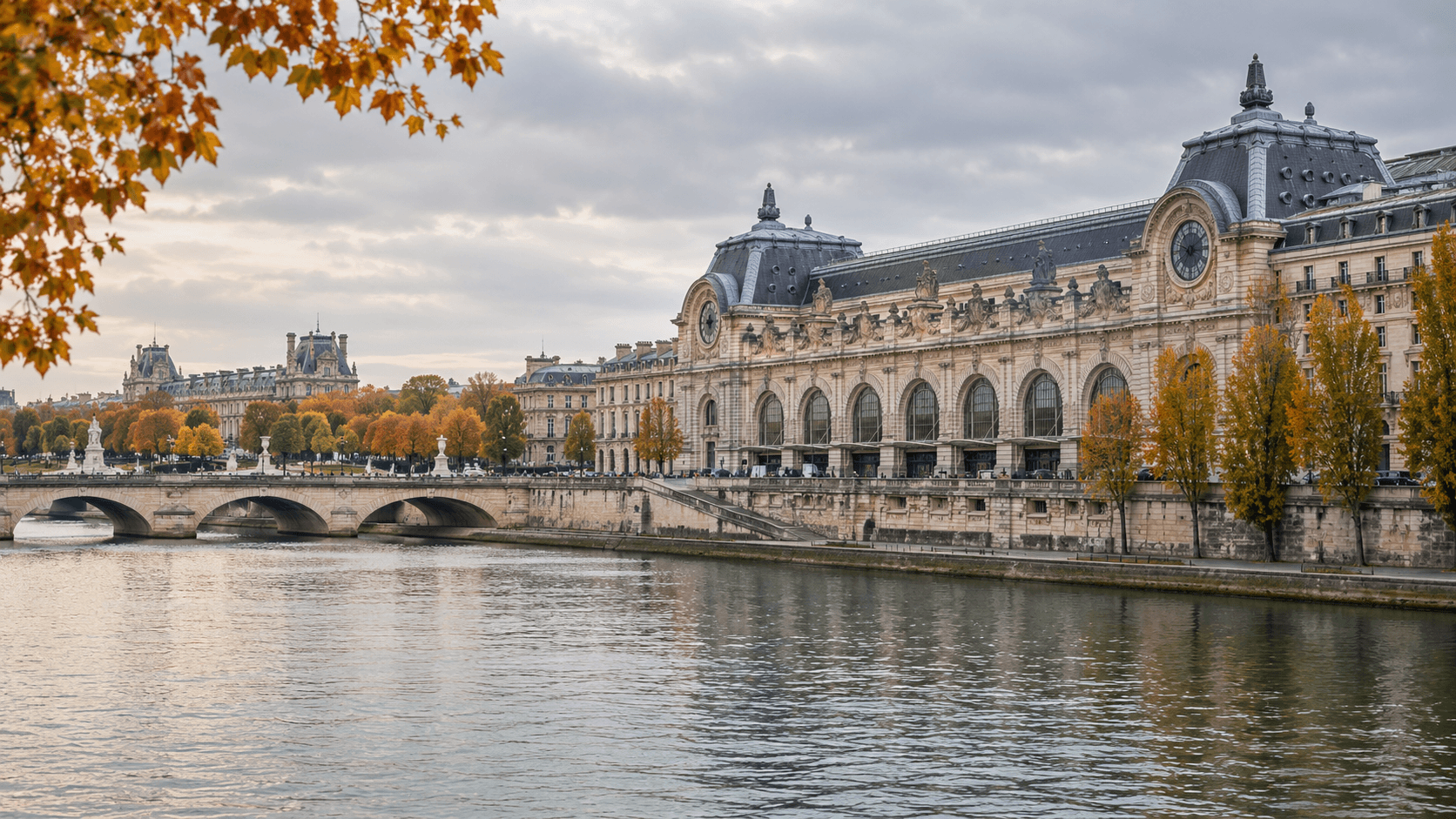
At a glance
- Orsay closure
- Closed Mondays
- Orangerie closure
- Closed Tuesdays
- Combined admission
- €20 listed at the museum
Paris has two museums linked by the same public institution but built for different kinds of looking. The Musée d'Orsay gives you a broad sweep of nineteenth-century art; the Musée de l'Orangerie gives Monet's large Water Lilies rooms and the Walter-Guillaume collection a more concentrated setting. An October 2026 choice has a fresh reason to pause at the Orangerie: its Monet, painting time exhibition opened on 30 September and is scheduled through 25 January 2027. If you can choose only one, base the decision on the art you want, the day each museum opens and the time you can actually give it.
The central choice: breadth or immersion
Choose Orsay if you want to move among painting, sculpture and other works across a substantial historical period. Its paintings collection history explains the museum's role in bringing Impressionist and Post-Impressionist works together with a larger account of art from the nineteenth century into the early twentieth. The building itself is a former railway station, so the visit also has an architectural scale that invites exploration. A reader hoping to see more than a single artist or series will usually get more variety here.
Choose the Orangerie if Monet's Water Lilies are the point of the day. The museum says the large decorations occupy two oval rooms designed around the work, while its Walter-Guillaume collection brings other early twentieth-century artists into the visit. Its account of the collection mentions Renoir, Cézanne, Picasso, Modigliani and others. This is not an empty “Monet-only” stop, but the spatial encounter with the Water Lilies is its most distinctive reason to go. A compact museum can still merit unhurried time if you want to sit with one body of work.
Neither decision is a verdict on which museum is objectively better. A first-time art visitor who wants a range of styles, names and media may prefer Orsay. Someone who already knows that a single immersive Monet experience matters more than an overview may be happier at the Orangerie. If you are traveling with companions, ask each person for one work or experience they would regret missing. That often resolves the choice faster than comparing rankings.
What the October Monet exhibition changes
The Orangerie's temporary exhibition is about Monet's relationship with time, from fleeting light in Impressionist painting through repeated subjects and eventually the Water Lilies. The museum dates its Paris run from 30 September 2026 to 25 January 2027. This gives autumn visitors a particular reason to consider the Orangerie even if they have seen images of the permanent oval rooms before. It also makes ticket planning more important: temporary exhibitions can draw a different level of demand from a routine collection visit. Use the museum's current booking page for the date you need.
The exhibition is an additional reason to visit, not a substitute for checking what your ticket admits. The official exhibition page has a booking link and lists its own information. Read the selected ticket type and time in the checkout rather than assuming every general admission, concession or third-party product includes the same event. If your interest is primarily the permanent Water Lilies rooms, verify their access as well. Room closures, special events and capacity management can change the visitor experience even when the museum is otherwise open.
Opening days prevent an easy scheduling error
Orsay's official visit page says it closes on Mondays. Its regular public schedule is 9:30 a.m. to 6 p.m. Tuesday through Sunday, with a Thursday evening opening until 9:45 p.m. The museum lists last entry at 5 p.m. on ordinary days and 9 p.m. on Thursdays, with galleries beginning to close before the building itself. A ticket for a late arrival therefore does not give you a full afternoon or evening inside.
The Orangerie's visit page says it closes on Tuesdays, opens at 9 a.m. on the other regular days and ordinarily closes at 6 p.m. Last admission is 5:15 p.m., with gallery closing at 5:45 p.m. The page also describes Friday evening openings during exhibition periods, with a reduced late rate and an earlier final admission than the building's closing. Check the specific date rather than assuming every Friday has an identical late program. The different Monday and Tuesday closures can decide the museum for a short Paris stay before the collection comparison even begins.
Both museums list 1 May and 25 December closures. The Orangerie also lists the morning of 14 July. These dates may not affect an October visit, but they show why a saved generic “open daily” note is unsafe. Official opening pages are the place to check again just before booking, especially for a holiday, exhibition changeover or an evening slot.
Understand the ticket comparison
On the official pages checked for this article, Orsay lists full-rate admission at €16 online and €14 at the museum. The Orangerie lists general admission at €12.50 online and €11 at the museum. These are distinct museum tickets, and the different online and on-site prices mean an apparent saving needs care. The Orangerie also lists a combined Orsay/Orangerie ticket at €20 at the museum. That can be useful if you genuinely have time and energy for both, but do not buy it solely because the arithmetic looks attractive: verify current availability, any timing rules and admission terms at checkout.
The official pages list free or reduced categories, including under-18 visitors and qualifying young residents of the European Economic Area. Eligibility is more specific than a vague “student discount.” Check the applicable category and carry the proof the ticketing rules ask for. A traveler who already qualifies for free or reduced entry may find the combined full-rate ticket a poor fit. Likewise, someone with an existing pass should check each museum's reservation instructions rather than assume that holding a pass automatically secures a timed entry.
The Orangerie warns against mirror sites, street sellers and claims of “skip-the-line” tickets that may not be valid. Buy through the official museum ticket path, reached from the venue page, and inspect the name and date before payment. Priority access is not the same as instant entry under every condition. Leave enough margin for security and ticket checks, and avoid structuring a tight cross-city appointment around a promise of zero queue.
A worked choice for a short stay
Imagine arriving in Paris on Sunday evening and leaving Tuesday night with only one museum morning. Monday rules out Orsay because it is closed; the Orangerie is the practical choice if its tickets and galleries fit your interests. If the only open morning is Tuesday, the situation reverses: the Orangerie is closed and Orsay is open. That simple timetable check prevents a wasted journey and makes the decision more reliable than a general ranking of the two institutions.
For a full Thursday, the choice is different. You might reserve the Orangerie for daylight and use Orsay's Thursday evening opening, but only if both admissions fit the actual ticket terms and you want a two-museum day. Build in time to eat and travel between them; the museums are in different parts of central Paris. If you have just one short window, use it for the collection you care most about. Buying a combined ticket cannot create extra attention or energy after a long day.
Make the visit work on the ground
The Orangerie lists its address in the Tuileries Garden near Place de la Concorde and identifies Concorde Métro connections. Orsay's visit page provides its own access information on the Seine's other bank. Check a current route from your hotel rather than assuming the two entrances are interchangeable because the museums share an institution. Save your ticket and a map before leaving the hotel. Mobile data can help with route changes and a ticket email, but an eSIM is connectivity, not museum admission. For a France trip, compare Roameo destination plans and confirm that your phone is compatible before travel.
Finally, decide what success looks like. At Orsay, it might be following a thread from nineteenth-century realism to Impressionism and Post-Impressionism without racing past every gallery. At the Orangerie, it might be giving the Water Lilies rooms quiet time, then seeing how the Walter-Guillaume works widen the story. If a temporary exhibition is the main draw, prioritize its reserved entry and check the current display. One carefully chosen museum can be a better Paris afternoon than two hurried admissions.
Frequently Asked Questions
Is the Orangerie only Monet's Water Lilies?
No. The oval Water Lilies rooms are central, but the Walter-Guillaume collection includes other early twentieth-century artists.
Which museum is open on Monday?
The Orangerie normally opens Mondays; Orsay is normally closed. The Orangerie is normally closed Tuesdays. Confirm your exact date on the official visit pages.
Should I buy the combined ticket?
Only if you plan to visit both and the current conditions suit your dates and eligibility. Compare individual, reduced and free admission before paying.
Keep reading

Kinkaku-ji or Ginkaku-ji: Which Kyoto Temple Fits?
Choose Kyoto’s Golden Pavilion for its pond view or Ginkaku-ji for a garden walk. Compare hours, admission, access and mobility before planning one stop.
Read more
Helsinki Airport I or P Train: Which Side of the Loop?
At Helsinki Airport, both I and P trains reach the city. Choose by your actual stop, check the direction and buy the right HSL zones after October works.
Read more
Barcelona Airport: Aerobús or R2 Nord for Your Hotel?
Land at Barcelona airport? Compare Aerobús A1 or A2 with R2 Nord by terminal, hotel stop, late arrival and the extra shuttle from T1 to T2 before buying a ticket.
Read more