
Prado Free Hours or Paid Ticket: Which Madrid Visit Works?
Compare the Prado Museum’s final-two-hour free window with a paid timed ticket. See the collection scope, capacity rule, closing time and visit scenarios.
How-to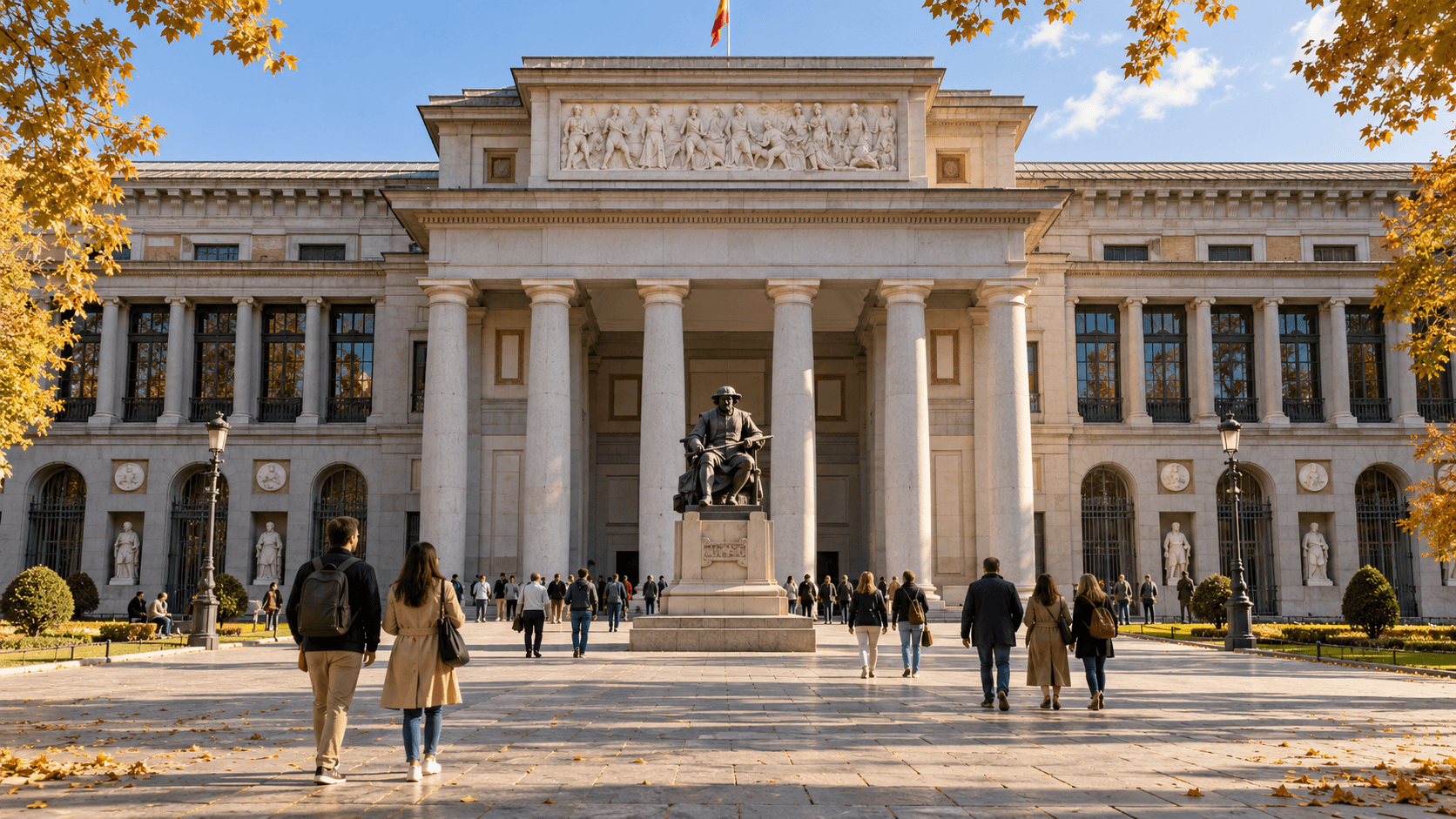
At a glance
- Paid admission
- €15
- Free window
- last two hours before closing
- Free scope
- free tickets become available
- Saturday hours
- 10:00 to 20:00
For an autumn Madrid visit, the Museo Nacional del Prado presents a real choice: pay for a daytime visit or try the free period in its last two opening hours. Madrid’s official tourism page lists general admission at €15 and confirms the normal free windows. Its city-card listing says free tickets become available when the final-two-hour window begins. Neither choice is automatically better. The right one depends on how much art you want to see, how tightly scheduled your evening is and how much uncertainty you can accept when visiting a major museum late in the day.
What “free at the Prado” means
The regular free period is the last two hours before closing: 18:00 to 20:00 from Monday to Saturday, and 17:00 to 19:00 on Sundays and public holidays, according to the city’s official tourism page. The city-card listing says tickets are available from the beginning of those windows. It does not set out the admission treatment of every current temporary exhibition. If a temporary show is your main reason for visiting, check that exhibition and its ticket in the museum’s official booking flow rather than assuming the free-period ticket includes it. The simple, supported promise is a defined time window for free museum entry.
The free period is a limited window, not a reservation for a full day inside. City tourism confirms the museum’s regular closing time, and the city-card page describes when free tickets become available. Neither page promises an instant queue-free entry. Leave room in your itinerary for the ticket process and for the walk from your previous stop. If your train arrives near the start of the free window, the only way to know how much time you will actually have is to allow for the trip across Madrid and the conditions at the venue on that date. That uncertainty is the chief practical cost of the free option.
What a paid ticket buys
The city tourism listing gives €15 as the general admission price and links visitors to the museum’s ticket provider. A paid visit lets you choose an earlier part of the normal opening day rather than restrict yourself to the closing window. It does not promise empty rooms, and the visitor should still check the specific ticket and exhibition inclusions before purchasing. If your aim is to study several schools of painting, an afternoon entry can give you more room to pause, backtrack and follow the works that catch your attention. At the ECB reference rate for 22 October 2026, €15 is approximately US$16.81 before card fees.
The city also lists a €7.50 reduced ticket (approximately US$8.40 at that reference rate) for specified groups and points readers to the museum for full eligibility. That is a separate question from the daily free period. Do not assume that an old student card or an age category automatically qualifies you; inspect the admission rule and proof requirements on the ticket provider’s current page. If you can obtain a qualifying concession, compare its price and visit time against a late free entry. For a traveler with only one reliable afternoon, the small reduced fare may be a practical way to protect a longer viewing period.
Time inside is shorter than the two-hour label
Regular museum hours are 10:00 to 20:00 Monday through Saturday and 10:00 to 19:00 on Sundays and public holidays, as Madrid’s official tourism page reports. A visitor who enters at the start of the free period can have no more than the remaining two opening hours, even before any ticket or entry process. A later arrival cuts that period directly. If you want a slow visit, this is a more important calculation than the admission price alone. Take the closing time on the date you will actually go and subtract your realistic arrival time, not the time you hope to leave the hotel.
If you want to view one or two named works, a limited visit can be satisfying. Spain's official tourism description names Velázquez's Las Meninas, Bosch's Garden of Earthly Delights and works by Goya among the collection's highlights. Pick a short list, locate the rooms using the museum's current map, and accept that a gallery can be temporarily closed or a work moved. If you hope to cover many schools of painting or compare works slowly, the evening window is a poor substitute for several hours with a paid daytime visit.
Worked scenario: one Madrid afternoon
Imagine arriving in the city at 15:00 with an evening meal booked. You could buy a daytime Prado ticket and use the afternoon for a focused visit, or plan to enter free at 18:00. The free option saves the admission charge but compresses the museum into the time before closing and may involve a ticket queue. If you must be at dinner across town by 19:30, the free option might leave very little gallery time. The paid option gives you more choice of arrival hour. This is an itinerary comparison, not a prediction of the day's queue or a guarantee of any particular ticket availability.
Now imagine you have two full days in Madrid and mainly want to see Las Meninas and one nearby group of paintings. You can afford to attempt the free period, with a backup if a queue or temporary closure interferes. The cost saving may be worthwhile. The backup matters: decide before arriving whether you would purchase a paid ticket for the following day if you cannot enter, or whether you are happy to move on. A traveler who would deeply regret missing the Prado should not make a short late-evening window the sole plan.
Days that do not follow the usual window
The museum lists closure on 1 January, 1 May and 25 December. It lists reduced hours of 10:00 to 14:00 on 6 January, 24 December and 31 December. These dates show why the routine 18:00 or 17:00 rule should never be copied blindly into a holiday itinerary. Consult the museum's current calendar for the specific date and any special activity or exceptional closure. Madrid's tourism listing also reproduces the standard and reduced hours, but the museum is the controlling source for day-of-visit changes.
The phrase “public holiday” is especially easy to misread if you are traveling from another country. A holiday at home is not necessarily a holiday in Madrid, and a local holiday can alter visitor demand or opening arrangements. Check the venue's calendar rather than deciding from your home-country calendar. If your only possible visit is on a special-hours day, a paid ticket for an earlier hour gives more time to respond to changes, although it does not remove the need to check for updates.
Ticket process, bags and approach
Paid visitors should keep the purchased ticket accessible and follow the entry instructions stated by the ticket provider. Free-period visitors should follow the current process at the museum; the city-card page says free tickets become available at the window’s start. Both groups should have a short list of rooms or artists in mind rather than using the entire visit to decide where to go. The city’s tourism description identifies Spanish, Italian and Flemish schools across the collection, so your route can be thematic: perhaps Velázquez and Goya on one visit, then another school on a later day. A focused route is especially helpful when your time begins near closing.
The tourism page lists the Prado at Paseo del Prado and names nearby transport, including Atocha and Estación del Arte. Check the route from your actual starting point before choosing a narrow late window. If you are coming directly from an airport or train with large luggage, check the museum’s current visitor rules and storage arrangements before setting off; do not assume a gallery will accommodate your bags. If you need step-free access, the city tourism page provides accessibility information, but the best entrance and route for your situation should be verified with the venue. These small logistics can consume much of a two-hour opportunity.
Use connectivity without making it essential
Mobile data can help confirm the current ticket page, check the route from your hotel and find the museum map, but keep any purchased pass and key directions accessible offline. A travel eSIM is one option for visitors whose home plan makes roaming expensive. Check device support and plan coverage before purchase, and remember that service depends on local network conditions. Roameo's compatibility page and destination plans can help you compare that option. Connectivity does not replace a valid museum ticket or the museum's rules at the door.
The decision in one sentence
Choose the free period for a short, flexible look when you can tolerate a late start; choose a paid daytime ticket when you need more hours or a specific exhibition or have only one reliable opportunity. Confirm the date, closing time and applicable ticket conditions on the official museum site before you travel. The money saved at the door is only a saving if the shorter, less certain visit still answers what you came to see.
Frequently Asked Questions
Are temporary exhibitions free in the Prado's free hours?
The city confirms the free two-hour period but does not define the treatment of every temporary show on that listing. Check the current exhibition ticket details with the museum before assuming the free-period ticket includes a particular show.
Do I need a ticket for the free period?
Madrid’s city-card listing says free tickets are available from the start of the final-two-hour window. Follow the venue’s current ticket procedure on arrival; the city page does not promise a queue-free visit.
Is the free period always 18:00 to 20:00?
No. It is 17:00 to 19:00 on Sundays and public holidays under normal hours, and special or reduced-hour dates need a fresh check against the museum calendar.
Keep reading
Incheon AREX Express or All-Stop: Which Fits Your Seoul Stop?
Choose the right Incheon airport train for your Seoul hotel. Compare stops, ride times, tickets and the true door-to-door route before buying Express or all-stop.
Read more
Haneda Monorail or Keikyu: Which Reaches Your Tokyo Hotel?
Choose Haneda Airport rail by your hotel station, transfers and terminal. This guide compares Monorail and Keikyu routes, timing estimates and arrival checks.
Read more
Schönbrunn Palace Ticket or State Apartments?
Compare Schönbrunn’s compact State Apartments route with the longer Palace Ticket, including rooms, current prices, timed entry and important pass pitfalls.
Read more