
Québec Winter Carnival 2027: Dates and Booking Guide
Québec Winter Carnival runs February 5-14, 2027. Plan around what is confirmed now: the ten-day window, deep-winter weather, entry documents, and city transport.
Destinations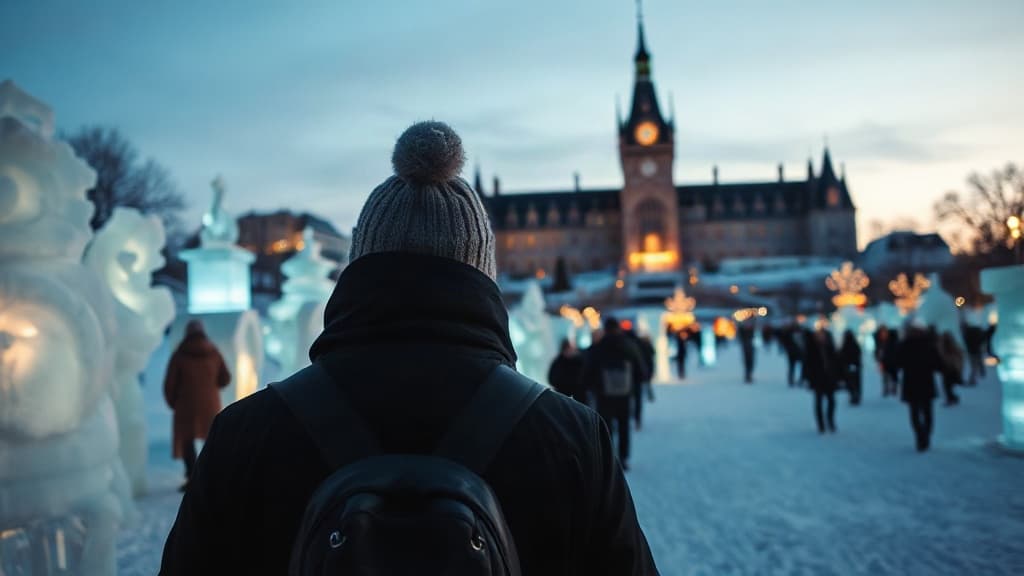
At a glance
- Carnival dates
- February 5-14, 2027
- Duration
- 10 festival days
- February averages
- -6°C high / -16°C low
- Canada eTA
- CAD 7 (about USD 5) for eligible air travellers
- Airport bus
- RTC Route 80 every 30 minutes
- Current day pass
- CAD 10.50 (about USD 7.47)
Parc de la Francophonie, Québec City — Parc de la Francophonie, Québec City · Québec City Jean Lesage International Airport · Rue du Petit-Champlain
Québec Winter Carnival has fixed its next dates: February 5-14, 2027. That creates 10 festival days around which travellers can book flights and hotels now, but it does not make every ticket advertised online a 2027 product. As of September 23, 2026, the official Carnival site confirms the dates, Bonhomme's Ice Palace, two night parades, musical evenings, snow and ice sculpture displays, and the ice-canoe race. It has not yet posted a 2027 general Effigy pass price or a day-by-day programme. Book the scarce part — a well-located room — and wait for the organiser to publish the rest.
What you can plan now, and what must wait
The fixed ten-day window is enough to choose a stay. A long weekend can capture one night parade if its 2027 date matches your visit; a midweek stay usually gives more room to explore official sites without betting the whole trip on one evening. But the organiser has not yet assigned public dates and times to each parade or released the complete activity calendar. Do not copy the 2026 weekday pattern into a 2027 itinerary.
The same caution applies to admission. The Carnival traditionally uses a wearable Effigy as the pass to official sites, but the live ticketing pages still contain 2026 wording and prices. This guide therefore does not label a past Effigy rate as the 2027 cost. Subscribe to the organiser's update list or recheck its ticketing page when the 2027 programme launches. Separately priced reserved experiences may appear before the general pass, so read what a ticket actually includes rather than assuming it opens every site.
The dates are ready to book; the full programme and general 2027 pass price are not. A hotel with sensible change terms is more useful in September than an unofficial festival package built around last year's schedule.
The three anchors worth building around
Bonhomme's Ice Palace is the visual centre of the Carnival and is rebuilt from ice blocks near Old Québec each year. It works as the first orientation stop because many official activities cluster within walking distance of the upper town. The exact 2027 design and opening hours belong to the programme still to come.
The night parades are the events that most reward advance planning. They bring illuminated floats, performers and Bonhomme onto city streets, which also means closures, packed viewpoints and slow travel immediately before and afterward. Once the routes and dates are published, choose a viewing area and approach it on foot instead of expecting a car to cross the parade corridor.
The ice-canoe race is the spectacle that costs nothing to understand or watch. The Carnival's official must-see guide says spectators can view teams alternating between paddling and hauling their canoes over St. Lawrence River ice for free from Quays 19 and 21 at the Port of Québec. Premium viewing products may be sold separately, but a paid upgrade is not required to see the public race.
The cold is an itinerary constraint, not scenery
Québec City's tourism board publishes February averages of -6°C high / -16°C low, with 63 centimetres of snow and 13 millimetres of rain over the month. An average is not a promise for your dates: the same board notes that winter conditions can swing from around -20°C to 0°C within a few days. The practical consequence is that an all-day outdoor schedule designed at home can fail after one hour on Grande Allée.
Use three functional layers: a moisture-moving base, an insulating middle, and a wind-resistant outer shell. Waterproof insulated boots matter more than fashionable city shoes because standing still on snow during a parade chills feet faster than walking. Add mittens, a warm hat and something that protects your face. If you do not own serious winter gear, the official tourism board lists local rental services that can deliver coats and boots to a hotel; price that against buying equipment you may use once.
Plan warm resets, not just warm clothing. A realistic Carnival day alternates an outdoor site with lunch, a museum, a café or a return to the hotel. Keep one indoor option unbooked so a snowstorm or severe wind chill does not turn into a lost day. Phone batteries also drain faster in cold conditions: keep the device in an inner pocket and carry a charged power bank rather than leaving both exposed in an outer bag.
Where to stay and how to move
Old Québec and the area around Parliament Hill put the principal Carnival zone, restaurants and indoor warm-up stops within walking distance. Lower Town and Petit-Champlain are atmospheric and close to the river, but their steep connections to Upper Town can be icy. Sainte-Foy can offer a wider range of rooms, yet it turns every festival day into a bus or taxi journey. Compare the money saved on the room with the time and cold added at each end of the day.
From Québec City Jean Lesage International Airport, RTC Route 80 every 30 minutes provides the public-transport link toward the city, seven days a week. The RTC says the route operates from 6:00 AM to 12:30 AM and connects with routes 800 and 801 for Parliament Hill. Confirm the live timetable against your flight, especially for a late arrival during snow.
The RTC fare table in force since July 1, 2026 lists a regular day pass at CAD 10.50 (about USD 7.47), a regular ticket at CAD 3.85 (about USD 2.74), and a cash fare at CAD 4 (about USD 2.84). The USD comparisons use the Bank of Canada's September 22, 2026 daily average of USD 1 to CAD 1.4064; card exchange rates vary. Check again before February because the transit agency may revise fares before the trip.
Canada entry documents depend on passport and transport
Do not treat “going to Canada” as one universal application. Visa-exempt foreign nationals who fly to Canada generally need an electronic travel authorisation linked to their passport, while travellers who require a visitor visa must use that process instead. Entry by land or sea changes the eTA rule for some visa-exempt visitors, so use the Government of Canada's official questionnaire for your passport and route.
The official eTA page lists CAD 7 (about USD 5) for eligible air travellers and warns that the online form cannot be saved. Have the passport, email address and accepted payment method ready before starting. Most applications are resolved quickly, but the government says some travellers are asked to submit documents after applying; do not leave it until airport check-in.
If your passport requires a visitor visa, Canada's current official fee list shows CAD 100 (about USD 71.10) for an individual application, with biometrics potentially charged separately. That is not a blanket fee for every traveller: check the document finder first, then use the government site rather than a look-alike application service.
Food, language and a plan that survives the weather
French is the public language of Québec City. Visitor-facing staff often handle English, but transit notices, temporary street signs and smaller food stalls may lead with French. Download the relevant map area and a French language pack before heading outside. That preparation is especially useful when gloves, snow and a dense parade crowd make repeated web searches awkward.
Leave room for the food tied to the event rather than filling every meal with reservations. Maple taffy is poured hot onto snow and rolled onto a stick; warm drinks and substantial Québécois dishes are practical breaks as well as local flavour. Alcoholic Carnival products are not a substitute for warming up indoors, and drinking can make cold exposure harder to judge.
A two-day plan might use the first daylight period for the Ice Palace and sculptures, retreat indoors through the coldest lull, then return for an evening event once the exact programme is known. Put the ice-canoe race on the second day if its published time aligns, with Petit-Champlain or an Old Québec indoor stop nearby. The schedule should remain modular until the organiser releases dates for the two parades and any reserved activities.
Connectivity for tickets, weather and disrupted routes
The highest-value uses of mobile data here are mundane: a changed bus time, the official weather warning, a digital ticket, and a message sent when a meeting point becomes inaccessible. Download tickets and maps for offline use anyway; cold can affect the phone even when the network is working. If your device is compatible, compare Canada eSIM plans before departure and install the plan while you still have reliable home Wi-Fi. Network performance varies by place, congestion and local partner, so no reseller can promise a particular speed at a crowded parade.
FAQ
When is Québec Winter Carnival in 2027?
It runs February 5-14, 2027. The organiser has confirmed the ten-day window, but the detailed daily programme was not yet published on September 23, 2026.
How much is the Québec Winter Carnival pass for 2027?
The general 2027 Effigy price was not yet published when this guide was checked. The official ticket pages still showed 2026 material, so wait for the organiser to label a product for 2027 rather than budgeting from an old rate.
How cold is Québec City during the Carnival?
The official tourism board gives February averages of -6°C for the daily high and -16°C for the low. Conditions can be materially colder or warmer, so check the forecast and use a base, insulating and wind-resistant outer layer.
Do I need a visa or eTA for Canada?
It depends on your passport, residence status and whether you arrive by air, land or sea. Eligible visa-exempt air travellers generally use the CAD 7 eTA; travellers whose nationality requires a visitor visa must apply for that instead.
Keep reading

Banff and Jasper's Free Admission Window Closes September 7, 2026
Canada's national parks are free to enter until September 7, and Jasper's $520M wildfire rebuild is finally visible. Here's what to book before it ends.
Read more
Feria de Cali 2026: Salsa Festival Dates and Entry Guide
Cali's salsa fair runs December 25-30, 2026, opening with the Salsódromo parade. Colombia's entry rules, the optional Check-Mig form, and how to plan the trip.
Read more
Pushkar Camel Fair 2026: Dates, Visa Fees, Booking Guide
Pushkar's camel fair runs November 17-24, 2026, peaking at Kartik Purnima on the 24th. Here's the e-visa fee, tent-city booking window, and how to get there.
Read more