
SFO to San Francisco: BART or SamTrans Route 292?
Arriving at SFO? Compare BART with SamTrans Route 292 by terminal access, actual hotel stop, published bus fare and late-night service limits before choosing a ride.
Travel tips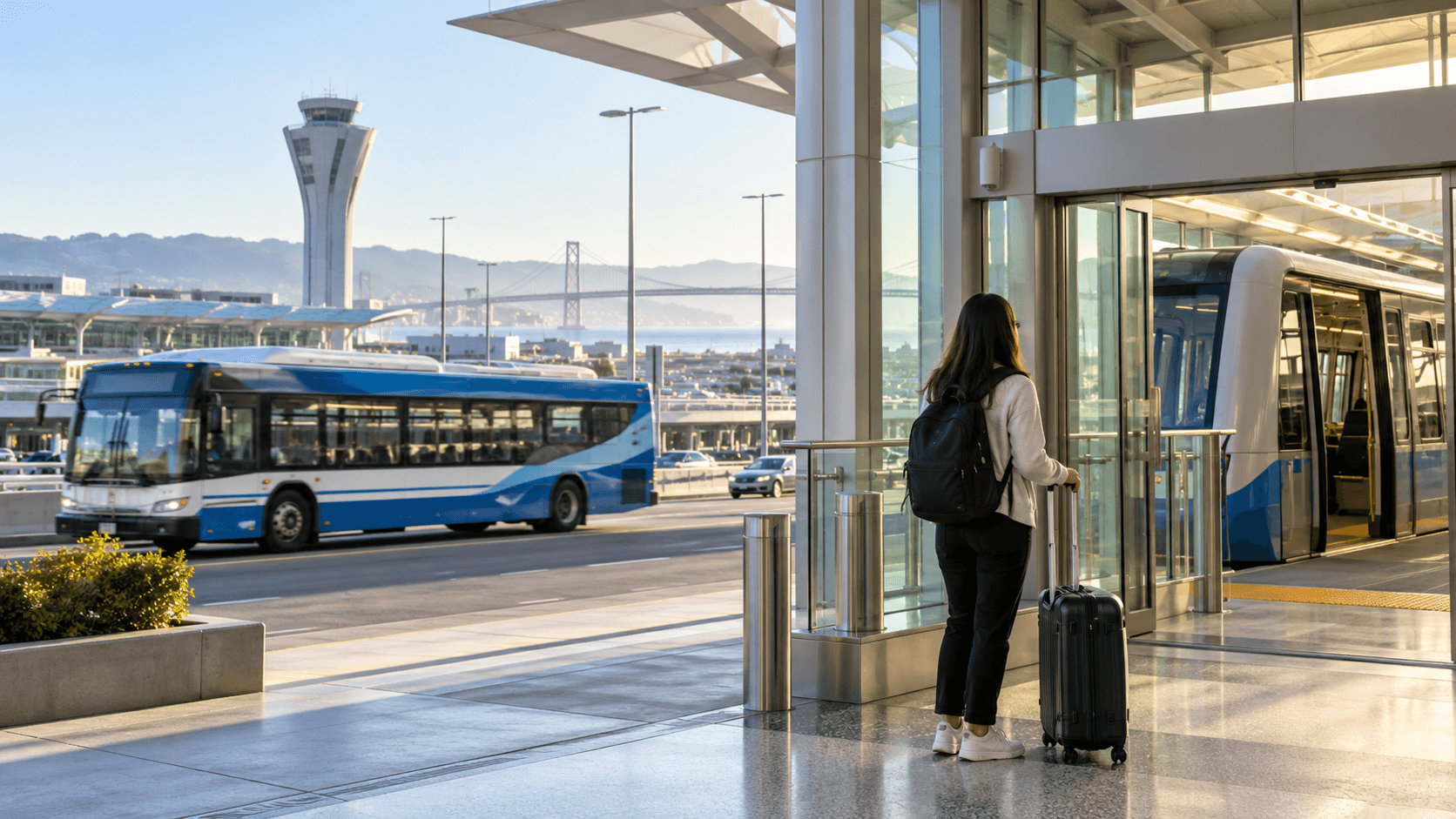
At a glance
- BART station
- SFO International Terminal
- Route 292
- Stops at airport terminals
- SamTrans adult fare
- $2.25 cash or mobile; $2.05 Clipper
A late October arrival at San Francisco International Airport can lead to two quite different public transport plans. BART is the rail route to downtown stations. SamTrans Route 292 is a local bus that stops at airport terminals and continues toward San Francisco. The useful question is not whether “the train beats the bus” in the abstract. It is whether your first address, arrival time, luggage and fare method make one route simpler from the airport curb to the hotel door. The BART airport guide and SFO's public transit guide establish those different roles.
Map your hotel before following a transit sign
BART's SFO station is at the International Terminal. Its airport guide describes direct trains to downtown San Francisco and identifies downtown stations along the line. If your hotel is close to one of those stations, rail provides a clear, traffic-free main leg. BART says downtown is about a 30-minute train ride from SFO, but that is a train segment estimate. A traveler starting at a domestic terminal still needs to reach the BART station, wait for the correct train and walk or transfer from the exit station. Measure the entire trip, especially if a steep walk or a city bus connection remains after the train.
Route 292 follows a different pattern. SFO says the bus stops directly at airport terminals, including Terminal 2, Terminal 3 and the International Terminal, and runs during the day and evening. A bus stop beside your terminal can save the initial AirTrain or terminal walk required to reach BART. The benefit is strongest if the bus's San Francisco endpoint or an intermediate stop sits near your actual destination. It can disappear if your hotel is far from the 292 route and you need another transit leg. Look up the route's current stop list and schedule, not a generic “bus to downtown” label.
Do not confuse the airport's free internal AirTrain with BART. AirTrain moves people around SFO, including to the BART station; it does not carry you into San Francisco. BART's page says travelers from all terminals can use the free AirTrain to reach the station. If you land at the International Terminal, walking to BART may be straightforward. From a domestic terminal, the AirTrain or signed walk adds a real, if often manageable, step. Route 292's terminal-side stop may be more convenient when handling luggage or traveling with someone who finds interterminal wayfinding difficult.
Compare current fares honestly
SamTrans publishes its adult Local/Express fare as $2.25 paid by cash or its mobile method and $2.05 using Clipper. The Route 292 service is a SamTrans local route, so that fare is a useful starting point for an adult rider. Reduced fares have eligibility rules; a visiting adult should not assume a youth or senior rate applies without checking the operator's terms. If paying cash, SamTrans says the farebox does not give change. Bringing exact fare or arranging a supported payment method in advance avoids a frustrating boarding moment.
BART prices trips by distance. Its fare guidance explicitly directs riders to the fare calculator for a particular origin and destination, so a single invented “SFO to downtown” price would be misleading. Enter SFO and your actual exit station into that calculator before treating the bus fare as a saving. BART now accepts contactless bank cards and mobile wallets at its gates as well as Clipper. Each rider aged five or older needs an individual card or device for payment. Tap the same method at entry and exit, since BART assesses a penalty fare when the payment record lacks a matching entry or exit.
A lower posted bus fare may still buy a less convenient trip if the 292 schedule or endpoint creates a long wait and an additional ride. Conversely, BART's faster rail segment may not be worth more to a traveler whose hotel is beside a 292 stop. Do a door-to-door comparison with the current timetable and fare calculator. For a group, calculate per-person transit fares rather than treating one adult ticket as the cost for everyone. Avoid folding a taxi price into the same comparison without a current quote, because road prices and travel time depend on the hour and demand.
Timing matters more than a generic “24/7” claim
BART's airport page lists service hours and warns travelers to arrange another plan for early Sunday travel. Those hours vary by day. A late-night arrival should compare its realistic terminal exit time with the last BART departure rather than the flight's scheduled landing time. Add immigration, baggage collection, a restroom stop and the walk or AirTrain ride to the station. If the last train is too close for comfort, look up a bus or another available mode before leaving the terminal.
SFO says SamTrans has some around-the-clock airport coverage, but its public transit page distinguishes Route 292, which runs during the day and evening, from limited late-night service on other routes. That distinction prevents an important mistake: “SamTrans operates 24/7 from SFO” does not mean Route 292 itself runs every hour. At night, check the specific route number and direction displayed in the live planner. Never rely on an older timetable photo or a search result that simply says the airport has buses.
The return journey deserves the same care. Confirm which terminal your flight uses, then plan the final step from BART's International Terminal station or the correct SamTrans stop to that terminal. Keep a buffer for security and airline check-in. If you plan a very early Sunday departure, BART's stated first train time can make the rail option unsuitable even if it worked perfectly on arrival. A transport choice can be right in one direction and wrong in the other.
Worked choices for different destinations
Imagine a solo visitor arriving at Terminal 3 in mid-afternoon and staying close to a downtown BART station. The traveler can follow SFO's signs to the AirTrain, reach the International Terminal station, pay at the BART gate and exit near the hotel. The rail ride avoids highway traffic and the station is a useful final stop. Route 292 may cost less under SamTrans's listed adult fare, but the relevant comparison is its next departure and where it lets that traveler off. If the bus endpoint leaves a long walk, the saving may not justify the extra leg.
Now imagine another visitor landing at Terminal 2 and staying near a stop served by 292, with no need to reach a BART station. SFO lists a Terminal 2 bus stop at the arrivals and baggage claim level, center island near Courtyard 2. The bus may allow that visitor to board near the terminal and leave near the hotel. They should check the current 292 timetable and direction first, since routes and downtown stopping patterns can change. If the wait is long or the last useful bus has passed, BART or another mode may become better despite the stop's proximity.
A third traveler arrives on a Sunday evening and flies out early the next Sunday. There is no need to buy into a symmetrical round-trip plan. They can use the mode that fits the arrival, then revisit BART's Sunday airport schedule and the current SamTrans routes for departure. The practical cost of missing the first departure check on an early flight is much larger than a modest fare difference. Write down a fallback route and its latest viable departure before the trip.
How to check a changing stop pattern
Transit agencies update timetables and routes. SamTrans's timetable update page has documented changes to 292's downtown routing and endpoint, so older articles or map screenshots can be wrong even if the route number stays the same. Open the operator's current schedule and check the exact stop name nearest your hotel. If a journey planner and an old PDF disagree, use the live operator information and confirm at the stop. BART's trip planner serves the same purpose for rail departures and connections.
Before flying, save the address, stop name and an offline map. If your phone supports it, compare a United States travel eSIM for live routing after landing. Mobile data can help you see an updated bus arrival or rail disruption; it does not guarantee coverage, and it is not a substitute for confirming fares with the transit operator. Keep a screenshot of the essential route in case activation or airport connectivity takes longer than planned.
The resulting rule is simple but specific. Take BART when its downtown rail stop fits the hotel, its operating hours fit your arrival and you value a main leg free of road traffic. Consider Route 292 when its current stop pattern fits your destination, its departure time works and a terminal-side bus stop saves a transfer. Check live route, fare and hours before travel; this October 2026 decision guide cannot freeze a timetable.
Frequently Asked Questions
Does BART leave from every SFO terminal?
No. BART's airport station is in the International Terminal. SFO's free AirTrain connects the terminals with that station.
Does Route 292 run all night?
SFO describes 292 as a day and evening route. Some other SamTrans routes provide limited overnight coverage; check the exact route and time before relying on a bus.
Can one contactless card pay for a whole group on BART?
BART says each rider aged five or older needs their own payment card or device. Use the same method at entry and exit for each rider.
Keep reading
Athens Airport: Metro Line 3 or X95 to Syntagma?
Compare Athens airport Metro Line 3 and X95 by hotel stop, published airport fare, transfer validity, late arrivals and contactless payment conditions.
Read more
Barcelona Airport: Aerobús or R2 Nord for Your Hotel?
Land at Barcelona airport? Compare Aerobús A1 or A2 with R2 Nord by terminal, hotel stop, late arrival and the extra shuttle from T1 to T2 before buying a ticket.
Read more
Orsay or Orangerie: Which Paris Museum Should You Visit?
Pick Orsay for a broad nineteenth-century art visit or the Orangerie for Monet’s Water Lilies. Check opposite closure days, tickets and the current exhibition.
Read more