
Spain's Border Went Biometric: The EU's New EES in 2026
Spain logged a record 11.5 million July visitors. Every non-EU arrival now gets fingerprinted at the border under the EU's new EES — what changed, and what hasn't.
Guides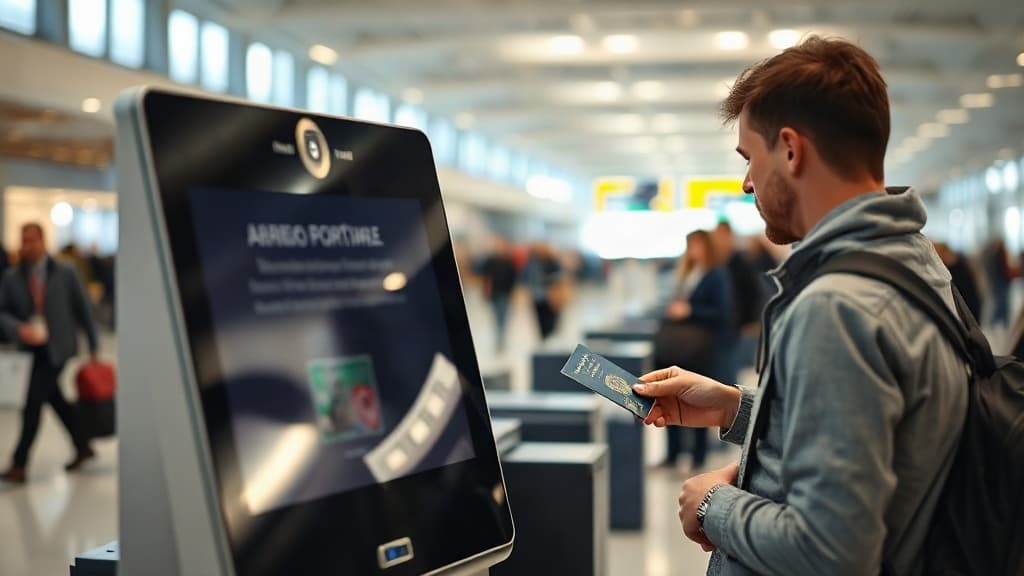
At a glance
- EES fully operational
- Since 10 April 2026, across 29 Schengen states
- Biometric data taken
- Fingerprints and a facial scan, first crossing only
- Who it applies to
- Non-EU/EEA passport holders on short stays
- ETIAS status
- Delayed indefinitely; no confirmed 2026 date
- Planned ETIAS fee
- EUR20 (~US$23) once it eventually launches
- Reported peak queues
- 2-4 hours at Madrid, Barcelona and Malaga airports
Madrid — Madrid · Adolfo Suárez Madrid–Barajas Airport · Barcelona–El Prat Airport · Málaga-Costa del Sol Airport
If you've landed in Madrid, Barcelona or Malaga any time since 10 April 2026, a border officer or self-service kiosk has taken your fingerprints and a photo before your passport got scanned — not stamped. That's the EU's Entry/Exit System (EES), and as of this month it has been running at full strength across all 29 Schengen countries for nearly five months, right through the summer that just delivered Spain a record 11.539 million international tourists in July alone, up 4.6% on the year before, according to Trading Economics data reported by TradingView. If you're planning a trip to Spain this autumn or winter, here's what's actually changed at the border, what's still just a rumor, and how to not lose half a day of your trip standing in a queue.
What EES actually does
The European Commission's own announcement of the system going fully live describes EES plainly: it's a digital border-management tool that logs entries, exits and refusals of entry for non-EU nationals visiting the Schengen area, replacing manual passport stamping with a digital record tied to your passport, a facial image, and your fingerprints (European Commission, Directorate-General for Migration and Home Affairs). The rollout started gradually on 12 October 2025 and reached full operation on 10 April 2026. In the Commission's own words, the system had already logged over 45 million border crossings by the time it went fully live, flagged more than 24,000 people for refused entry over invalid or insufficient documentation, and identified over 600 people as security risks — including cases of the same person trying to enter under two different identities, something a stamped passport could never catch.
If you hold an EU or EEA passport, or a residence permit for a Schengen country, none of this applies to you — you use the separate lane, same as always. It's specifically non-EU/EEA travelers on short stays (tourists, business visitors, anyone without residency) who now get fingerprinted and photographed the first time they cross into the Schengen area on a given passport. After that first registration, most travelers pass through EES-enabled lanes using facial recognition alone, without resubmitting fingerprints, unless the passport changes or the record expires.
Why the queues at Spanish airports have been running long
The theory was that self-service kiosks would speed things up. In practice, Spain's airports have been some of the more visible examples of the opposite. Ryanair CEO Michael O'Leary was quoted directly in an iNews report from 3 April 2026 describing queues of up to three to four hours at airports in Spain and Germany after the new EES checks went live, which he called a "Brexit punishment" for UK travelers specifically. A month later, a separate World of Cruising report from May 2026 confirmed queues of two to four hours had been reported at Madrid, Barcelona and other major hub airports, prompting the travel industry to push Brussels to consider suspending the system during peak summer travel — a suspension that, as of this writing, has not happened. Industry outlet Biometric Update separately reported in January 2026 that Spain, alongside Madrid and Malaga specifically, was among the airports where the EES rollout was drawing criticism from border-technology experts as a "mess" in its early phase.
None of this means EES is broken everywhere or permanently — processing speeds up as more travelers get registered and staff get more practiced with the kiosks — but it does mean you should not book a tight connection through Madrid-Barajas, Barcelona-El Prat or Malaga-Costa del Sol on the assumption that passport control takes ten minutes. Build in at least an extra hour at any Spanish airport if you're arriving from outside the EU/EEA for the first time on that passport, especially during peak midday and early-evening arrival banks.
EES checks happen on arrival, not departure. You won't be fingerprinted leaving your home country — only when you first cross into the Schengen area, whether that's by air into Madrid, or overland from Gibraltar or across the France-Spain border, since EES applies at every external Schengen crossing point, not just airports.
ETIAS: still not required, and that's the part worth knowing
EES is the border check. ETIAS — the European Travel Information and Authorisation System — was meant to be the second half: a pre-travel authorization that visa-exempt travelers (US, UK, Canadian, Australian and other passport holders) apply for online before flying, similar to the US ESTA. It was originally due in the final quarter of 2026. It is not happening on that timeline. Multiple outlets reported in mid-to-late August 2026 that ETIAS's launch date had been pulled entirely from the official EU website, with The Independent (13 August 2026) reporting that a revised timeline is only expected after eu-LISA's board meeting in September 2026 — this month — and that a 2027 launch is now considered the most likely outcome. TimeOut UK's 14 August 2026 coverage put it more bluntly: the rollout has been delayed indefinitely.
Two practical things follow from that. First, if you're traveling to Spain or anywhere else in the Schengen area on a visa-exempt passport before ETIAS actually launches, you don't need to do anything beyond your normal passport check — there is no ETIAS application to file. Second, and more importantly: The Points Guy's reporting confirms the EU has also raised the planned ETIAS fee to EUR20 (about US$23) from an original EUR7, valid for three years once it does launch — and that gap between "widely discussed" and "actually live" is exactly the window scam sites exploit, charging travelers for an authorization that doesn't exist yet. Rio Times' August 2026 coverage of the delay makes the same point: don't pay anyone for ETIAS until the European Commission itself announces a live application date on its official channels.
What to actually do before you fly to Spain
Bring a passport with at least three months' validity beyond your planned departure from the Schengen area, expect the first-crossing biometric step to take a few extra minutes even when queues are short, and build real buffer time into any connection through a Spanish hub airport. If you're flying in on a budget carrier or landing during a peak arrival window, treat the border as the slowest part of your day, not the fastest. None of this requires paperwork in advance — there's no app to download and no form to submit before EES, and definitely nothing to pay for ETIAS, whatever a paid-search ad might imply.
Having working mobile data from the moment you land also matters more than it used to: if your flight gets rebooked around a long queue, if you need to show a hotel confirmation or a ride-hailing app the moment you clear the gate, or if you just want to check Adolfo Suárez Madrid–Barajas's live arrivals board while stuck behind a slow kiosk, airport Wi-Fi is the last thing you want to depend on. An eSIM for Spain activates before you land, so you're online the second you're through the gate — long queue or short one. If you're not sure your phone supports eSIM, it's worth a quick check on our device compatibility page before you fly, not after you've landed and found out the hard way.
Frequently Asked Questions
Do I need to apply for anything before flying to Spain in 2026?
No. EES registration happens automatically at the border on arrival — there's no pre-travel form. ETIAS, the pre-travel authorization some reports describe, has been delayed indefinitely and is not required as of this run; ignore any site charging a fee for it now.
Does EES apply if I'm just transiting through a Spanish airport?
If you clear passport control in Spain — including for a connecting flight that requires you to pass through Schengen border checks — EES applies the same as if Spain were your final destination. A same-terminal transit that never crosses passport control doesn't trigger it.
How long should I budget for passport control at a Spanish airport now?
Reports from April and May 2026 documented two-to-four-hour queues at Madrid, Barcelona and Malaga during peak periods. Build in at least an extra hour beyond what you'd have budgeted pre-EES, especially on a tight connection.
Will EES slow me down on every future trip to Spain?
The heaviest delays were reported during the system's rollout and its first full summer. Once your fingerprints and photo are on file from a first crossing, later trips generally use facial recognition only, which is faster — though queue length still depends on staffing and how busy the airport is that day.
Keep reading

Sagrada Familia in 2026: Tickets, Towers and Barcelona Costs
The cross went up in February and Pope Leo XIV blessed the tower in June. What visiting Barcelona's finished spire costs this autumn, and what still is not open.
Read more
Barcelona Airport Metro: Why T-casual Does Not Work
T-casual is not valid at Barcelona airport's L9 Sud metro stations. Compare the Airport Ticket and Hola Barcelona card, plus what to do at the exit.
Read more
Seville Alcázar: Is the Upper Royal Rooms Add-On Worth It?
The Alcázar general ticket covers palaces and gardens; the Upper Royal Rooms are a separate organized visit. Decide whether to add them this autumn in Seville.
Read more