
International travel packing checklist
Pack the things that would be hardest to replace first. This guide sorts your trip into documents, cabin essentials, and checked-bag extras, then gives you a checklist you can use on screen or print.
Roameo Editorial Team · 26 September 2026
What should you pack for an international trip?
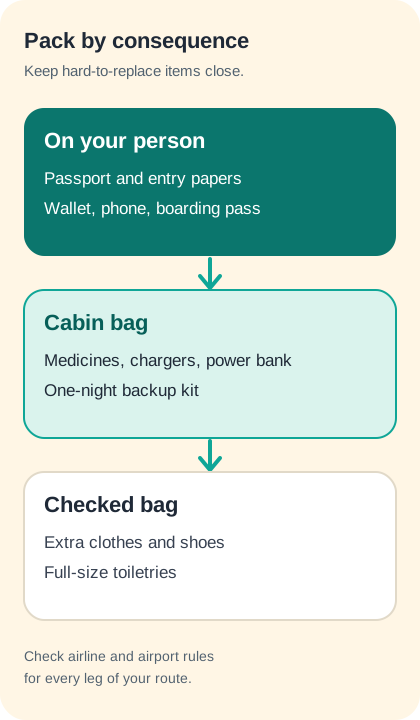
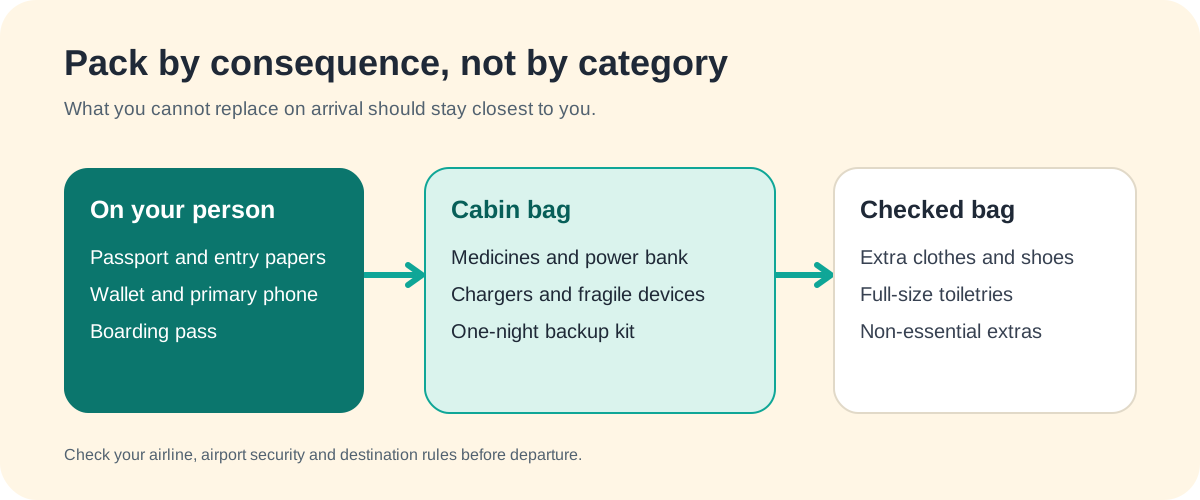
Start with your passport, any required entry permission, payment methods, medicine, and the phone you will use to reach your bookings. Put those items where you can reach them throughout the journey. Next pack enough in your cabin bag to manage a delayed checked bag for one night. Clothes and non-essential toiletries come last. The exact list changes with your destination, weather, length of stay, activities, and the airports you pass through.
A generic list cannot tell you whether your passport is valid long enough, whether a medicine is legal at your destination, or whether a particular airport accepts a larger liquid container. Check those details against official destination and airport guidance. The U.S. State Department traveler checklist is a useful example of the checks to make, but entry rules depend on your passport and itinerary.
Pack in three layers
| Place | Pack here | Reason |
|---|---|---|
| On your person | Passport, boarding pass, wallet, primary phone, essential entry documents | You may need them at check-in, security, immigration, and on arrival. |
| Cabin bag | Medication, power bank, chargers, glasses, one change of clothes, small toiletries | These are useful if a checked bag is delayed and some must travel in the cabin. |
| Checked bag | Extra clothing, spare shoes, and permitted full-size toiletries | These are generally more replaceable and less urgent in transit. |
Never put a spare lithium battery or power bank in checked baggage. The FAA's PackSafe guidance says they belong in carry-on baggage; airline and international rules may add limits. Keep medication accessible and check destination restrictions before travel. The CDC travel health packing guide recommends tailoring the health kit to the destination and carrying copies of prescriptions when relevant.
Documents to prepare before you pack
Check your passport's expiry date when you book, not the night before you fly. Some destinations require remaining validity beyond the return date; others have different rules. Confirm the requirement for your nationality, destination, and transit points on the relevant official immigration or embassy site. Do the same for a visa, electronic travel authorization, arrival card, or proof of onward travel. A ticket confirmation is not a substitute for entry permission.
Save your flight, accommodation, and transport confirmations both in your email and in an offline folder on your phone. Write down the first night's address in a format you can show a driver or border officer without mobile data. Keep a copy of your passport and important bookings separate from the originals, and leave a copy with someone you trust. The State Department recommends multiple copies for loss or theft; your own government may provide a similar checklist.
If you plan to drive, check whether the destination recognizes your home licence or asks for an international driving permit. If you are carrying a child's documents, pet paperwork, or a medical certificate, verify the exact form and timing with the issuing authority. These extras are easy to overlook because they do not sit in the suitcase.
What belongs in your carry-on?
Think of the cabin bag as a 24-hour fallback. Pack a change of underwear, a light layer, basic hygiene items, and anything you must use before your checked bag is delivered. Keep fragile electronics and valuables with you. If a gate agent asks you to check the cabin bag, remove the power bank, spare batteries, documents, medication, and other items that cannot go in the hold.
For liquids, use the rule at every airport where you pass through security, including transfers and the return trip. EU airport guidance currently uses containers of no more than 100 ml in a one-litre transparent bag, with stated medical and baby-food exceptions. The UK government says rules can vary by airport, including whether a separate bag is needed or larger containers are allowed. A partly filled 200 ml bottle may still fail a 100 ml container rule. Check the specific airport shortly before flying.
Pack prescribed medicines in their original labelled packaging where practical, with a prescription copy or doctor's letter if needed. Some everyday medicines are restricted overseas. Ask the destination's embassy or health authority before flying if you are uncertain, especially for controlled medication. Do not rely on the airport security rule alone: a medicine can clear screening and still be restricted at the border.
How many clothes should you take?
Build outfits around the forecast and your actual itinerary instead of packing one outfit for each day by default. For a trip with laundry access, a small set of clothes you can combine usually works better than a suitcase of single-use pieces. Lay out the clothes before packing; remove pieces that require a separate shoe or layer for only one event. Wear the bulky shoes in transit and pack the lighter pair if your airline's weight limit makes that useful.
Weather changes the list more than trip length. A wet city break may need a rain shell and quick-drying shoes; a cold trip needs layers that can be added or removed; a hot destination may need sun protection and clothing that suits local customs. If you will hike, dive, attend a formal event, or rent equipment, make a small activity-specific add-on list. Check whether your accommodation provides towels, a hair dryer, or laundry before carrying them across borders.
Aim to leave some space for wet laundry and the return journey. Weigh your packed bag at home using your airline's allowance for the specific fare. Cabin dimensions and personal-item allowances vary by airline; there is no single safe suitcase size for every international ticket.
Prepare your phone and travel data
Your phone may hold your boarding pass, hotel address, payment authentication, translation, maps, and transport apps. Charge it before departure and download the material you would need without a signal: maps, tickets, a translation language pack, and the first night's address. Keep a charging cable and suitable plug adapter in your cabin bag. Check the destination's plug type and voltage before using a device that is not dual-voltage.
Decide how your phone will connect after landing. Your home carrier may already include roaming; otherwise compare its travel pass, a local SIM, and a travel eSIM. If you choose an eSIM, check that the phone supports it and is unlocked, then install it while you still have dependable Wi-Fi. Save the provider's activation instructions offline. Our phone preparation guide walks through the setup, and the compatibility checker helps with supported devices.
Keep your home number available only if your plan and charges make sense. Set the intended line for mobile data and review the home line's roaming setting so the phone does not unexpectedly use an expensive fallback. Test the travel line according to the provider's activation instructions, which may start validity at installation or at first network connection.
When should you do each check?
| When | Useful checks |
|---|---|
| When booking | Passport validity, visa and transit rules, medicine restrictions, insurance, airline baggage allowance. |
| About a week before | Forecast, laundry and activity needs, phone compatibility, maps and bookings saved offline. |
| Day before | Airport liquid rules, power-bank rating, document folder, bag weight, phone charge, first-night address. |
The lead time for a visa, vaccination, or travel document can be much longer than this packing sequence. Follow the relevant authority's deadline as soon as you know the trip. This table is a way to organize your own work, not a substitute for those deadlines.
International travel packing checklist
Tick items as you pack, or print a copy for your bag.
Documents and money
In your cabin bag
Clothes and daily kit
Before leaving home
What do people most often forget?
The easy-to-miss items are often outside the suitcase: a valid travel document, an entry authorization, a medicine letter, a plug adapter that matches the destination, and a working way to reach the hotel on arrival. Put a reminder for each of these beside your booking confirmation, not only on a packing list. A printed checklist works best when it includes actions as well as objects.
Do one final test: imagine your checked bag does not arrive until tomorrow and your phone has no data at the airport. If you can clear immigration, contact your accommodation, travel there, take your medicine, and get through the night, your essentials are in the right place. If not, move the missing item into your cabin kit or save an offline copy before you leave.
More travel preparation
For the digital part of the trip, use our international phone checklist. If you are deciding between a home plan, a local SIM and an eSIM, read eSIM vs physical SIM vs pocket Wi-Fi. Browse destination plans only after you know your route and device compatibility.