
Nuremberg Christmas Market 2026: Dates, Costs and Map
Nuremberg's 2026 Christmas market opens on 27 November. Use this guide to choose dates, map its four areas, budget transport and handle new EES checks.
Guides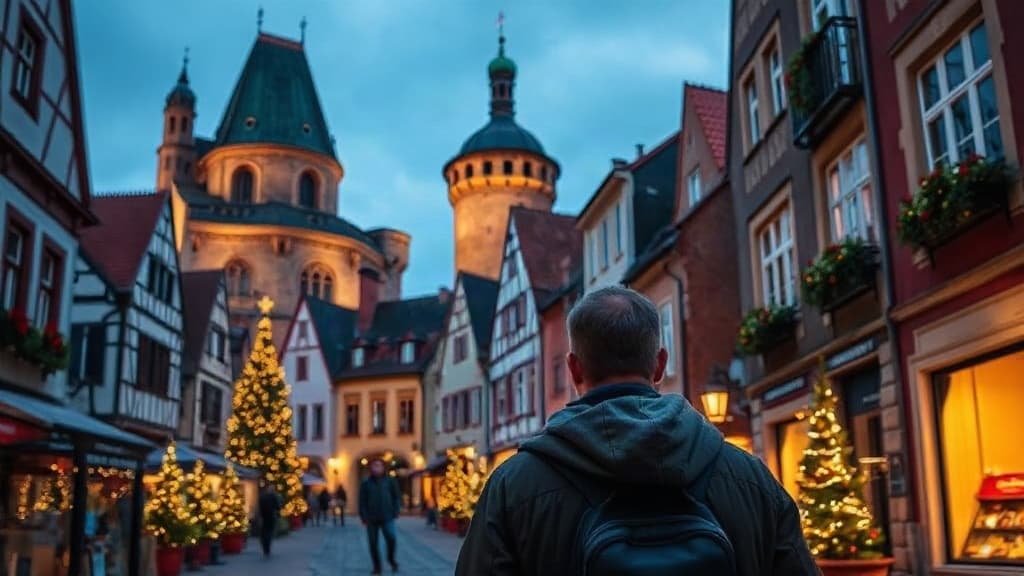
At a glance
- Market dates
- 27 November-24 December 2026
- Opening ceremony
- 27 November at 5:30 p.m.
- Daily hours
- 10 a.m.-9 p.m.
- Christmas Eve
- 10 a.m.-2 p.m. on 24 December
- Airport train
- U2 to Central Station in 12 minutes
- Zone A day ticket
- EUR 10.60 (about US$12)
Nuremberg Hauptmarkt — Nuremberg Hauptmarkt · Children's Christmas, Hans-Sachs-Platz · Nuremberg Imperial Castle · Nuremberg Central Station · Nuremberg Airport
Nuremberg has fixed the dates that matter for Christmas 2026: the Christkindlesmarkt runs 27 November-24 December 2026, and the opening prologue begins on Friday, 27 November at 5:30 p.m. With that calendar now published, late September is the useful booking window for travellers who want a central hotel or a specific weekend rather than whatever remains in December.
The market is not one fenced attraction with a ticket and a single entrance. It spreads through Nuremberg's Old Town, with the traditional red-and-white stalls on Hauptmarkt, a children's market on Hans-Sachs-Platz, regional producers by St Sebald and an international market nearby. That is good news for pacing, but it also means a vague plan to “see the market” can miss half of it. This guide maps the areas, separates confirmed 2026 facts from prices vendors have not yet posted, and builds a route around the hours that are live now.
Nuremberg Christmas Market 2026 dates and hours
The dedicated official Christkindlesmarkt site gives the controlling 2026 schedule: 10 a.m.-9 p.m. daily from 27 November through 23 December. On the final day, 10 a.m.-2 p.m. on 24 December, the market closes early for Christmas Eve. The Nuremberg tourism board's 2026 at-a-glance page confirms the same 9 p.m. ordinary closing time.
| Date | Hours | What changes |
|---|---|---|
| 27 November | Opening ceremony at 5:30 p.m. | The Christkind reads the prologue from the Frauenkirche balcony |
| 28 November-23 December | 10 a.m.-9 p.m. | Full market schedule |
| 23 December | Final full day | Sister Cities Market and Original Regional finish |
| 24 December | 10 a.m.-2 p.m. | Short final session on Christmas Eve |
Do not plan the international or regional stalls for 24 December. The tourism board states that the Sister Cities Market and Original Regional end on the 23rd even though the main Christkindlesmarkt gets a four-hour final session the next day. A Christmas Eve visit works for a last circuit of Hauptmarkt, not for the complete multi-market experience.
If the opening prologue is the reason for your trip, book Thursday and Friday nights, not just Friday. The ceremony starts at 5:30 p.m. on 27 November, so arriving by air or rail that afternoon leaves little margin for disruption or checking in.
Which market area should you visit first?
Start at Hauptmarkt, the square in front of the Frauenkirche. The official tourism page describes roughly 180 wooden stands under red-and-white roofs, with the traditional focus on handmade decorations, the local gold-foil angel, gingerbread and Nuremberg bratwurst. It is the visual centre of the event and the place to be for the opening prologue.
Then walk east to Hans-Sachs-Platz for the Children's Christmas Market. The tourism board's market guide lists hands-on activities such as cookie baking, glass painting and writing a wish list, alongside a nostalgic carousel and big wheel. Families should put this section before the evening crush rather than treating it as an afterthought on the way back to the station.
The Sister Cities Market adds international stalls connected to Nuremberg's 14 twin cities, with proceeds from many handmade items going to charitable organisations in those cities. Original Regional, in the Rathausplatz niches beside St Sebald, stays closer to Franconian producers: its official listing names honey, beeswax goods, preserves, sausage specialities and locally made drinks. Both finish on 23 December.
The tourism board also places seasonal stalls around St Lorenz and St Jakob and identifies the Feuerzangenbowle area as a separate stop. Treat these as extensions of a walking route, not competing “best markets.” From Hauptmarkt, Hans-Sachs-Platz is only a short Old Town walk; the point of the map is to keep you moving in one direction instead of repeatedly crossing the busiest square.
What does a 2026 visit cost?
There is no timed-entry product on the official market site: the squares are public and you walk into the stalls during opening hours. Your variable spending is food, drink and shopping, and the 2026 vendor list does not publish one standard price for those purchases. Any article promising a universal mug deposit or bratwurst price before the individual stalls post their menus would be guessing, so set that part of the budget yourself.
Transport prices are already fixed. VGN's current 2026 tariff charges EUR 3.65 online or EUR 3.90 from a machine for a Zone A adult single ticket, valid for one direction for 90 minutes. At the European Central Bank's 24 September reference rate of EUR 1 to USD 1.1367, those are about US$4.15 and US$4.45. The EUR 10.60 (about US$12) Zone A day ticket covers one person. A TagesTicket Plus is EUR 15.50 (about US$17.60) and covers up to six people, but no more than two may be aged 18 or over; it can be especially useful for two adults travelling together.
If you want museums as well as markets, the digital Nuremberg Card costs EUR 38 (about US$43) for visitors aged 12 and over and EUR 12 (about US$14) for ages six to 11. It lasts 48 hours, covers Zone A public transport and includes one admission to a long list of attractions, including the Imperial Castle, Albrecht Dürer's House and the Toy Museum. Children aged five and under get the card free when it is issued with at least one regular adult card.
Do the arithmetic before buying the card. Standard adult admission at most Nuremberg municipal museums is EUR 7.50 (about US$8.50), and adding EUR 4 converts that admission into a same-day municipal-museum ticket. A traveller who mostly wants free market time and walks from a central hotel may spend less with individual tickets. Someone planning the castle, two museums and several train rides has a clearer case for the 48-hour card.
Getting from Nuremberg Airport and Central Station
U2 to Central Station in 12 minutes is the airport's own published journey. The underground stop is directly in front of the terminal, and the ride falls inside VGN Zone A. From Central Station, the Old Town is immediately north; walk through the historic core toward Hauptmarkt or connect by local transport if luggage or mobility makes the cobbled route difficult.
Nuremberg Central Station is the more flexible gateway if your international flight lands elsewhere in Germany. It puts you within walking distance of St Lorenz and the southern Old Town, and it avoids parking during the city's busiest seasonal weeks. The market itself is compact enough that public transport is most valuable for the airport, a hotel outside the walls or a museum beyond the central walking circuit.
Buy a mobile ticket only after checking when it becomes valid. VGN says a single ticket is valid immediately after purchase, allows transfers but not a return journey, and can be bought through the VGN app, online shop, machines, bus drivers or sales points. That “immediately” detail matters if you buy before collecting a checked bag and then lose most of the 90-minute validity waiting at the airport.
A practical one-day route
Arrive at Hauptmarkt shortly after 10 a.m., before the strongest evening atmosphere also brings the day's densest foot traffic. Walk the traditional stalls first, step into the Frauenkirche area, then continue north to Original Regional and the Sister Cities Market. This gets the two 23 December closing areas done while they are open and while you still have space to look at small stalls.
Move to Hans-Sachs-Platz around midday if travelling with children. Otherwise, use the middle of the day for the Imperial Castle above the Old Town or one municipal museum, then return to Hauptmarkt after dark. The market's appearance changes more than its inventory: daytime is better for inspecting ornaments and labels, while the illuminated red-and-white roofs are the reason to make a second pass in the evening.
Keep dinner flexible. Nuremberg's market identity is tied to gingerbread, bratwurst and mulled drinks, but queues and menus vary by stall. Choose what you can see priced on the day instead of building an itinerary around an unverified online menu. If you need a seated meal or have allergies, reserve a restaurant separately and treat the market as tasting and shopping rather than assuming every dietary need will be easy to solve at a crowded booth.
On 24 December, compress the route: Hauptmarkt at 10 a.m., one final circuit, and leave before the 2 p.m. close. Do not pair that short session with a plan that depends on the Sister Cities Market, Original Regional or normal museum hours. Christmas Eve is a departure-day visit, not a substitute for one of the full dates.
Entry rules for international visitors in 2026
Germany's rules depend on the passport you travel on. EU nationals and people covered by Germany's visa-waiver list do not need a short-stay visa for a tourist visit of up to 90 days in any 180-day period. If your passport needs a visa, the German Federal Foreign Office says the standard Schengen application fee is EUR 90 (about US$102), with reductions or waivers for specified categories. Check the official country list rather than inferring your status from residence in another country.
The border process changed this year. Germany says the Entry/Exit System became fully operational on 10 April 2026 across participating Schengen external borders. For covered short-stay non-EU travellers, the system records travel-document details, fingerprints and a facial image; passports are no longer stamped manually. EU, EEA and Swiss citizens, and holders of residence permits or long-stay visas, are among those exempt. EES changes border processing, not whether you need a visa.
Mobile data at the market
A working connection is useful for VGN mobile tickets, live opening updates and navigating between the market areas, but no travel eSIM can promise a particular speed in a crowded square. Network performance depends on the underlying carrier, congestion, handset bands and where you stand among the Old Town buildings.
Roameo's live catalogue listed 93 Germany plans from US$2.99 when checked on 25 September 2026. Compare current allowances on the Germany eSIM page, and use the device checker before buying. Install while you still have reliable Wi-Fi, keep your primary voice line available if you need bank verification messages, and save the hotel address and transport plan offline as a fallback.
FAQ
When is the Nuremberg Christmas Market in 2026?
It runs from 27 November through 24 December 2026. The opening prologue is at 5:30 p.m. on 27 November; ordinary daily hours are 10 a.m. to 9 p.m., with an early 2 p.m. close on Christmas Eve.
Do I need a ticket for Nuremberg Christkindlesmarkt?
No timed market ticket is listed or required: the stalls occupy public Old Town squares and visitors walk in during opening hours. Budget separately for food, drinks, shopping, transport and any museums or tours.
Is 24 December a good day to visit?
Only for a short final circuit. The main market opens 10 a.m.-2 p.m., while the Sister Cities Market and Original Regional finish on 23 December. Choose an earlier date for the full experience.
How do I get from Nuremberg Airport to the market?
Take the U2 underground from the stop directly outside the terminal to Nuremberg Central Station; the airport publishes a 12-minute journey. From the station, continue on foot through the Old Town toward Hauptmarkt.
Do I need a visa to visit Nuremberg?
That depends on your passport. Visa-exempt travellers may generally make Schengen tourist stays of up to 90 days in any 180-day period, while travellers whose passports require a visa must apply for a Schengen visa. Check Germany's official country list for your specific passport.
Keep reading

Oktoberfest 2026 in Munich: Dates, Tent Booking and Beer Prices
Munich's 191st Oktoberfest runs 19 September-4 October 2026. What the dates, tent reservations, record beer prices and entry rules mean for a first-time visitor.
Read more
Berlin Festival of Lights 2026: Free Route and Costs
Berlin's free light festival runs 9-18 October. Use this practical route through the confirmed displays, with current transit fares and entry checks now.
Read more
Frankfurt Terminal 1–Terminal 3 Transfer Guide
Use Frankfurt Airport’s free SkyLine by day and terminal shuttle overnight. This guide resolves the published 22:00–23:00 overlap conservatively at night.
Read more