
Pearson to Toronto: UP Express or TTC 900 for Your Stop?
UP Express reaches Union quickly; TTC 900 goes to Kipling on a TTC fare. Map your exact hotel stop and transfer before comparing ticket prices or travel times.
Travel tips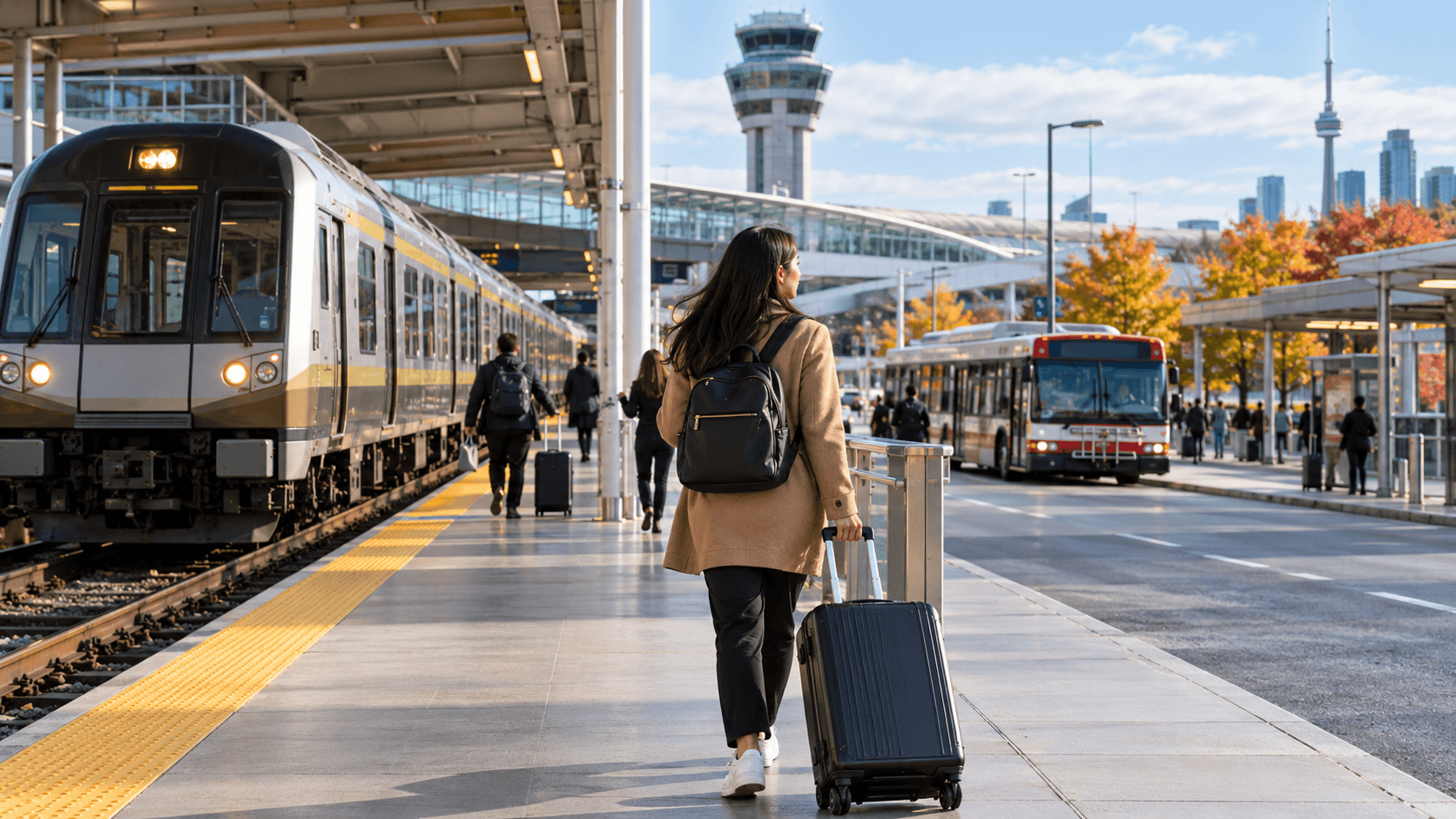
At a glance
- UP to Union
- About 28 minutes
- TTC 900 destination
- Kipling Station on Line 2
- 900 bus ride
- About 20–25 minutes to Kipling
Toronto Pearson's two useful public-transit choices answer different destination questions. UP Express reaches Union Station in about 28 minutes, while the TTC 900 Airport Express reaches Kipling Station on Line 2 in about 20–25 minutes before any subway ride. Calling the bus “slower” because it does not arrive at Union would compare different endpoints. In an autumn arrival, especially with a hotel address already booked, work backward from your final stop. The airport's UP Express page and TTC airport guide provide the route details.
The route map decides before the fare table
UP Express runs between Pearson and Union, with intermediate stops at Weston, Mount Dennis and Bloor. A stay close to Union, or a trip connecting to an intercity train there, makes the rail service a direct fit. A hotel near Bloor or a connection at one of the intermediate stops can also change the answer. Do not ride to Union and backtrack if an earlier UP stop is closer to your destination. Confirm the exact stop's walking route or onward local connection before purchasing a ticket for a longer segment.
The TTC 900 links Pearson with Kipling Station, where riders can continue on Line 2. TTC lists stops at Terminal 1 ground level and Terminal 3 arrivals level, as well as a few stops along the airport approach. It is a useful choice when a destination lies along the Bloor–Danforth subway corridor or when the cost of an express train plus a separate last leg would be hard to justify. The 20–25-minute TTC figure is only the bus leg to Kipling; it is not a promise of a 25-minute trip to downtown. Include platform access, waiting, subway time and the final walk in your estimate.
Build the route from the hotel backward: nearest transit station, route to that station, number of changes, and practical walk from the station entrance. If it is near Union, UP may save effort even if its ticket costs more. If it is near Line 2 west of downtown, the 900 may avoid a detour. If your hotel requires a separate TTC ride after UP, compare the full journey instead of just the airport leg. This method also works if the “destination” is a meeting point or a friend's address rather than a hotel.
Compare fares using the correct payment method
Pearson currently lists an adult one-way UP fare from Pearson to Union of CAD 12.35, or CAD 9.25 with PRESTO. The airport also says trains arrive every 15 minutes and advises checking the schedule. Those are airport-to-Union figures, not necessarily the fare or timing for every UP stop. Check the current UP details for the segment you intend to ride and for any eligibility-based discount. A traveler should not budget the PRESTO price unless they will actually use a qualifying payment method.
TTC says a single TTC fare covers the 900 airport service and the city-side TTC journey under its transfer rules. The current TTC fare page lists adult pay-as-you-go prices by payment method and explains that cash does not receive the same two-hour transfer arrangement as eligible tapped payment. TTC accepts PRESTO, contactless debit or credit, mobile wallet and cash, but the proof of payment is the specific card or device used. Each rider aged 13 or over must use their own payment medium; a family should not try to tap one card repeatedly as if it were one shared group fare.
For a simple example, a solo adult headed to a hotel beside a Line 2 station can compare one TTC fare and the bus–subway travel time with a UP ride to Bloor or Union and any further fare. The price gap may be meaningful, but the express service may remove a change or a long walk. For a group, calculate each passenger's eligible fare and age category. Pearson says children under 12 ride UP free; TTC says children 12 and under ride TTC free. Those policies differ at the boundary age, so enter the actual ages rather than copying the adult comparison across the family.
What to do at each terminal
Do not treat “Pearson station” and “Pearson bus stop” as one doorway. The TTC guide places 900 stops at Terminal 1 ground level and Terminal 3 arrivals level. UP Express uses its airport rail station and operator signs. Check your arrival terminal and follow the live airport wayfinding for the chosen mode. This matters after a long flight: an unnecessary terminal transfer can erase the convenience you expected from a shorter in-vehicle time. If a map app proposes a route from the other terminal, verify that it has recognized where you actually landed.
TTC's airport guide describes 900 service as all-day, with operating windows that differ by day of week. UP Express's airport page says trains run every 15 minutes seven days a week, but the first and last departures still need a timetable check. An arrival near the beginning or end of service deserves a backup plan. Flight arrival time is not the time you stand at the platform: immigration, baggage, walking and ticket purchase all take variable time. Use the operators' live schedules rather than a fixed “last train” remembered from another trip.
Three worked itineraries
First, imagine a traveler whose meeting is next to Union Station. UP is the natural first rail comparison because its stated Pearson–Union ride is about 28 minutes with no subway change. The TTC alternative starts with the 900 to Kipling, followed by a Line 2 trip and at least one further connection or walk depending on the exact meeting place. Even if TTC costs less, the extra journey stages may be a poor fit for a tight but realistic arrival window. The traveler should still allow time from aircraft door to station and check for service alerts.
Second, imagine a hotel close to a western Line 2 station. TTC 900 to Kipling can connect directly to the subway line serving that neighborhood. UP to Union would travel away from the hotel; UP to Bloor might be viable, but its station access and local connection should be examined before assuming it is better. The useful comparison is from Pearson terminal to hotel door. A route drawing with four edges—airport walk, first vehicle, transfer, final walk—often reveals the answer faster than a table of published vehicle speeds.
Third, imagine a traveler continuing by rail beyond Toronto from Union. UP can make the intercity connection straightforward, but a tight train reservation still needs a buffer for the flight and airport procedures. If the onward departure is much later, a TTC route might be acceptable for a traveler prioritizing fare. Neither operator's quoted ride time includes a protected connection to a separate train, so buy a flexible onward ticket where possible and read its terms. It is safer to plan a realistic station arrival than to make a connection depend on a perfect landing.
Before buying and boarding
Save the exact destination address, map the closest UP or TTC stop, check that day's service notices and choose the fare medium you can actually use. For TTC, keep the same card or device available as proof of payment and for eligible transfers. For UP, check the ticket conditions for the segment you will ride. If you need live routing or a digital ticket after landing, arrange mobile data and confirm your handset works with eSIM before departure. Roameo's compatibility guide can help with that device check; connectivity depends on local networks and the plan chosen.
Frequently Asked Questions
Does the TTC 900 go to Union Station?
No. Its city endpoint is Kipling Station on Line 2. Add the subway and any onward connection to your travel-time estimate.
Is the UP Express fare the same with every payment method?
No. Pearson shows different adult Pearson–Union prices for standard payment and PRESTO; check your actual payment method and segment.
Can I board the 900 at either passenger terminal?
TTC lists stops at Terminal 1 ground level and Terminal 3 arrivals level. Follow current airport signs to the stop serving your terminal.
Keep reading
YVR to Vancouver: Canada Line or Taxi for Your Stay?
The airport train has a departure surcharge, while taxis use destination zones. Compare your actual hotel stop, group size and luggage before choosing.
Read more
Melbourne Airport: SkyBus or Route 901 for the City?
SkyBus goes to Southern Cross; Route 901 reaches Broadmeadows for a train connection. Compare the terminal walk, ticket system, hotel location and final transfer.
Read more
SFO to San Francisco: BART or SamTrans Route 292?
Arriving at SFO? Compare BART with SamTrans Route 292 by terminal access, actual hotel stop, published bus fare and late-night service limits before choosing a ride.
Read more