
YVR to Vancouver: Canada Line or Taxi for Your Stay?
The airport train has a departure surcharge, while taxis use destination zones. Compare your actual hotel stop, group size and luggage before choosing.
Travel tips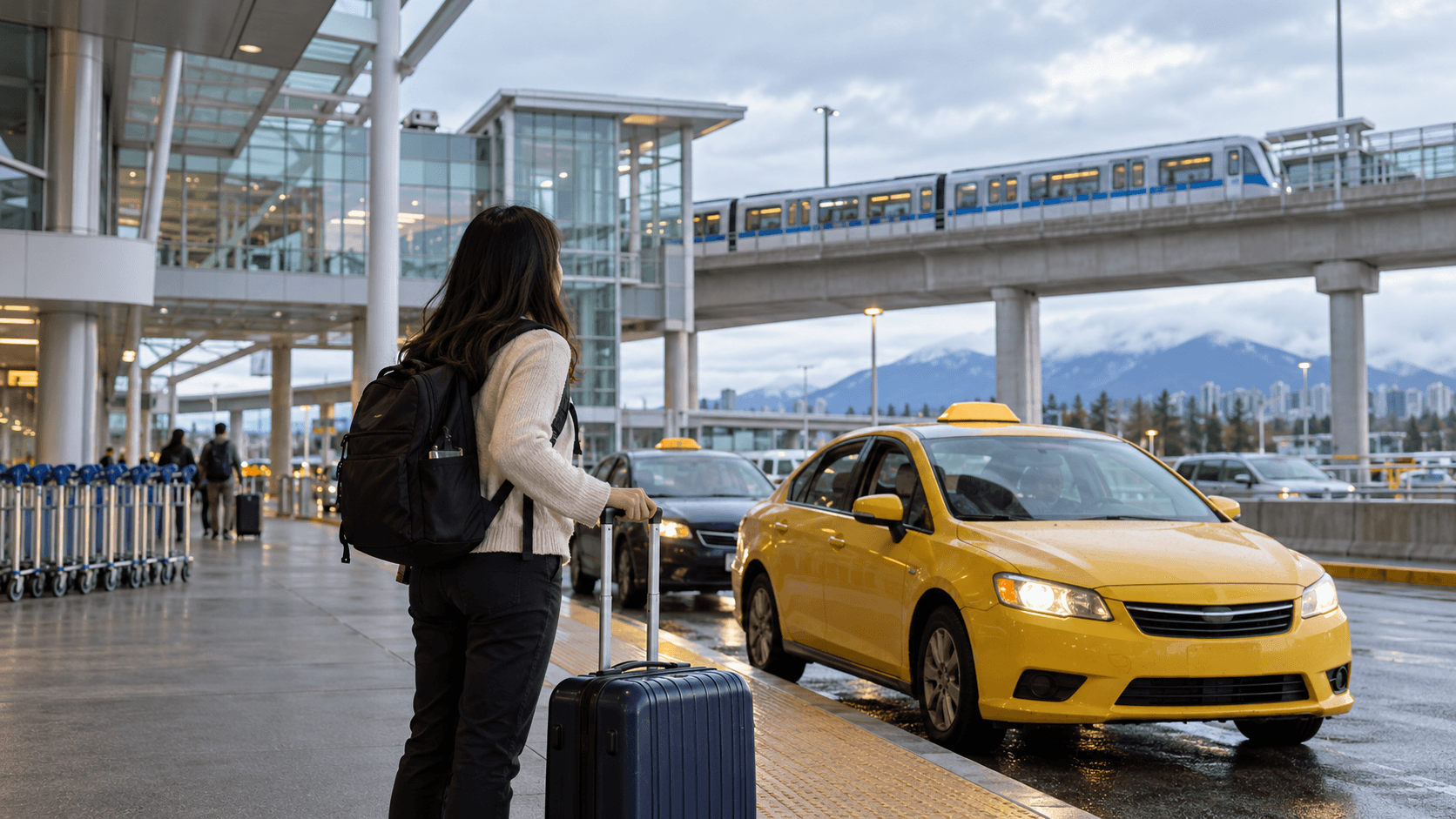
At a glance
- Rail to downtown
- About 25 minutes to Waterfront
- YVR rail AddFare
- CAD 6.50 on most departing trips
- Taxi fare basis
- Airport zone fare or meter outside map
The July 2026 fare change makes an old Vancouver airport shortcut misleading: the Canada Line is inexpensive, but most trips from YVR include a CAD 6.50 airport AddFare. A taxi can be sensible for a group or a hotel beyond an easy station walk, yet the airport's flat taxi zones do not cover every address. The right choice starts with your exact destination and the cost of the last leg, rather than a generic claim that one mode is always cheaper. TransLink explains the departure surcharge and exemptions; YVR explains its taxi zones and exceptions.
Start with the hotel address, not downtown as a single point
The Canada Line connects the airport with Waterfront Station in about 25 minutes, according to TransLink's visitor guide. It also serves intermediate stops. A stay near one of those stops can make rail the simplest way to arrive: get off close to the room, avoid road traffic and keep the transfer count at zero. For a waterfront stay, Waterfront may be the natural rail endpoint. A room farther west or east can change the calculation because the arrival may require another bus, another rail line, a long walk, or a taxi from the station.
Put the hotel on a map and identify its nearest Canada Line station before you pay. Compare the walking route with the straight-line distance. A hotel that appears close to a station can be awkward with luggage if the practical route has a steep block, a busy crossing or a long detour. If the walk is unsuitable, look up the onward bus or transfer. TransLink says a single fare is valid for 90 minutes across its main transit modes, subject to the correct zones and payment method, so a short onward journey does not automatically require a fresh fare. A taxi, by contrast, goes to the address you give the driver, assuming that address is road accessible.
What the train actually costs when you leave YVR
As of the July 2026 tariff, TransLink lists a CAD 6.50 YVR Airport AddFare on many journeys starting at YVR–Airport, Sea Island Centre or Templeton and ending at Bridgeport or beyond. This is in addition to the underlying transit fare. The AddFare does not apply to travel toward the airport. That direction matters: a return trip can have a different transit cost from the arrival even if you ride the same line between the same stations. The fare is automatically deducted when an eligible rider taps a contactless card or uses Compass stored value; buying an ordinary airport-station single-use ticket also normally triggers it.
TransLink's fare table states that zone count depends on when and where you travel. For an adult, the published cash or contactless fare is CAD 3.50 for one zone and CAD 5.10 for two; stored-value fares are lower. Trips starting after 6:30 p.m. on weekdays, and travel on weekends or provincial statutory holidays, use a one-zone fare across the system. The YVR AddFare remains a separate charge at those times. Do not take a late-evening one-zone rule to mean that leaving the airport becomes surcharge free.
There are specific exemptions, and the details matter more than clever ticket tricks. TransLink says monthly pass holders, eligible program-pass holders, trips solely among the three Sea Island stations, and customers using certain DayPasses or Compass Tickets bought outside Sea Island are exempt. It distinguishes a ticket bought outside Sea Island from the same kind bought at an airport station. If you already have a qualifying ticket, check the exact wording before assuming an exemption; buying a new ticket at YVR just to imitate someone else's fare will not produce the same result.
What the taxi fare means
YVR uses zone fares for taxi journeys departing the airport to addresses within its zone map. The boundary street is important: YVR says the lower zone fare applies to a destination directly on a zone boundary. For an address outside the map, the meter applies. The map shown by the airport should be checked against your actual hotel address before you compare it with a rail fare. A taxi price quoted for one neighborhood is not a citywide price and should not be pasted into a plan for another neighborhood.
The airport also specifies what is and is not included. Its taxi guidance says a CAD 4 passenger load charge is included in flat zone fares from YVR, while the charge is added to a metered fare outside the zones. Tolls, an en-route stop, or a cleaning charge can be exceptions to the no-extra-surcharge rule. Gratuities are not included. When two passengers ask for different destinations, the zone fare covers the first stop and the meter may apply after the driver starts toward the second. A group comparing a single taxi with several rail tickets should therefore confirm that everyone is going to the same address.
On the way to YVR, the airport generally describes metered taxi fares rather than the arrival's zone schedule, with a specific flat-fare exception from Canada Place Cruise Ship Terminal. This direction asymmetry is easy to miss when building a round-trip budget. Ask the driver how the applicable rule is being used and check the destination zone before departure. YVR says its official taxi stands are on the domestic and international arrivals levels; for a South Terminal arrival, the stand and available operators differ. Confirm which terminal you actually use before following a saved map pin.
A worked choice for three kinds of arrival
Consider a solo traveler staying by a Canada Line station downtown. Their first comparison is the applicable zone fare plus CAD 6.50 against the taxi fare for that hotel zone. They also need to account for the short walk from the station and the time needed to find the platform. With a small bag and a simple route, rail may be the more predictable choice. That conclusion is about this itinerary, not a claim about every downtown hotel or every time of day. The traveler should check the live service status before paying because a disruption changes the practical answer.
Now consider two adults and two children with several large bags bound for a hotel beyond a convenient station. The rail cost is per eligible rider, whereas a single taxi zone fare is per vehicle to one address, subject to capacity. The family must compare the total rail fare, onward transit or taxi cost, and whether everyone and all luggage safely fit in a taxi. YVR specifically says no separate luggage fee is permitted, but a larger or additional vehicle may be needed if baggage exceeds safe capacity. A door-to-door taxi can become attractive even when its sticker fare is higher than one train ticket.
For a cruise passenger heading to Canada Place, the Canada Line to Waterfront is a plausible first option because the rail endpoint is close to the waterfront district. Still check the ship's actual check-in location and the walking route with luggage. YVR's cruise guidance names the Canada Line, taxi, rideshare and cruise-line transfers as options. A passenger with limited mobility or a tight boarding window may reasonably choose a direct vehicle. Neither the airport rail travel time nor the taxi zone fare includes time to clear arrivals or reach the final check-in desk.
Arrival checklist
Before landing, save the hotel's full street address, its nearest practical Canada Line station and the airport taxi zone map. Decide whether your party can make the final walk comfortably. Check whether your existing pass or pre-bought ticket truly qualifies for an AddFare exemption. At the station, use the same payment card or device for the trip, and follow TransLink's tap instructions. If you choose a taxi, use the airport's designated stand and confirm the destination and fare basis with the driver. For online maps and tickets after landing, arrange mobile data before the journey; compare Roameo eSIM options for a compatible device without assuming any network speed or availability at a specific point.
Frequently Asked Questions
Is the Canada Line AddFare charged both ways?
No. TransLink describes it for qualifying trips starting at the airport or the other two Sea Island stations and ending beyond Bridgeport; travel to YVR does not incur it.
Does a taxi have one fixed price to all downtown hotels?
No. YVR's zone map and destination boundary govern qualifying outbound airport trips. Check the address; outside the map the meter applies.
Can I buy a DayPass at YVR to avoid the AddFare?
Do not assume so. TransLink's exemption is for qualifying DayPasses bought outside Sea Island, not simply any DayPass bought at the airport station.
Keep reading

Pearson to Toronto: UP Express or TTC 900 for Your Stop?
UP Express reaches Union quickly; TTC 900 goes to Kipling on a TTC fare. Map your exact hotel stop and transfer before comparing ticket prices or travel times.
Read more
Melbourne Airport: SkyBus or Route 901 for the City?
SkyBus goes to Southern Cross; Route 901 reaches Broadmeadows for a train connection. Compare the terminal walk, ticket system, hotel location and final transfer.
Read more
SFO to San Francisco: BART or SamTrans Route 292?
Arriving at SFO? Compare BART with SamTrans Route 292 by terminal access, actual hotel stop, published bus fare and late-night service limits before choosing a ride.
Read more